Run a fingertip across a page and feel nothing but paper. Now imagine the same page covered in small raised dots, each pattern a letter, a number or a note of music. For millions of people, that is how a book, a bank statement, a bus sign or a medicine label is read. World Braille Day, observed every January 4, asks the world to notice that quiet technology and to ask a simple question: who can read the information that shapes our lives, and who is left out? It sits naturally beside the International Day of Persons with Disabilities, because reading is a right, not a favor.
A day born in a committee room
Braille is named for Louis Braille, who, according to UN News, invented the tactile system for reading and writing at the age of 15. The system outlived its inventor and spread across languages and continents. Official recognition came much later. In 1949, UNESCO began a survey aimed at establishing Braille uniformity, an early sign that international bodies saw it as a shared tool and not a local curiosity.
The day itself came through the General Assembly’s Third Committee, which handles social and human rights questions. In November 2018 the Committee approved, without a vote, a draft titled “World Braille Day,” introduced by the representative of Antigua and Barbuda. The Assembly then adopted resolution A/RES/73/161, which proclaims January 4 as World Braille Day, beginning in 2019. It invites member states to observe the day by raising public awareness of Braille as a means of communication. The press summary noted that related activities depend on voluntary contributions, so the day relies on goodwill as much as budgets.
What Braille actually is
Braille is not a language. It is a way of writing a language by touch, using raised dots arranged in small cells. UN News describes it as read through between one and six embossed dots, and the same cell can carry the letters of many languages, along with numbers, punctuation and musical notation. That flexibility is why the tool has lasted. A reader can follow a novel, check a math equation or read a chemistry label without relying on anyone else to read it aloud.
That independence is the heart of the case for the day. The UN background page notes that the Convention on the Rights of Persons with Disabilities, adopted in 2006, considers Braille essential for education, freedom of expression and opinion, access to information and social inclusion. It also links the day to the 2030 Agenda, adopted in 2015, and says the full realization of human rights relies on inclusive written communication.
Example 1: two medicine boxes. Picture two identical boxes of tablets. One has a Braille label giving the name and dose, and the other does not. A blind patient can check the first alone, at home, in seconds. With the second, the patient must wait for someone sighted, or guess. The example is illustrative, but the principle is real: access to written information is access to safety and privacy.
The numbers behind the day
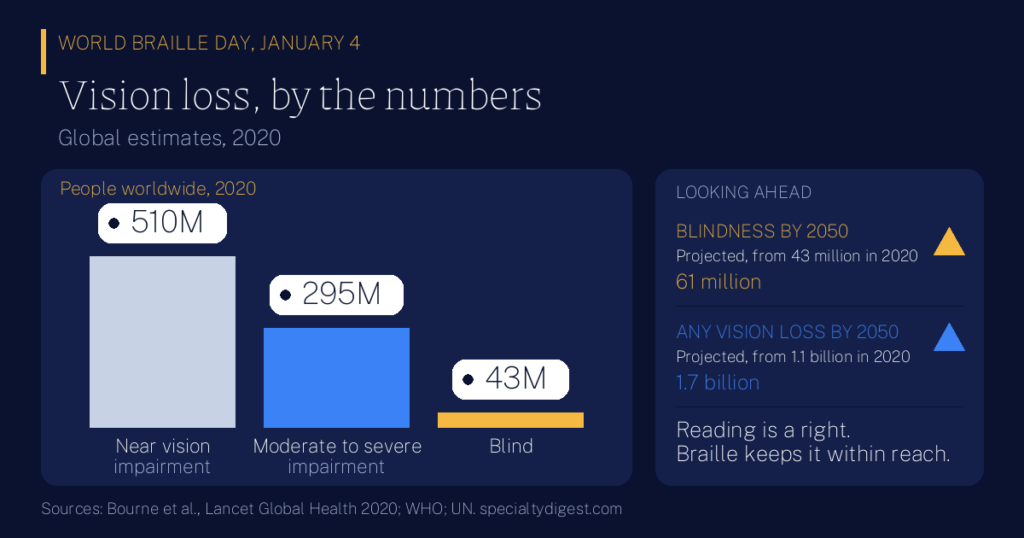
Who needs this? Estimates from the Vision Loss Expert Group, published in The Lancet Global Health in 2020, found that 43 million people were blind that year, with another 295 million living with moderate to severe vision impairment. A further 258 million had mild vision impairment and 510 million had near vision impairment. In all, 1.1 billion people lived with some vision loss. The world population in that analysis was 7.79 billion.
A different, wider count comes from the World Health Organization. Its fact sheet of February 2026 says at least 2.2 billion people have a near or distance vision impairment, and that for at least 1 billion of them the impairment could have been prevented or has yet to be addressed. These two sets of figures measure different things, so they should not be added together. Both show the same picture: far more people have some vision loss than are fully blind, and most of that loss can be treated or prevented. Most people with vision impairment and blindness are over 50. In the 2020 estimates, 73 percent of those with vision loss were 50 or older, and 8 percent were aged 0 to 19.
Example 2: a city of one million. The 2020 estimates put crude prevalence of blindness at 0.5 percent and of moderate to severe impairment at 3.7 percent. Apply those to a city of one million people and you get roughly 5,000 blind residents and about 37,000 with moderate to severe impairment. The numbers are rounded and illustrative, since local rates differ, but they show how a few percentage points become thousands of neighbors who need accessible signs, forms and schools.
Why access to information matters
Vision loss is tied to inequality. UN News notes that people with vision impairment are more likely to face higher rates of poverty, neglect and violence. The WHO fact sheet adds that two out of three people in low-income countries who need eyeglasses do not have access to them, and that one in two people worldwide who need cataract surgery lack access to it. Cataract and uncorrected refractive error are leading causes of vision impairment, and both are treatable.
Braille and eye care are not rivals. Treatment prevents loss where it can, and Braille keeps people reading when sight cannot be restored. The day belongs to the second effort, but its message depends on the first. WHO estimates annual global productivity loss from vision impairment at about US$ 411 billion in purchasing power parity terms, a reminder that exclusion has a measurable price.
- 2.2 billionpeople with near or distance vision impairment (WHO, 2026)
- 1 billioncases that could have been prevented or are unaddressed (WHO)
- 2 in 3people in low-income countries who need glasses lack them (WHO)
- US$ 411 billionestimated yearly productivity loss (WHO)
Example 3: one district, one clinic. Suppose 400 people in a rural district need cataract surgery. If one in two lack access, as the global estimate suggests, about 200 of them are waiting. Each one who regains sight can read print, work and travel again. Each one who cannot may need Braille, audio and other supports. The figures are round and made up for illustration, but they show why prevention and accessibility work side by side.
Looking ahead to 2050
The pressure will grow. The same 2020 analysis projects that blindness will rise to 61 million people by 2050 and total vision loss to 1.7 billion. Populations are aging, and age is the strongest driver. That means more readers will meet Braille later in life, after they have lost sight, rather than in childhood classrooms.
How the day is marked
There is no single global campaign theme for the day. Observances tend to follow current concerns. In 2021, for example, UN News focused on accessible information during COVID-19, and noted that UNDP Malawi produced 4,050 Braille products on the pandemic. Libraries, schools and associations of blind people use the date to show Braille displays, offer reading sessions and press for more accessible transport, voting materials and public services. Individuals can take part by asking whether their workplace, school or favorite shop offers information in Braille, large print or audio, and by supporting eye care in their community.
Key Takeaways
- Braille is a way of writing, not a language. Raised dots in small cells carry the letters, numbers and symbols of many languages.
- The day is recent. The General Assembly proclaimed January 4 in resolution A/RES/73/161, with observances beginning in 2019.
- It is a rights issue. The disability rights convention treats Braille as essential for education, expression and access to information.
- Vision loss is common. In 2020, 43 million people were blind and 1.1 billion lived with some vision loss.
- Much of it is treatable. WHO says at least 1 billion cases could have been prevented or are unaddressed.
- The need will grow. Blindness is projected to reach 61 million by 2050 as populations age.
- Everyone can help. Ask for accessible formats where you work and learn, and support affordable eye care.
How solid is this? The 2020 prevalence figures and 2050 projections are modeled estimates from the Vision Loss Expert Group and will be revised. WHO’s 2026 fact sheet gives its own, wider count, which measures different things, and the two are not meant to be added. The three worked examples use round, made-up numbers to show an idea. See also the International Days hub and the International Days Calendar.
More in Education
- United Nations, World Braille Day: Background
- UN Press, GA/SHC/4250, Third Committee approves draft on World Braille Day (2018)
- UN News, World Braille Day highlights importance of accessible information (2021)
- World Health Organization, Vision impairment and blindness fact sheet (February 2026)
- IAPB Vision Atlas, Magnitude of global vision loss (Bourne et al., The Lancet Global Health, 2020)