Logic is the quiet discipline behind every sound argument, every computer program and every mathematical proof. Yet most people meet it only briefly, if at all. World Logic Day, observed every year on January 14, exists to change that. It invites schools, universities, libraries and the public to look at how we reason: what makes an argument hold together, how errors creep in, and why a field that began with ancient philosophers now sits close to the heart of computing. UNESCO proclaimed the day in 2019, working with the International Council for Philosophy and Human Sciences (CIPSH). Its message is simple. Clear thinking is a shared skill, and it can be taught.
From a university idea to a UNESCO day
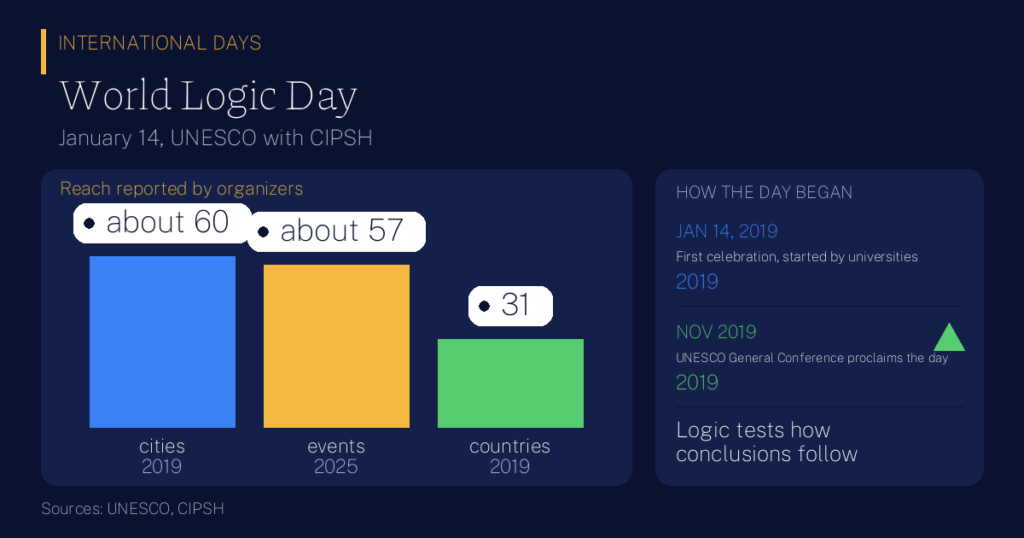
World Logic Day did not begin as a United Nations project. The first one was held on January 14, 2019, as an initiative of universities, research institutes, foundations and associations. CIPSH describes celebrations in about 60 cities and lists 31 countries among the participants. Brazil, a UNESCO member, then proposed that the organization give the day official standing. The proposal went to the 207th session of the UNESCO Executive Board in October 2019 and on to the 40th General Conference, which proclaimed January 14 as World Logic Day in November 2019. Official pages give slightly different days for that vote, so only the month is named.
A second observance followed on January 14, 2020, this time under the auspices of UNESCO. In her statement, Director-General Audrey Azoulay said that logic is “a particularly timely” discipline, “utterly vital to our societies and economies.” UNESCO runs the day in association with CIPSH, which was asked to coordinate the effort with its member institutions.
What logic actually is
Logic is the study of valid reasoning. It asks a narrow and powerful question: if the starting statements are true, must the conclusion be true as well? Notice that logic looks at the form of an argument, not at the facts inside it. An argument can be valid even when its starting statements are false, and an argument made of true statements can still be invalid because the conclusion does not follow from them.
UNESCO describes logic as one of the most defining features of human thought, and says there is little public awareness of its importance. That gap is the reason for the day. The figure below shows the difference between an argument that holds and one that only sounds convincing.
Example 1: the search box. Suppose a library catalog holds 1,000 items about cats and 800 about dogs, and 100 of them cover both. A search for cats AND dogs returns 100 items. A search for cats OR dogs returns 1,700, because the 100 overlapping items are counted once: 1,000 plus 800 minus 100. The numbers are round and illustrative, but the rule is exactly the logic of AND and OR, and it shows how changing one small word can change a result enormously.
A short history of an old idea
Logic is among the oldest disciplines. Aristotle set out the syllogism, the pattern in the figure above, in the fourth century BCE. Then, much later, it was transformed. George Boole’s The Laws of Thought (1854) showed that reasoning could be written as algebra. Gottlob Frege’s Begriffsschrift (1879) gave logic a precise formal language. Kurt Gödel’s incompleteness theorems (1931) showed that any consistent, rule-based system rich enough for arithmetic contains true statements it cannot prove. Alan Turing’s 1936 paper on computable numbers defined what a mechanical procedure can and cannot do, and that work is a root of modern computer science.
The reach of the day
The day is measured in gatherings rather than statistics, and the figures come from the organizers themselves. For the first celebration in 2019, CIPSH reports events in about 60 cities and lists 31 countries. By 2025 the organizers’ archive page listed roughly 57 events between January 2 and January 17, from Korea to Oxford, Warsaw and Istanbul, many of them held on the day itself. The 2026 page lists events at universities from Peru to Spain, Portugal and the United States, and Hungary’s workshop is numbered the eighth, which fits a start in 2019.
These are counts of registered local events, not of participants, and the organizers state that events are locally run and are not checked by CIPSH or UNESCO.
Why it matters beyond the classroom
Logic is not a luxury subject. Computer circuits, programming languages, database queries and software verification all rest on it. Artificial intelligence research draws on it, and the 2026 listings include an event on logic, language and AI. Mathematics depends on proof, and proof depends on logic. For everyday life, the same habits protect against bad reasoning: spotting a claim that sounds convincing but does not follow, or noticing that two statements cannot both be true.
UNESCO also links the day to science, technology and innovation, and says it can contribute to a culture of peace, dialogue and mutual understanding. The same spirit runs through World Science Day for Peace and Development.
Example 2: the surprising test. Imagine 10,000 people, of whom 100 have a rare condition. A test catches 90 of those 100, but it also wrongly flags 5 percent of the 9,900 healthy people, which is about 495. That makes 585 positive results in all, and only 90 are true. A positive result therefore means about a 15 percent chance of having the condition. The numbers are round and illustrative. The lesson is that careful reasoning about what a result means can differ sharply from a first impression.
Who is left behind
UNESCO notes that public awareness of logic is low. In places where formal reasoning is not taught in school, many people meet it late or never, and they are left without tools that help in work, study and civic life. The day aims to improve public understanding and to support associations, universities and institutions that work on logic, in both research and teaching.
Example 3: the alarm rule. A shop alarm should sound only if the door is open AND the system is armed. With two yes-or-no conditions there are four combinations, and the alarm sounds in just one of them. If a designer mistakenly wrote OR, it would sound in three of the four, and staff would hear false alarms all day. The numbers are illustrative, but the same truth-table thinking sits inside every circuit and every line of code.
How the day is marked
Observances are mostly lectures, courses, workshops, puzzle sessions and public talks. The 2026 page lists a multi-day virtual celebration in Peru, a five-session course on programming with proofs in Portugal, and a joint session on logic, language and AI. It also announced a graphic design challenge. You can join in simply: try a logic puzzle, ask a student what a valid argument is, or test one claim you read this week for whether the conclusion truly follows.
Key Takeaways
- Logic tests form, not facts. A valid argument guarantees its conclusion when the starting statements are true.
- The day began from the ground up. Universities and associations held the first one on January 14, 2019, before UNESCO adopted it in November 2019.
- UNESCO works with CIPSH. The organization proclaimed the day in association with the International Council for Philosophy and Human Sciences.
- The ideas are old but alive. From Aristotle to Boole, Frege, Gödel and Turing, logic shaped mathematics and computing.
- Public awareness is the gap. UNESCO says few people appreciate how important logic is, and the day aims to close that gap.
- Reasoning protects us. It helps us weigh claims, read test results sensibly and design reliable systems.
- Anyone can take part. Events are local and open.
How solid is this? Dates of the first celebration and the Executive Board session come from CIPSH and UNESCO pages, which give slightly different days for the General Conference vote, so only the month is stated. Participation figures are organizer-reported counts of local events, and the 2025 figure is our count of the listing. Historical milestones follow standard histories of logic. The three worked examples use round, made-up numbers to show an idea. See also the International Days hub and the International Days Calendar.
More in Education