Television is so familiar that it is easy to forget how strange it once was: moving pictures from far away, appearing in a living room at the same moment they happen. World Television Day, observed every November 21, asks us to look at that familiar box again. Its message is not that television is a gadget worth cheering for. It is that a medium able to put a distant crisis in front of millions of people at once has real influence over what the world notices, discusses and decides.
Where the day came from
The United Nations General Assembly proclaimed November 21 as World Television Day through resolution 51/205 of December 17, 1996. The date was chosen because the first World Television Forum had met under United Nations auspices on November 21 and 22 of that year. Media leaders gathered to discuss television’s growing importance and how they could work together.
The reasoning the UN gives is plain. Television increasingly shapes decision making, because it can bring world attention to conflicts and threats to peace and security, and it can sharpen focus on other large issues, including economic and social ones. The UN describes the theme of the day as not so much a celebration of the tool as of the philosophy it represents, with television serving as a symbol of communication and globalization.
A short history of the picture box
The technology is younger than most people assume. On October 2, 1925, the Scottish inventor John Logie Baird’s televisor delivered a moving image of his laboratory assistant, William Taynton. The first public demonstration followed in January 1926, which makes 2025 and 2026 a centenary season for the medium. Along the way, governments began to worry about what broadcasting could do. In 1936 the League of Nations produced the International Convention concerning the Use of Broadcasting in the Cause of Peace, and the UN Chronicle notes that a number of UN member states remain parties to it, at least formally. Standards followed: the International Telecommunication Union (ITU) released its first technical standards for television in 1949.
What television is, and what it is becoming
The word describes more than a glass screen in a living room. Television is a system for producing, carrying and showing video to large audiences, and today that system travels by antenna, cable, satellite and the internet. The UN observes that television remains the single largest source of video consumption and that the number of households with television sets keeps rising, while over-the-air broadcasting appears to be in slow decline in favor of streaming companies. Both things can be true at once, because the screen in the home is increasingly a window onto internet services.
Engineers at the ITU describe the next steps in practical terms. Linear channels now sit alongside streaming, and television still plays a role in emergency broadcasting. In 2025 the ITU noted that Brazil’s president signed a decree launching TV 3.0, a system that joins over-the-air broadcasts with broadband internet. Work on artificial intelligence, 5G and virtual and augmented reality is shaping how programs are made and delivered.
Example 1: one story, three routes. Imagine a storm warning issued at 6 p.m. A household with an antenna sees it on a broadcast channel, a second household sees it on a streaming news app, and a third gets nothing because it has no signal and no data plan. The numbers are made up and illustrative, but the lesson is real: the route a message takes decides who receives it.
The connection gap behind the screen
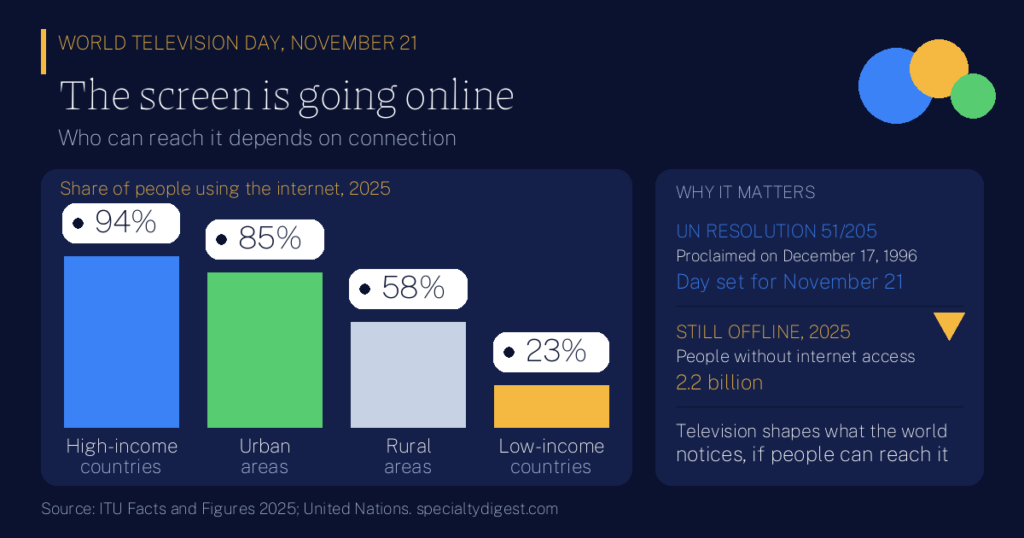
As more television moves online, access to the internet becomes access to the screen itself. The ITU estimated in its Facts and Figures 2025 report that about 6 billion people, roughly three quarters of the world, were using the internet in 2025. That is up from a revised estimate of 5.8 billion in 2024, and 2.2 billion people remained offline, down from a revised 2.3 billion. The gap is uneven: 94 percent of people in high-income countries use the internet, against 23 percent in low-income countries, and 96 percent of those offline live in low- and middle-income countries.
- 6 billionpeople online in 2025, about three quarters of the world
- 2.2 billionpeople still offline in 2025
- 96%of those offline live in low- and middle-income countries
- 1949year the ITU released its first television standards
Why a screen carries so much weight
The Assembly’s concern was never about furniture. A medium that reaches many people at once can direct attention to wars and disasters, and it can also be used to distort. The UN Chronicle recalls that the Assembly has declared that states must refrain from propaganda for wars of aggression, and it connects the day to peace, access to information for the 2030 Agenda, a knowledge society, human rights and democracy. The same piece notes that the Council of Europe recognized public service media in 1996 as an essential factor of pluralistic communication, the same year the UN day was born.
Seen this way, television is a public square with a transmitter. Who owns it, who may speak on it and who can actually receive it are questions about fairness as much as technology. A country can have excellent programs and still leave rural households, women or older people out of the audience.
Left out of the picture
The ITU’s 2025 television article points to one group that engineers must design for: about 15 percent of the world’s population lives with some form of disability or has special needs, according to United Nations data cited there. Captions, audio description, sign language and personalized program discovery are therefore not extras. They decide whether the medium works for everyone. The connectivity numbers add to the picture: 85 percent of urban residents are online against 58 percent in rural areas, 77 percent of men against 71 percent of women, and 82 percent of people aged 15 to 24 against 72 percent of everyone else.
Example 2: the village screen. Suppose a village of 1,000 people has one shared television and a clinic that posts vaccine dates on a regional channel. If 580 of the 1,000 have a way to get online and 420 do not, then a notice that appears only on streaming reaches fewer than six in ten residents, while the shared broadcast screen reaches those who gather around it. The figures are round and illustrative, loosely echoing the rural online rate, but they show why a mix of routes matters.
How the day is marked, and what comes next
There is no fixed yearly slogan. The UN frames the day around an idea, television as a symbol of communication and globalization, and in practice broadcasters, universities and standards bodies use it to discuss the medium’s role. Recent ITU contributions show the range of that conversation.
- 2023Television’s role in peace, human rights and access to information (UN Chronicle)
- 2024Linear television alongside streaming, and emergency broadcasting (ITU)
- 2025Television at 100: accessibility, AI and 5G (ITU)
Example 3: a media check. Take a family that watches 10 hours of video in a week, with 6 hours on a broadcast channel and 4 on streaming. If they lose home internet for a month, their viewing shifts but does not stop. The figures are made up and illustrative, yet they show why broadcast and online services still depend on each other. You can mark the day by asking what you watch, who made it, who may not be able to see it, and how reliable the source is. Related days include World Toilet Day, which also draws attention to a service that billions depend on.
Key Takeaways
- The UN set the day in 1996. Resolution 51/205 of December 17, 1996 proclaimed November 21, the date of the first World Television Forum.
- The point is influence, not gadgets. The UN stresses television’s power to focus world attention on conflict, peace and other major issues.
- The medium is about 100 years old. Baird’s first moving image dates to October 2, 1925.
- Screens and the internet are merging. Broadcast and streaming now share viewers, so connectivity shapes who sees what.
- The connection gap is wide. 94 percent of people in high-income countries are online against 23 percent in low-income countries.
- Accessibility is a design duty. About 15 percent of people live with a disability or special needs, so captions and audio description matter.
- Watch with a critical eye. Ask who made a program, who it leaves out and whether its source can be trusted.
How solid is this? The 1996 resolution details come from the UN observance page, and internet figures are modeled ITU estimates, with 2024 values revised in the 2025 report. The 15 percent disability figure is cited by the ITU from UN data without a stated year. No global count of television households is given here because the sources consulted gave none. The three worked examples use round, made-up numbers to show an idea. See also the International Days hub and the International Days Calendar.
More in Society
- United Nations. World Television Day.
- UN Digital Library. Proclamation of 21 November as World Television Day (resolution 51/205, 1996).
- UN Chronicle. Designed for Service: The Role of Television in Today’s Troubled World (2023).
- ITU. Television at 100, still evolving (2025).
- ITU. Television, a powerful communication tool with evolving technologies (2024).
- ITU. Facts and Figures 2025 (press release, November 17, 2025).