Every time an antibiotic is swallowed, injected or fed to livestock, bacteria get a lesson in survival. Most die. A few live, and they pass on what saved them. Over decades, that quiet process has made some of our most valuable medicines less reliable. World AMR Awareness Week, held from November 18 to 24 each year, asks everyone, from patients to presidents, to slow it down. AMR stands for antimicrobial resistance, and WHO describes it as a threat to the progress that modern medicine has made.
From antibiotic week to AMR week
The campaign grew out of the 2015 Global Action Plan on antimicrobial resistance, which called for better public understanding of the problem. An annual awareness week followed, first known as World Antimicrobial Awareness Week. On June 6, 2023, the Quadripartite, which is the partnership of the Food and Agriculture Organization (FAO), the UN Environment Programme (UNEP), the World Health Organization (WHO) and the World Organisation for Animal Health (WOAH), announced a new name: World AMR Awareness Week. The reason was practical. The new name includes the word resistance, which better describes the challenge. The abbreviation WAAW stayed the same.
The partners share the work because resistance does not respect boundaries. It moves between people, animals, crops, food and water. That is the idea behind the phrase One Health, and it is the core of this year’s theme.
What resistance really means
Resistance does not mean that a person becomes immune to a medicine. It means that the germ has changed so that the medicine no longer works against it. Antimicrobials include antibiotics, antivirals, antifungals and antiparasitic drugs, and any of them can lose power. WHO lists the main drivers as misuse and overuse of antimicrobials, poor access to clean water, sanitation and hygiene, weak infection prevention in homes, hospitals and farms, limited access to vaccines, diagnostics and medicines, and weak enforcement of rules. Clean water and toilets matter more than many people expect, which is one reason this week connects with World Toilet Day.
Example 1: the unfinished course. Imagine 1,000 germs in an infection, and 10 of them happen to carry a protective trait. A drug kills the 990 others. If the 10 survivors multiply, the next infection is made of drug-proof germs, and the same medicine fails. The numbers are round and illustrative, but the logic of selection is what scientists describe.
The numbers behind the week
The best global estimates are sobering. WHO notes that bacterial AMR was estimated to be associated with more than 4.7 million deaths worldwide in 2021. An earlier analysis for 2019 estimated almost 5 million deaths associated with bacterial AMR, including 1.27 million directly caused by it. These are modeled estimates, and associated means resistance was involved, not that it was the only cause.
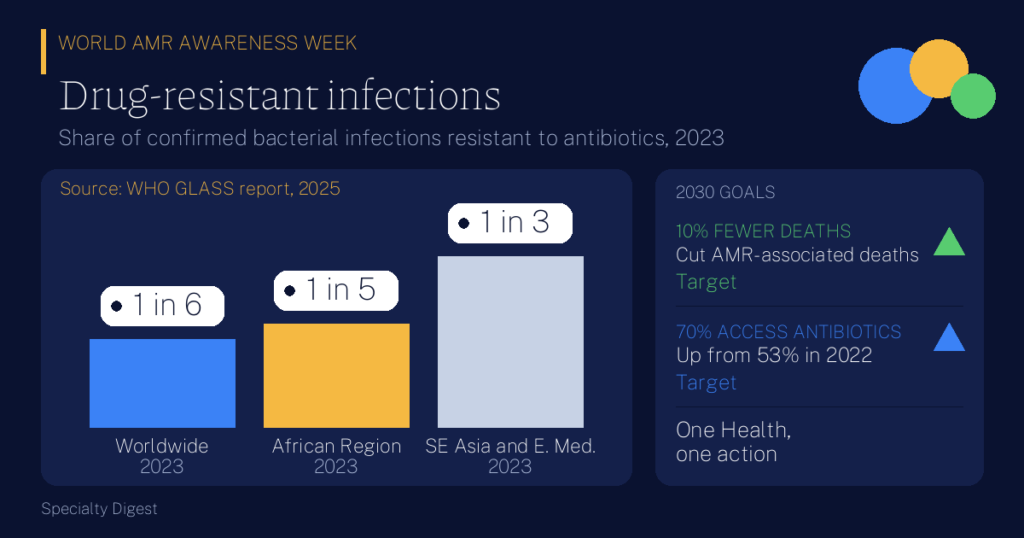
Routine laboratory data tell the same story. In WHO’s 2025 surveillance report, about one in six laboratory-confirmed bacterial infections worldwide in 2023 was resistant to antibiotics. Between 2018 and 2023, resistance rose in over 40 percent of the pathogen and antibiotic combinations monitored, by an average of 5 to 15 percent a year. More than 40 percent of E. coli and over 55 percent of K. pneumoniae were resistant to third-generation cephalosporins, a key class of drugs.
- 4.7 milliondeaths associated with bacterial AMR, 2021
- 1 in 6confirmed bacterial infections resistant, 2023
- 39 milliondeaths by 2050 without urgent action (WHO projection)
- $3.4 trillionpossible annual cost, per the same WHO page
Example 2: a hospital ward. Suppose a ward treats 600 bloodstream infections a year, and one in six, or 100, resists the first drug chosen. Those 100 patients need a second or third drug, longer stays and closer monitoring. The figures are round and illustrative, but they show how a global ratio turns into real beds and real days.
Why it matters to everyone
Resistance is not only a hospital problem. WHO says drug-resistant bacterial infections could cost US$412 billion a year in treatment up to 2035, plus US$443 billion a year in lost productivity. Its 2026 campaign page warns that without urgent action AMR could cause up to 39 million deaths by 2050. Specific diseases show the pressure: WHO reports resistance to ciprofloxacin in 75 percent of gonorrhea cases it cites, and in 2024 drug-resistant tuberculosis made up 3.2 percent of first episodes and 16 percent of previously treated cases. WHO also calls attention to an antimicrobial research and development crisis, with few new medicines in the pipeline.
Who is left behind
The burden is uneven. In WHO’s 2025 data, one in three infections was resistant in the South-East Asian and Eastern Mediterranean regions and one in five in the African Region, and WHO reports that resistance to third-generation cephalosporins exceeds 70 percent in Africa. Places with fewer laboratories, fewer diagnostic tests and weaker water and sanitation also tend to see less data. Reporting to WHO’s surveillance system grew from 25 countries in 2016 to 104 in 2023, yet 48 percent of countries did not report in 2023. What cannot be measured is hard to fight.
Example 3: a village clinic. A clinic with no lab can only guess which antibiotic to use. Suppose guesses fail in 3 of every 10 patients because the germs are resistant to the drug chosen. Each failed guess means a sicker patient, a second prescription and more resistance pressure. Diagnostics and clean water are cheap compared with that cycle. The numbers are illustrative.
The 2030 targets and what progress needs
In September 2024, world leaders adopted a political declaration at the UN General Assembly. It commits to reducing the estimated 4.95 million human deaths associated with bacterial AMR each year by 10 percent by 2030. It calls for sustainable national financing and US$100 million in catalytic funding, and it asks that at least 70 percent of human antibiotic use come from WHO’s Access group, the narrower-spectrum drugs. In 2022, Access antibiotics were about 53 percent of global human use. The declaration also set goals for infection prevention, water and sanitation in every health facility, national action plans and agrifood use, and asked the Quadripartite to set up an independent panel for evidence. In May 2026, the World Health Assembly adopted a new Global Action Plan on AMR for 2026 to 2036.
Individuals matter too. Take antibiotics only when a qualified health worker prescribes them, finish the course as directed, never share leftovers, stay up to date with vaccines, wash hands and handle food safely. This is general public guidance, not medical advice, so ask a clinician about your own case.
- 2022 and 2023Preventing Antimicrobial Resistance Together
- 2025Act Now: Protect Our Present, Secure Our Future
- 2026One Health, one action: Prevent AMR now
Key Takeaways
- Resistance is the germ changing. It means a medicine stops working against a microbe, not that a person becomes immune.
- The toll is large. Bacterial AMR was associated with more than 4.7 million deaths in 2021, by WHO’s account.
- It is measurable now. About one in six confirmed bacterial infections was resistant in 2023.
- Burden is uneven. One in three infections is resistant in two WHO regions, and nearly half of countries did not report in 2023.
- One Health is the strategy. People, animals, food and the environment are connected, so action must be too.
- Targets exist. The 2024 declaration aims for 10 percent fewer deaths and 70 percent Access antibiotic use by 2030.
- Your choices count. Use antibiotics only as prescribed, vaccinate, and keep hands and kitchens clean.
How solid is this? Death and infection figures are modeled or surveillance-based estimates from WHO and partner analyses and are revised as data improve; the 2050 projection is a scenario, not a prediction. Reporting countries differ from year to year, so comparisons across years need care. The three worked examples use round, made-up numbers. See also the International Days hub and the International Days Calendar.
More in Health
- WHO, Antimicrobial resistance fact sheet
- WHO, Warns of widespread resistance to common antibiotics worldwide (October 13, 2025)
- WHO, World Antimicrobial Awareness Week will now be World AMR Awareness Week (June 6, 2023)
- WHO, World leaders commit to decisive action on antimicrobial resistance (September 26, 2024)
- WHO, World AMR Awareness Week 2025
- WHO, World AMR Awareness Week 2026