Most people picture creativity as a spark and innovation as a gadget. The United Nations takes a wider view. Every April 21, World Creativity and Innovation Day asks the world to notice how new ideas, and the people who turn them into useful things, shape every part of human development: how we heal, learn, build, trade and tell stories. The day is not a salute to genius alone. It is a reminder that imagination needs support, such as schools that welcome questions, funding that backs experiments and workplaces that let people try, if it is to improve lives. It shares its spirit with World Science Day for Peace and Development, which makes a similar case for research.
Where the day came from
According to the UN observance page, the United Nations designated April 21 as World Creativity and Innovation Day to raise awareness of the role of creativity and innovation in all aspects of human development, through resolution A/RES/71/284. UNESCO adds that the General Assembly established the commemoration in 2017 to underline the importance of creativity and innovation in problem-solving and in advancing the 2030 Agenda.
The day sits in a longer line of attention. In 2015, UNESCO, CISAC and EY published Cultural Times, the first global map of cultural and creative industries. In 2021, the UN marked the International Year of Creative Economy for Sustainable Development under resolution A/RES/74/198.
Two words, one partnership
The UN is candid that there may be no universal understanding of creativity, and that the creative economy has no single definition. UNESCO says creativity and innovation are found in every aspect of human endeavor, and that innovation embraces the methods and styles of the creative process to enhance the human experience. A practical way to hold the two together: creativity produces the new idea, and innovation carries it into use. The UN page lists audiovisual products, design, new media, performing arts, publishing and visual arts among the creative industries.
Example 1: from ideas to a product. A neighborhood baker sketches 10 ideas for using unsold bread, tests 2 of them and launches 1, a line of seasoned croutons. The 10 sketches are creativity. The one product on the shelf is innovation. The numbers are round and illustrative, but the shape, many ideas, a few tests and one launch, is a common pattern, and it shows why a day for both words makes sense.
The numbers behind creative work
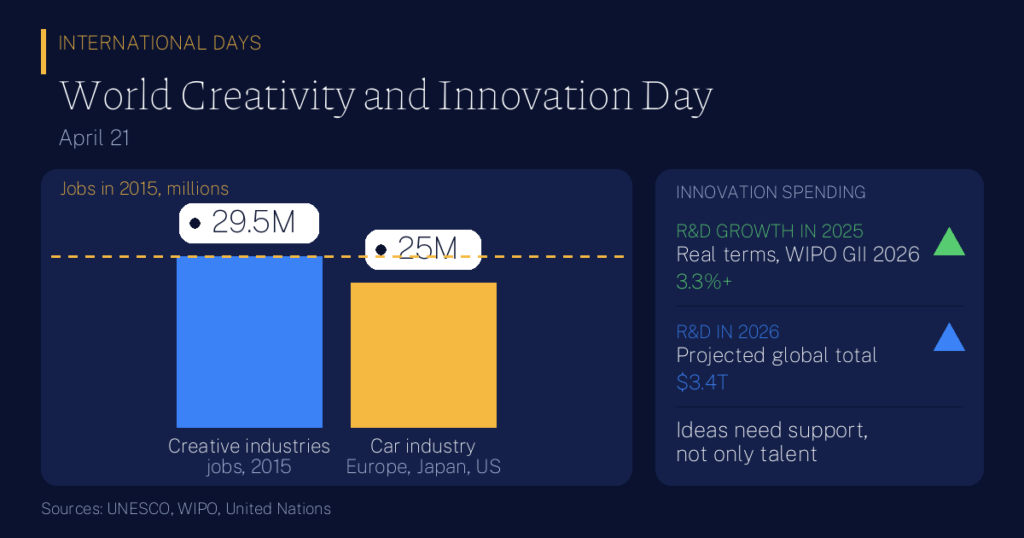
The 2015 Cultural Times report, covering 11 sectors from advertising and architecture to music, gaming and visual arts, put the revenue of cultural and creative industries at US$2,250 billion a year, about 3% of world GDP. It counted 29.5 million people employed, about 1% of the world’s active population, more than the car industry of Europe, Japan and the United States combined, which it counted at 25 million jobs. These are 2015 figures and measurement methods differ between studies, so treat them as a landmark rather than today’s total.
- $2,250 billionyearly revenue of creative industries, 2015
- 3%of world GDP, 2015
- 29.5 millionpeople employed, 1% of the active population, 2015
- Nearly 300cities in the UNESCO Creative Cities Network
Example 2: a city’s share. If a city of 1 million working people matched that 1% world share, about 10,000 of them would work in creative industries. A new festival district that adds 500 jobs would raise that group by 5%. The figures are round and illustrative, chosen only to show how a global share translates to a local scale.
Support is a separate question. The UN page, citing UNESCO’s fourth edition of Re|Shaping Policies for Creativity, which draws on over 120 countries, says direct public funding for culture is below 0.6% of global GDP and is declining globally.
Innovation by the numbers
On September 29, 2026, WIPO published the Global Innovation Index 2026. Switzerland, Sweden, the United States, the Republic of Korea and Singapore continue to lead, followed by the United Kingdom, the Netherlands, Finland, Denmark and China in tenth place. The index says global research and development grew by more than 3.3% in 2025 in real terms and will expand by 3.6% in 2026, to $3.4 trillion. Corporate R&D grew 5.8% in real terms in 2025 to $1.5 trillion, the highest on record. The 2025 edition had reported R&D growth of 2.9% in 2024.
Example 3: why growth rates matter. A research institute with a $100 million budget that grows 3.6% a year would have $103.6 million next year and about $107.3 million after two years. The figures are illustrative, but they show how steady, modest growth compounds into real capacity.
Who is left out
Innovation is not spread evenly. The GII 2026 counts more than 30,000 deep-science startups founded since 2000, worth $7.6 trillion, up 23% from 2024. The United States leads with 12,752, followed by China with 3,466 and the United Kingdom with 2,133. Capital is concentrated too: venture funding grew 28% to $510 billion in 2025, and artificial intelligence accounted for 53% of global venture deal value.
There are counter-signals. African startups raised about $3.2 billion in 2025, up 40% from the year before. The UN page also notes almost 300 cities in the UNESCO Creative Cities Network and UNDP Accelerator Labs with 89 lab teams covering 113 countries. The lesson of the data is that talent is everywhere, while funding, tools and recognition are not.
How the day is marked
The UN observance page does not name a single yearly theme, and I found no official 2026 theme in the sources used here. Observance is local and varied. In 2023, Namibia hosted a commemoration themed “Step Out and Innovate: Creating an Enabling Environment for Creativity and Innovation to Thrive,” at the Katutura Community Arts Centre. Schools, studios, libraries and laboratories can mark the day by showing how an idea moves from sketch to use, and by asking who in their community has the means to try.
Key Takeaways
- Two ideas, one chain. Creativity generates the idea and innovation puts it to use, and the UN observes April 21 for both.
- The day is recent but rooted. The General Assembly established it in 2017 through A/RES/71/284.
- Creative work is real work. Cultural Times counted 29.5 million creative jobs and about 3% of world GDP in 2015.
- Research spending keeps rising. Global R&D is projected to grow 3.6% in 2026, to $3.4 trillion.
- Support lags behind. The UN page says direct public funding for culture is below 0.6% of global GDP.
- Access is uneven. Deep-science startups and venture capital cluster in a few places, though African startup funding rose 40% in 2025.
- You can mark it. Make room for a question, a prototype or a neighbor’s idea this April 21.
How solid is this? The jobs and GDP figures come from a 2015 report and measure a different scope than later studies, so they are not directly comparable with newer estimates. Innovation figures are WIPO estimates and projections from its 2025 and 2026 press releases, and the 2026 values are forecasts. The three worked examples use round, made-up numbers to show an idea. See also the International Days hub and the International Days Calendar.
More in Society
- United Nations, World Creativity and Innovation Day
- United Nations General Assembly, resolution A/RES/71/284 (2017)
- UNESCO, Celebrating the Power of Human Imagination and Ingenuity (2023)
- UNESCO, CISAC and EY, Cultural Times: first global map of cultural and creative industries (2015)
- WIPO, Global Innovation Index 2026 press release (September 29, 2026)
- WIPO, Global Innovation Index 2025 press release (September 16, 2025)