When a quarrel grows between neighbors, there are two broad ways to settle it: the stronger side wins, or everyone sits down under agreed rules. The United Nations was built on the second idea. The International Day of Multilateralism and Diplomacy for Peace, observed every April 24, asks the world to remember why. Multilateralism means countries working together, three or more at a time, on problems that no single nation can solve alone. Diplomacy is the patient craft of negotiation that makes that work possible. Together they are the quiet machinery behind much that people take for granted, from a mending ozone layer to peacekeepers posted along fragile borders. The day invites everyone to look at that machinery and ask how well it works. It pairs naturally with World Water Day, since shared water is a problem countries must often solve together.
From San Francisco to a day on the calendar
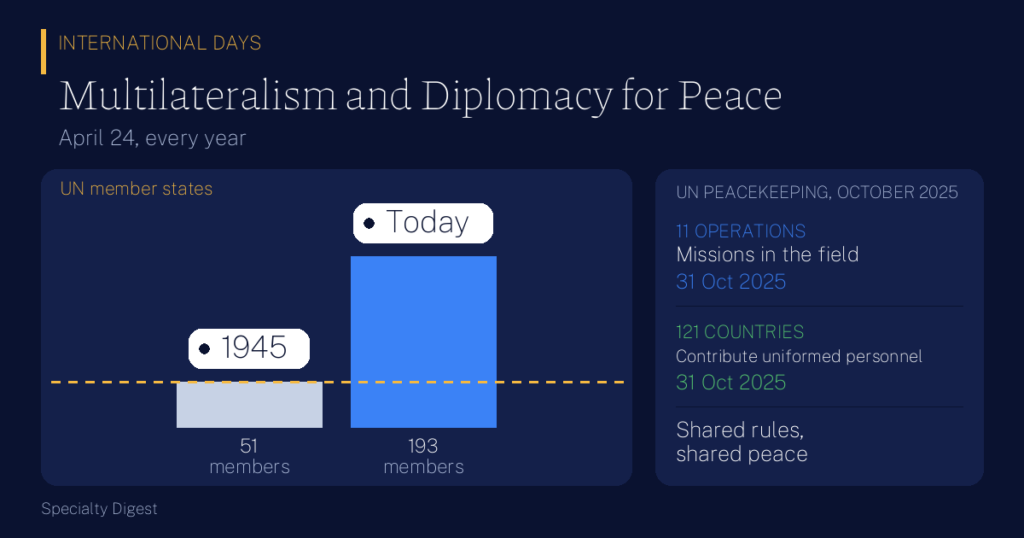
The story starts in 1945. Representatives of 50 countries gathered in San Francisco from April 25 to June 26 for the United Nations Conference on International Organization. The United Nations officially came into existence on October 24, 1945, after its Charter had been ratified by China, France, the Soviet Union, the United Kingdom, the United States and a majority of other signatories. The UN says its membership has grown from 51 states in 1945 to 193 today.
The day itself is much younger. On December 12, 2018, the General Assembly adopted resolution A/RES/73/127, “International Day of Multilateralism and Diplomacy for Peace,” by a recorded vote of 144 in favor to 2 against. The resolution invites member states, observers and organizations of the United Nations to observe the day and to spread understanding of the advantages of multilateralism and diplomacy for peace, including through education and public awareness activities. The UN describes the day as a reaffirmation of the Charter and its principle of resolving disputes among countries by peaceful means.
What the two big words mean
A bilateral deal involves two parties. A multilateral one involves many, and that changes the game. Rules written for everyone bind the powerful as well as the weak, and a problem that crosses borders, such as a pollutant in the air or a disease on the move, can be tackled by all affected at once. Diplomacy is how those rules get written: months or years of talks, drafts, compromises and trust. It rarely makes headlines, and when it works, the result is often an absence, no war, no outbreak, no collapse in trade.
Example 1: the shared river. Imagine three countries along one river. Each could build dams and drain it for its own farms, and the one at the mouth would be left dry. If instead they agree on a water-sharing schedule and a joint monitoring team, all three can plan crops years ahead. The numbers and countries here are made up for illustration, but this is the logic of multilateral rules: a small loss of freedom buys a large gain in certainty.
The numbers behind the day
The scale of the UN system is easiest to see in two figures. Membership has grown from 51 states in 1945 to 193 today, which means almost every country on Earth now has a seat and a vote in the General Assembly.
The second figure is peacekeeping, one of the most visible products of joint action. As of October 31, 2025, the UN reported 11 peacekeeping operations with 67,783 personnel in total, and 121 countries contributing uniformed personnel. The General Assembly approved a peacekeeping budget of $5.38 billion for the 2025 to 2026 fiscal year, slightly down from $5.59 billion the year before, when it covered 14 operations.
- 11peacekeeping operations, October 2025
- 67,783personnel serving, all categories
- 121countries contributing uniformed personnel
- $5.38 billionapproved for the 2025 to 2026 fiscal year
Example 2: sharing the bill. Suppose a mission costs $100 million a year and 100 countries share the cost evenly. Each pays about $1 million, a sum most governments can fit in a budget. If one country had to fund the mission alone, it might never happen. The figures are round and illustrative, and real UN assessments are set by a scale that reflects each member’s capacity to pay, but the principle is the same: shared burdens become bearable.
Proof that cooperation can work
The strongest case for multilateralism may be the ozone layer. The Montreal Protocol, signed in September 1987, regulates nearly 100 man-made chemicals that damage the ozone layer. A scientific panel, reported by UN News in January 2023, confirmed the phase-out of nearly 99 percent of banned ozone-depleting substances. If current policies stay in place, the ozone layer is expected to return to 1980 values by 2040, with recovery around 2045 over the Arctic and around 2066 over the Antarctic. The Protocol has also helped avoid an estimated 0.5 degrees Celsius of global warming, and the panel estimates its 2016 Kigali Amendment on HFCs will avoid another 0.3 to 0.5 degrees by 2100.
No single country could have done that. It took shared science, shared rules and the patience of negotiators over many years.
Why it matters, and what is at stake
At the first observance in 2019, the President of the General Assembly noted that 650 million people lived in extreme poverty and more than 821 million suffered from hunger, and argued that such problems call for joint answers. In September 2024, world leaders adopted the Pact for the Future at the Summit of the Future, an agreement aimed at strengthening global cooperation. Yet the system is under strain, and the peacekeeping figures above, with a smaller budget and fewer missions than a year earlier, show that cooperation must be funded and renewed to endure.
Example 3: the cost of talking. Suppose a mediation effort costs $2 million and prevents a conflict that would cost $200 million in damage and lost trade. Even if it succeeds only one time in ten, it still pays for itself several times over. These numbers are invented for illustration, but they capture why diplomats call prevention the cheapest form of security.
How the day is marked
The resolution asks member states, observers and UN organizations to mark the day through education and public awareness. At the first observance in 2019, all the main organs of the UN issued a joint message, and the General Assembly president convened an informal forum on the importance of multilateralism. Beyond official events, the day works well in classrooms and communities: a model UN session, a talk on how a treaty came about, or a simple discussion of how your own country takes part in international bodies.
Key Takeaways
- Multilateralism means shared rules. Countries solve cross-border problems together instead of alone.
- The day is young but the idea is old. Resolution 73/127 passed 144 to 2 in 2018, and it builds on the 1945 Charter.
- The table has grown. UN membership rose from 51 states in 1945 to 193 today.
- Peacekeeping is cooperation made visible. In October 2025, 67,783 personnel served in 11 operations, with 121 countries contributing uniformed personnel.
- Cooperation can repair the planet. The Montreal Protocol phased out nearly 99 percent of banned ozone-depleting substances.
- Diplomacy works best when unseen. Its successes look like things that did not happen.
- It needs support. Budgets, trust and public understanding keep it going, so learn how your country takes part.
How solid is this? Dates, the resolution number, the vote and the membership counts come from UN pages. Peacekeeping figures are from the October 2025 fact sheet and the July 2025 UN News report, and ozone projections are scientific estimates that can change. The UN observance page also lists a second resolution symbol in its documents; this article uses A/RES/73/127, the one its text names. The three worked examples use round, made-up numbers. See also the International Days hub and the International Days Calendar.
More in Society
- United Nations: International Day of Multilateralism and Diplomacy for Peace
- President of the 73rd General Assembly, statement at the first observance, April 24, 2019
- United Nations: History of the UN
- UN Peacekeeping: fact sheet, October 2025
- UN News: General Assembly approves $5.4 billion peacekeeping budget for 2025-2026
- UN News: Ozone layer recovery is on track, due to success of Montreal Protocol
- United Nations: Summit of the Future 2024