Every vaccine, weather forecast and clean water system began as a question that someone was free to ask. World Science Day for Peace and Development, observed every year on November 10, invites the public to notice that chain of questions and to help protect it. UNESCO leads the day, and its message is simple: science belongs to everyone, it works best when countries share it, and it is one of the most practical tools people have for building peaceful and sustainable societies. It is a close cousin of World Water Day, because solving shared problems such as water depends on shared knowledge.
From a conference in Budapest to a UNESCO day
The day grew out of a commitment made at the UNESCO and International Science Council World Conference on Science, held in Budapest in 1999. That conference produced the Declaration on Science and the Use of Scientific Knowledge and a Science Agenda: Framework for Action. Two years later, in 2001, the UNESCO General Conference proclaimed World Science Day for Peace and Development. The first observance was held worldwide on November 10, 2002, under UNESCO auspices.
What the day sets out to do
UNESCO lists four objectives. The first is to strengthen public awareness of the role of science in peaceful and sustainable societies. The second is to promote national and international solidarity for shared knowledge and scientific cooperation. The third is to renew national and international commitment to using science for the benefit of societies. The fourth is to draw attention to the challenges science faces and to raise support for scientific work. The day also aims to keep citizens informed about developments in science, and to bridge the gap between science and society.
Notice the pairing in the name. Peace and development are not extras added to science; they are the reasons to share it. A discovery kept inside one lab or one country helps few people, while a discovery shared can feed farms, protect cities and cure illness far from where it was made.
The numbers behind the day
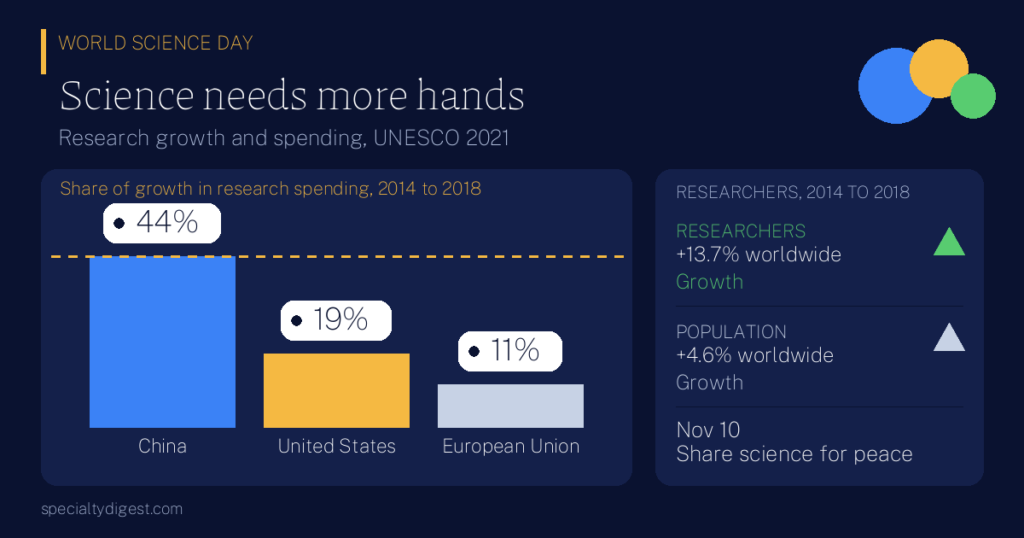
The UNESCO Science Report 2021 gives the most recent complete global snapshot used here. In 2018 the world had an estimated 8.854 million full-time equivalent researchers, up from 7.790 million in 2014. That is growth of 13.7 percent, while the world population grew by 4.6 percent. Global spending on research and development reached 1.79 percent of world gross domestic product in 2018, up from 1.73 percent in 2014.
- 8.854 millionfull-time equivalent researchers worldwide, 2018
- 1.79%of world GDP spent on research and development, 2018
- 33.3%of researchers who are women, 107 countries, 2015 to 2018 data
- 37countries spent 1% or more of GDP on research, 2018
Money is concentrated. Of the growth in global research spending between 2014 and 2018, China accounted for 44 percent, the United States for 19 percent, the European Union for 11 percent, the Republic of Korea for 5 percent and India for 4 percent. The remaining 17 percent, our own subtraction, was spread across the rest of the world.
Example 1: reading a research budget. Suppose a country with an economy of $500 billion spends 1 percent of it on research. That is $5 billion a year. If it raised the share to 2 percent, spending would double to $10 billion. The numbers are round and illustrative, but they show why a small shift in a percentage matters so much.
Who is counted and who is missing
Science depends on people, and the people are not evenly spread. UNESCO Institute for Statistics data covering 107 countries put women at 33.3 percent of researchers in 2018, up from 28.4 percent in 2013. The estimate excludes North America and China. Women made up only 22 percent of the artificial intelligence workforce, according to the UN’s 2021 summary of the report.
Funding is uneven as well. The report notes that only 37 countries spent 1 percent or more of their national income on research and development in 2018, and UN News summarized the finding as four out of five countries investing less than 1 percent. Where laboratories, libraries and trained teachers are scarce, local problems such as crop disease or flood risk may go unstudied by the people who live with them.
Example 2: a missing lab. Imagine two neighboring districts, each with 1,000 students interested in science. One has a working laboratory and the other has none. If 100 students in the first district get hands-on training and only 10 in the second do, the second district has one tenth of the future talent from the same starting point. The figures are made up for illustration, yet they capture how access shapes who becomes a scientist.
Science as a bridge between nations
The 2026 theme is Common ground through science diplomacy. Science diplomacy means using scientific cooperation to build understanding and trust between countries, even when their governments disagree on other matters. The logic is practical. Shared problems, from disease outbreaks to shared rivers, do not stop at borders, and the evidence needed to solve them is stronger when many countries contribute to it.
Example 3: a shared river. Picture two countries that depend on one river. If each measures rainfall and flow separately and keeps the data private, both plan with guesses. If they pool their measurements, both can plan for floods and droughts using the same facts. The setting is imaginary and the numbers are not real, but it shows how cooperation on evidence can quietly build trust.
The decade ahead and how the day is marked
In August 2023 the UN General Assembly declared 2024 to 2033 the International Decade of Sciences for Sustainable Development, led by UNESCO and promoting science as a common good that fuels innovation, inclusion and collaboration across borders. The 2024 observance, held under the Decade with a focus on young people, used the theme Why Science Matters: Engaging Minds and Empowering Futures. Each year UNESCO and its partners hold events such as webinars and discussions, and schools, museums and science centers around the world run their own activities. Anyone can join in by visiting a science center, asking a local scientist to speak to a class, or simply checking a claim against a trusted source before sharing it.
Key Takeaways
- The day has a clear origin. It follows the 1999 Budapest conference and was proclaimed by UNESCO in 2001, with the first observance in 2002.
- Peace and development are the point. The day asks countries to share science and to use it for the benefit of societies.
- The research workforce is growing. Researchers rose 13.7 percent from 2014 to 2018, faster than the 4.6 percent growth in population.
- Spending is concentrated. Only 37 countries spent 1 percent or more of GDP on research in 2018, and China and the United States drove most of the growth.
- Women are still a minority in research. They were 33.3 percent of researchers in 2018, up from 28.4 percent in 2013.
- Science diplomacy is the 2026 theme. Cooperation on evidence can build trust where other ties are weak.
- Everyone has a part. Support local science education, and check what you read before you share it.
How solid is this? The statistics come from the UNESCO Science Report 2021 and cover 2014 to 2018, so more recent figures may differ. They are modeled estimates, and women’s share covers 107 countries and excludes North America and China. The 2026 theme is as published by UNESCO and the UN. The three worked examples use round, made-up numbers to show an idea. See also the International Days hub and the International Days Calendar.
More in Science
- UNESCO, World Science Day for Peace and Development
- United Nations, World Science Day for Peace and Development
- United Nations Academic Impact, World Science Day
- UNESCO Science Report 2021, facts and figures
- UNESCO Science Report 2021, one in three researchers is a woman
- UN News, UNESCO report highlights need for greater investment, diversity in science (2021)
- UNESCO, World Science Day for Peace and Development 2024