Every year on October 24, the United Nations asks the world to look at a question that sounds dry and decides a great deal: who knows what, and who is left in the dark? World Development Information Day was created in 1972 to draw the attention of the world to development problems and to the need to strengthen international cooperation to solve them. It falls on the same date as United Nations Day, and that is deliberate. The idea behind it is older than the internet and more relevant than ever. People can only act on problems they can see, and they can only share in development if information, services and a voice can reach them. Today the clearest test of that idea is connectivity.
Why the Assembly wanted a day for information
By the early 1970s, the United Nations had already launched a series of Development Decades, long campaigns in which governments agreed on goals for growth and cooperation. The General Assembly noticed a gap between those ambitions and public awareness. In 1972 it decided that better dissemination of information and mobilization of public opinion, particularly among young people, would lead to greater awareness of the problems of development. It set the date to coincide with United Nations Day, on October 24.
What “development information” means
The phrase covers more than news. It means the facts people need to make decisions: prices, weather warnings, school and health services, job openings, public budgets, and the data governments use to plan. Development agencies call the lack of it an information gap, and the UN page for the day links it to what it calls the digital divide, the difference between people who can use information and communications technology and people who cannot. A later General Assembly resolution, 65/141, is cited there on that very subject. The 1972 decision looked ahead further than its authors could have known: the main road for information in the twenty-first century is the internet.
The numbers behind the day
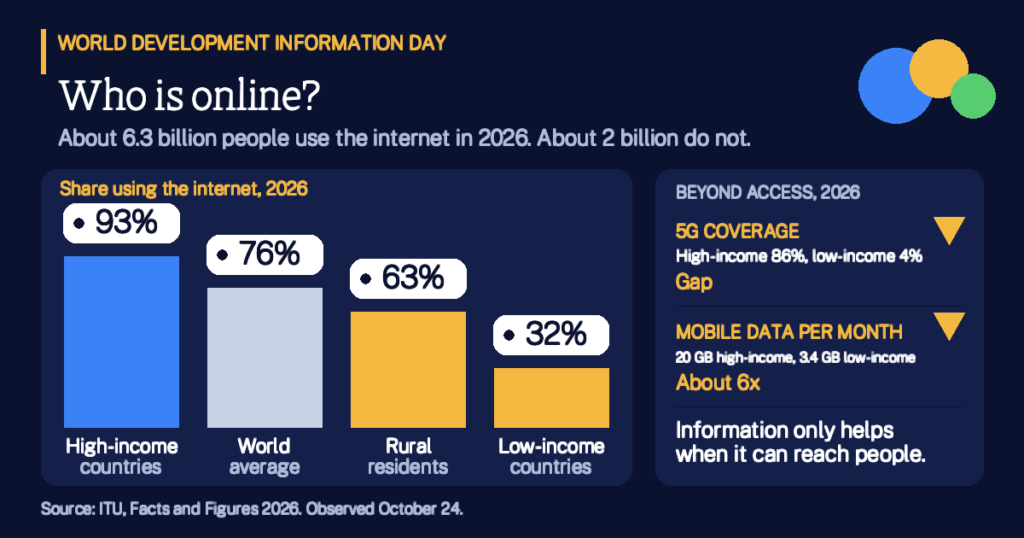
The International Telecommunication Union (ITU), the UN agency for digital technologies, published its latest estimates on November 3, 2026. It reports that about 6.3 billion people, or 76 percent of the world, are using the internet in 2026. Its revised figure for 2025 is 6.1 billion, or 74 percent. About 2 billion people remain offline. The ITU says digital divides persist, and the data show where.
- 6.3 billionpeople online in 2026, 76% of the world
- 2 billionpeople still offline in 2026
- 32%internet use in low-income countries, 2026
- 1.2%median price of a data-only mobile plan as a share of income per person, 2026
Example 1: a district of 10,000 adults. Suppose a rural district matches the 63 percent rural average. About 6,300 adults are online and 3,700 are not. Those 3,700 people cannot easily read a health alert, look up a crop price or apply for a service posted on a website. The numbers are round and illustrative, but the pattern is the one the data describe.
Beyond access: price, speed and quality
Being counted as online does not mean being equally served. The ITU reports that 5G reaches 59 percent of the world’s population, from 86 percent in high-income countries to 4 percent in low-income countries. Mobile phone ownership among people aged 10 and over is 84 percent worldwide, above 95 percent in high-income countries and 57 percent in low-income countries. The ITU also says monthly mobile traffic per subscription is 20 GB in high-income countries, roughly six times the 3.4 GB in low-income countries.
Cost is part of the story. The ITU reports that the median price of a data-only mobile broadband plan fell to 1.2 percent of income per person in 2026, and that landlocked developing countries and small island developing states met the 2 percent affordability target for the first time. Yet the median price in the least developed countries remains at 6.1 percent of income per person, and three in ten economies meet neither the fixed nor the mobile target.
Example 2: the price of a data plan. Imagine a person whose income is $100 a month. At the 2 percent target a plan would cost $2. At 6.1 percent it costs $6.10, more than three times as much. The income is made up and rounded, but it shows why affordability matters as much as coverage.
Who is left behind
The gaps are not only between countries. In 2026, 82 percent of urban residents use the internet, against 63 percent of rural residents. Among men the share is 79 percent and among women 74 percent, a women-to-men ratio of 0.94. Young people lead: 86 percent of those aged 15 to 24 are online, compared with 74 percent of everyone else. The 2025 release, using earlier estimates, showed 85 percent urban against 58 percent rural, 94 percent in high-income countries against 23 percent in low-income countries, and 2.2 billion people offline. Some of those gaps appear to be narrowing, though ITU revises prior-year estimates, so such comparisons need care.
Information in the age of AI
The 2025 Human Development Report from the UN Development Programme, titled “A matter of choice: people and possibilities in the age of Artificial Intelligence,” widens the question. Its release said projections for 2024 showed stalled progress on the Human Development Index in all regions, the smallest increase since 1990 outside the crisis years of 2020 and 2021. It added that inequality between low and very high human development countries had risen for the fourth year in a row. On AI, it said access alone is not enough, and that the real divide will hinge on how effectively AI complements and augments what people do. That is the 1972 idea in a new form: information has to be reachable, understandable and useful.
Example 3: a lesson pack. A teacher in a low-income area wants to share a 1 GB set of video lessons. At the 3.4 GB monthly average for a low-income subscription, that single download uses almost a third of a typical month’s data. At the 20 GB high-income average it uses one twentieth. The comparison is rounded and illustrative, but it shows how quality and cost shape what information people can actually use.
How the day is marked
The UN page for the day gives no annual theme. Governments, schools, libraries, statistical offices, telecom regulators and civil groups use October 24 to publish data, run digital skills sessions and discuss how to widen access. Because the date matches United Nations Day, it is a natural moment to ask whether the information that shapes development decisions reaches everyone it affects. You can mark it simply: share a reliable statistic, teach someone a digital skill, or ask how your community’s public information reaches people without a phone or a connection.
Key Takeaways
- The day dates from 1972. The UN General Assembly created it to draw attention to development problems and strengthen cooperation.
- It shares a date with UN Day. The Assembly chose October 24 on purpose.
- Most people are online, but not all. About 6.3 billion use the internet in 2026, and about 2 billion do not.
- Income sets the gap. Internet use is 93 percent in high-income countries and 32 percent in low-income countries.
- Quality and price matter. 5G reaches 86 percent of people in high-income countries and 4 percent in low-income countries.
- Divides run inside countries too. Rural residents and women use the internet less than urban residents and men.
- Access is a start. UNDP says the real divide in the age of AI depends on how people can use new tools.
How solid is this? Internet figures are ITU estimates from its November 2026 press release and are revised each year, so comparisons with earlier releases need care. The resolution number for the 1972 decision could not be confirmed against the official record, so this article gives the year only. The three worked examples use round, made-up numbers to show an idea. See also United Nations Day, the International Days hub and the International Days Calendar.
More in Society
- United Nations. World Development Information Day.
- United Nations. List of International Days and Weeks.
- International Telecommunication Union. 6.3 billion people now online, yet digital divides persist (November 3, 2026).
- International Telecommunication Union. Facts and Figures 2025 press release (November 17, 2025).
- United Nations Development Programme. Human Development progress slows to a 35-year low (Human Development Report 2025, May 6, 2025).