Most weeks on the calendar celebrate something. Disarmament Week asks a harder question: how do societies agree to own fewer of the things that can hurt them most? It opens every year on October 24, the anniversary of the founding of the United Nations, and runs for seven days. The week is not a holiday and has no ceremony to attend. It is an invitation to learn how weapons are counted, limited and, in some cases, destroyed, and why that slow work is among the most practical forms of peace-building. It opens on the same date as United Nations Day, and the two share a purpose.
A week born at a special session
The idea comes from the Final Document of the 1978 special session of the UN General Assembly devoted to disarmament, adopted as resolution S-10/2. That document asked for a week, starting on October 24, to promote the aims of disarmament. For years the week was largely a diplomatic custom. In 1995 the General Assembly, in resolution 50/72 B of December 12, invited governments and civil society groups to keep taking an active part, so that ordinary people could better understand the subject. The UN’s observance page notes that the week begins on the anniversary of the founding of the Organization.
The timing is not an accident. The United Nations Charter, signed in 1945, makes the regulation of armaments part of the work of keeping the peace. The week ties that old promise to a date everyone can remember.
Three words that are often confused
News coverage tends to blur several terms, so it helps to separate them. Disarmament means reducing or eliminating weapons. Arms control covers the rules and limits that govern weapons, including how many may be held and how they may be used. Nonproliferation aims to stop weapons from spreading to new hands. A single treaty can do more than one of these jobs, but the goals differ, and so do the ways of checking whether a promise has been kept.
Example 1: reading a headline. Imagine a country announces it will cut 300 of its 1,500 warheads. That is a 20 percent reduction, which sounds large. The useful follow-up questions are whether the 300 are dismantled or only retired, and whether outside inspectors can confirm it. The numbers are round and illustrative, but those two questions are exactly what treaty verification exists to answer.
The numbers behind the week
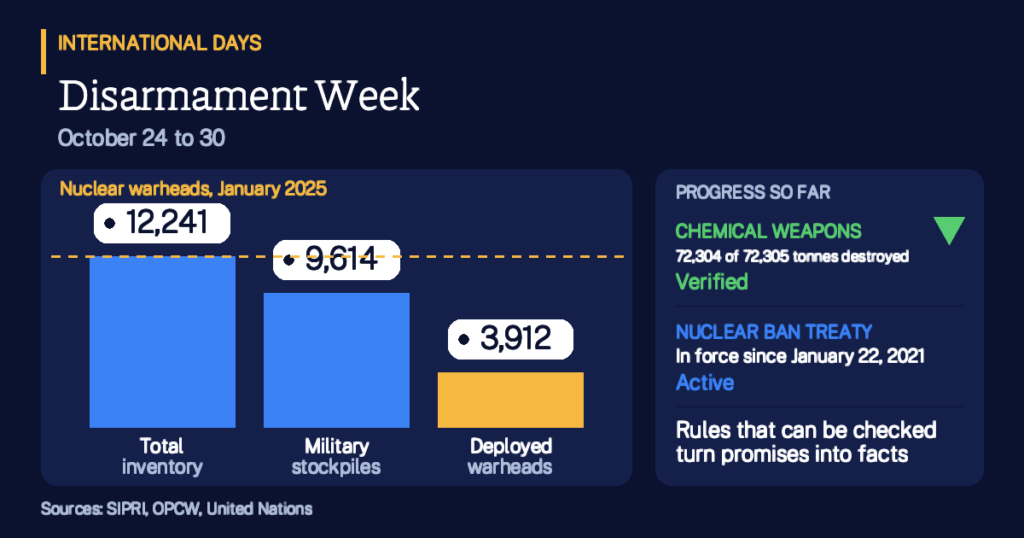
The best-known public estimates of nuclear forces come from the Stockholm International Peace Research Institute (SIPRI). Its 2025 Yearbook estimated a total inventory of 12,241 nuclear warheads in January 2025. Of these, about 9,614 were in military stockpiles, meaning available for possible use. An estimated 3,912 were deployed with missiles and aircraft, and around 2,100 were kept on high operational alert on ballistic missiles. Nine states hold such weapons, and Russia and the United States together possess around 90 percent of all of them.
- 12,241estimated warheads in total, January 2025
- 9,614in military stockpiles
- 3,912deployed with missiles and aircraft
- 193States Parties to the Chemical Weapons Convention
These are estimates, because states keep exact holdings secret, and each new yearbook revises them. Readers should compare numbers only when they come from the same source and year. Total holdings are also not the whole story, since stockpile size, readiness and the rules governing them each shape the level of risk.
What disarmament has already achieved
The clearest success story involves chemical weapons. The Chemical Weapons Convention entered into force on April 29, 1997, and now has 193 States Parties. On July 7, 2023, the Organisation for the Prohibition of Chemical Weapons (OPCW) confirmed that all declared stockpiles had been verified as irreversibly destroyed, after the last United States munition was eliminated at Blue Grass, Kentucky. The OPCW reports 72,304.34 of 72,305 metric tonnes of declared agents destroyed. That is proof that a whole class of weapons can be dealt with under international inspection.
Nuclear weapons have their own milestones. The Treaty on the Prohibition of Nuclear Weapons was adopted on July 7, 2017, by a vote of 122 states in favor, with one against and one abstention. It entered into force on January 22, 2021, after its 50th ratification on October 24, 2020, which is the first day of Disarmament Week. Governments differ on the best route to nuclear disarmament, and the UN reports on the views of its members rather than choosing between them. The UN also notes that the New START treaty between the United States and Russia expired on February 5, 2026.
Why it matters beyond the headlines
Weapons policy can feel distant, yet it reaches ordinary life. Resources spent on arms are resources not spent on schools or clinics, and the damage from weapons falls most heavily on civilians. Disarmament work also has quiet, local forms: clearing explosive remnants, securing small arms, and teaching young people how treaties work. The UN Office for Disarmament Affairs also promotes disarmament education for this reason, since an informed public is part of how agreements are demanded, understood and checked.
Example 2: the stockpile tally. Suppose two neighboring states each hold 500 older missiles and agree to cut 40 percent over five years. That removes 200 each, or 400 together, about 80 a year per state. Add a rule that each side may inspect the other’s destruction sites, and both can trust the count. The numbers are made up for illustration, but trust built through checking is the core idea of arms control.
How the week is marked, and what progress needs
There is no single official program. Governments, universities, libraries and civil society groups hold talks, exhibitions and classes, and the UN encourages states and civil society to use the week to focus attention on disarmament. Anyone can take part by reading a treaty summary, asking a local library for an event, or following the First Committee of the General Assembly, which handles disarmament each autumn.
Progress needs three things: reliable numbers, rules that can be checked, and public understanding that keeps the subject on the agenda. The chemical weapons case shows that this combination can work.
Example 3: why checking matters. Imagine a treaty requires a state to destroy 1,000 tonnes of a harmful agent. If it reports 600 tonnes destroyed and inspectors verify 580, officials investigate the 20 tonne gap rather than assume bad faith or accept it silently. The figures are illustrative, but verification works this way: it turns a promise into a fact.
Key Takeaways
- The week starts on October 24. It opens on the anniversary of the United Nations and traces to the 1978 Final Document, resolution S-10/2.
- Three terms, three goals. Disarmament reduces weapons, arms control sets limits, and nonproliferation stops spread.
- The nuclear numbers are estimates. SIPRI counted about 12,241 warheads in January 2025, with about 9,614 in military stockpiles.
- Concentration is high. Russia and the United States together hold around 90 percent of all warheads.
- One class of weapon is nearly gone. The OPCW reports 72,304.34 of 72,305 tonnes of declared chemical agents destroyed.
- Verification builds trust. Rules that can be checked turn promises into facts.
How solid is this? Nuclear warhead counts are estimates by SIPRI for January 2025 and are revised each year, so newer figures may differ. Treaty dates and chemical weapons figures come from the UN and the OPCW. The three worked examples use round, made-up numbers to show an idea. See also the International Days hub and the International Days Calendar.
More in Society
- United Nations, Disarmament Week
- UN General Assembly, Final Document of the Tenth Special Session (S-10/2, 1978)
- SIPRI, Yearbook 2025 press release (June 2025)
- OPCW, All declared chemical weapons stockpiles verified as destroyed (July 2023)
- OPCW, OPCW by the Numbers
- UN Office for Disarmament Affairs, Treaty on the Prohibition of Nuclear Weapons
- United Nations, International Day for the Total Elimination of Nuclear Weapons