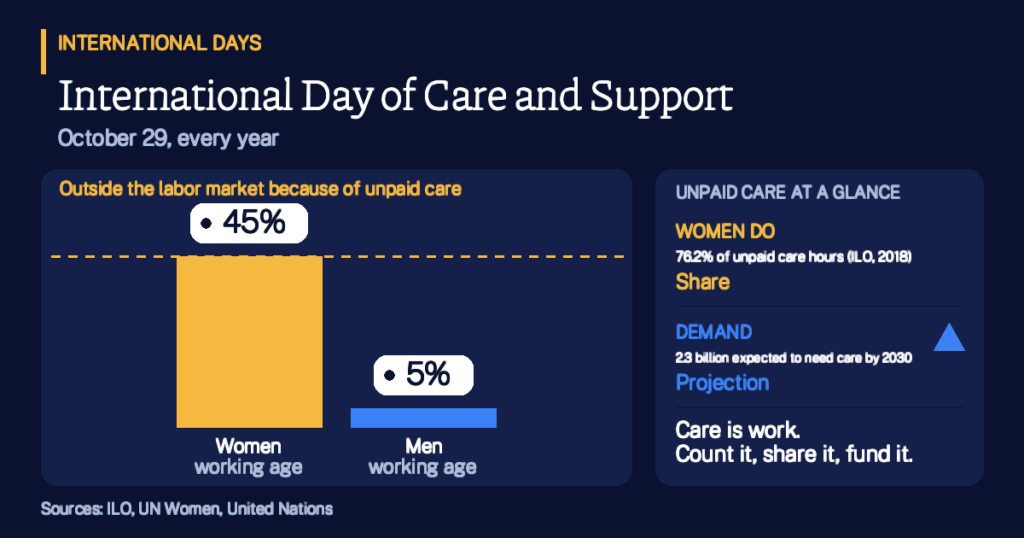
Every society runs on care. A baby is fed, a parent with dementia is bathed, a child with a disability is helped to school, a patient is nursed through the night. Most of this work is never counted, never paid and rarely thanked. The International Day of Care and Support, observed every year on October 29, asks the world to look at that work, see who does it, and decide how to share it fairly. It is a close relative of World Toilet Day, since both are about the unglamorous systems that keep daily life going.
A new day for an old problem
The day is young. The UN General Assembly decided to proclaim October 29 as the International Day of Care and Support in resolution 77/317, adopted in 2023, and the first observance followed that October. By 2024 UN Women described the commemoration as the second time the world had marked it. The resolution stresses investing in the care economy and building robust, resilient, gender-responsive, disability-inclusive and age-sensitive care and support systems. It also calls for recognizing and valuing paid care workers as essential workers, and for equal pay for work of equal value. Governments and others are invited to observe the day each year to raise awareness.
The problem the day names is far older than its date: care has always been done, mostly by women, mostly without pay.
What care and support actually mean
Care is the work of looking after people who cannot fully look after themselves, and of helping everyone live with dignity. It comes in two forms. Paid care is done by nurses, health aides, child care staff, personal assistants and domestic workers. Unpaid care is done at home, usually by family, and includes feeding, washing, supervising, accompanying someone to appointments and the housework that surrounds it.
Support is the other half of the phrase. It means the services, leave, income and equipment that let both the person who needs care and the person who gives it live fully. The 2025 commemoration, held in Geneva on October 29 and organized by OHCHR, UN Women and the ILO, used the theme Care and Support for all: Realizing human rights of all those providing and requiring care and support. It treats care as a matter of rights.
The hours nobody counts
In 2018 the International Labour Organization (ILO) estimated that 16.4 billion hours are spent on unpaid care work every day, using data from 64 countries that cover two thirds of the world’s workers. That equals two billion people working eight hours a day with no pay. Women perform 76.2 percent of those hours, more than three times as much as men. More recent UN Women summaries put the figure at about 16 billion hours a day and say women spend about 2.5 times as many hours on unpaid care as men. The ratios differ because the years, countries and methods differ, but every estimate points the same way.
Example 1: one household. Imagine a home where care and housework take eight hours a day. If the mother does six hours and the father two, she carries 75 percent of the load, close to the global pattern. Over a year that is 2,190 hours for her and 730 for him. The gap of 1,460 hours equals more than 36 full-time work weeks. The numbers are round and illustrative.
Who needs care, and who provides it
Demand is large and growing. In 2015 about 2.1 billion people needed care, and 1.9 billion of them were children under 15, with the rest older persons (ILO, 2018). The ILO warned that a global care crisis could affect 2.3 billion people by 2030, and the UN observance page likewise says the number of people receiving care is predicted to reach 2.3 billion by 2030.
The paid workforce that meets this demand is also overwhelmingly female. The UN reports a global care workforce of 249 million women and 132 million men, and says women in the health and care sector earn on average 24 percent less than their male peers.
- 16.4 billionhours of unpaid care every day, 2018 estimate
- 76.2%of unpaid care hours done by women
- 2.3 billionpeople predicted to need care by 2030
- 24%lower average pay for women in health and care than male peers
What care costs women
Unpaid care is not free for the person who gives it. The ILO found in 2018 that 606 million women, compared with 41 million men, were unavailable for employment or not seeking a job because of unpaid care. A 2024 ILO brief, cited by UN Women, says 45 percent of working-age women are outside the labor market because of unpaid care responsibilities, against 5 percent of men. ILO also found that fewer than half of mothers with children under six were able to secure paid work.
The cost starts early. UN Women, citing UNICEF, says girls do 160 million more hours of unpaid care and domestic work every day than boys. Each extra hour of unpaid care reduces a woman’s chance of paid work by 38 percent and of higher education by 34 percent, according to UN Women’s reading of Progress of the World’s Women 2019-2020. Around 80 percent of domestic workers are women, many of them in jobs with weak protection.
Example 2: the price of a reduced schedule. Suppose a woman earns $20 an hour and cuts her paid week from 40 hours to 30 to look after a parent. She gives up $200 a week, or about $10,000 over a 50-week year, before counting lost retirement savings. The wage is made up for illustration.
Care as an investment
Care is often described as a cost. UN Women argues it is also a source of jobs. Investing in comprehensive care systems could create nearly 300 million jobs by 2035, almost three times as many as construction, with about 30 percent fewer emissions. An earlier ILO analysis found that 269 million jobs could be created within 12 years if countries doubled investment in education, health and social work. UN Women also notes that if unpaid work were valued in money, it would exceed 40 percent of GDP in some countries.
Example 3: a town opens child care centers. Suppose a town opens 10 centers, each employing 10 workers. That is 100 new paid care jobs at once. If each center lets 20 parents take paid work, another 200 people join the labor force. The figures are round and illustrative.
Sharing the load: the six Rs
UN Women frames the response as six actions: Recognize, Reduce, Redistribute, Reward, Represent and Resource.
Some governments have started. UN Women’s 2024 statement names national care systems laws in Colombia and Panama, the Caregivers Welfare Act in the Philippines and a long-term care strategy in Spain. In Iceland each parent receives six months of paid leave, and fathers take nearly 90 percent of theirs. The gaps remain wide, though. In 2016 only 77 of 184 countries met minimum maternity protection standards, and at the pace the ILO measured in 2018 it would take 210 years to close the gender gap in unpaid work.
How the day is marked
Individuals can take part: count the hours of care in your own household, talk about how they are divided, thank a care worker, and ask your employer or representative what support exists for people who care. The aim is not to make care smaller. It is to make it visible, shared and valued.
Key Takeaways
- Care is the work beneath all other work. Without it, no economy, school or workplace could function.
- The day is new but the issue is old. The General Assembly created it in 2023 through resolution 77/317.
- The load falls on women. Women perform 76.2 percent of unpaid care hours, by the ILO’s 2018 estimate.
- Care limits paid work. 45 percent of working-age women, against 5 percent of men, are outside the labor market because of care.
- Demand is rising. The number of people receiving care is predicted to reach 2.3 billion by 2030.
- Care is also a job engine. UN Women estimates nearly 300 million jobs could be created by 2035.
- Fair care needs six actions. Recognize, reduce, redistribute, reward, represent and resource.
How solid is this? Hours and labor-market figures are modeled estimates that depend on the year, the countries covered and the method, so they differ between the 2018 ILO report and later UN Women summaries. The 2.3 billion figure is a projection. The three worked examples use round, made-up numbers to show an idea. See also World Toilet Day, the International Days hub and the International Days Calendar.
More in Society
- United Nations, International Day of Care and Support
- UN General Assembly resolution A/RES/77/317 (2023)
- UN Women, Member States agree on International Day of Care and Support (2023)
- UN Women, FAQs: What is unpaid care work and how does it power the economy? (2025)
- UN Women, Care: a critical investment for gender equality (2024)
- UN News, Global care crisis set to affect 2.3 billion people (ILO, 2018)
- ILO, Care and Support for all (2025 commemoration)