Imagine a child who bruises far more than other children, or whose small cut will not stop bleeding. In a country with strong health services, a blood test names the cause and treatment can begin. In much of the world, nobody ever names it. World Haemophilia Day, observed every April 17, exists to close that gap. It is led by the World Federation of Hemophilia, and its message is simple: people cannot be treated for a condition nobody has identified. (This article uses the common American spelling, hemophilia, in the text.) Like World Chagas Disease Day, it asks the world to look at a condition that too often goes undiagnosed.
A day led by patients and families
Unlike days created by a General Assembly resolution, this one is driven by the bleeding disorders community itself. The WFH sets a theme each year and supplies toolkits, and groups in many countries add their own events. The signature gesture is Light It Up Red. According to the WFH, thousands of people took part in the 2025 campaign by lighting more than 175 landmarks red. The 2026 theme, announced for April 17, 2026, is “Diagnosis: First step to care.” The 2022 theme, “Access for All: Partnership. Policy. Progress,” shows the thread that runs through the years: access, and the people who are missing from the count.
What hemophilia actually is
The U.S. Centers for Disease Control and Prevention (CDC) defines hemophilia as a bleeding disorder in which blood does not clot properly. Clotting depends on proteins called clotting factors. People with hemophilia A have a low level of factor VIII, and people with hemophilia B have a low level of factor IX. Hemophilia A is about three to four times as common as hemophilia B, and the CDC reports that inherited hemophilia occurs in about 1 of every 5,000 male births.
Both genes sit on the X chromosome. Because males have one X and one Y chromosome, a male with the altered gene on his only X chromosome has the disorder. Females can have hemophilia too, but this is much rarer, and a female with one altered copy is called a carrier. Most cases are passed from a parent to a child, though about one third of diagnosed babies have no other family member with the disorder.
The danger is bleeding that does not stop on its own, and it is not always on the surface. Bleeding into joints, often the knees, elbows and ankles, can lead to chronic joint disease and pain. Bleeding in the head can cause long term problems, and uncontrolled bleeding can be fatal. The lower the factor level, the more likely bleeding becomes, and about half of those affected have the severe form.
The numbers behind the day
Each year the WFH asks its national member organizations to report how many people they know of. The latest report, published in October 2025 and covering 2024, drew data from 135 countries, an 89 percent response from the 152 member organizations. It counts 271,918 people with hemophilia: 224,353 with hemophilia A, 45,600 with hemophilia B and 1,716 whose type is unknown. It also counts 110,184 people with von Willebrand disease, another inherited bleeding disorder, and 77,504 with other bleeding disorders. These are people who have been identified, not everyone who lives with a condition.
The diagnosis gap
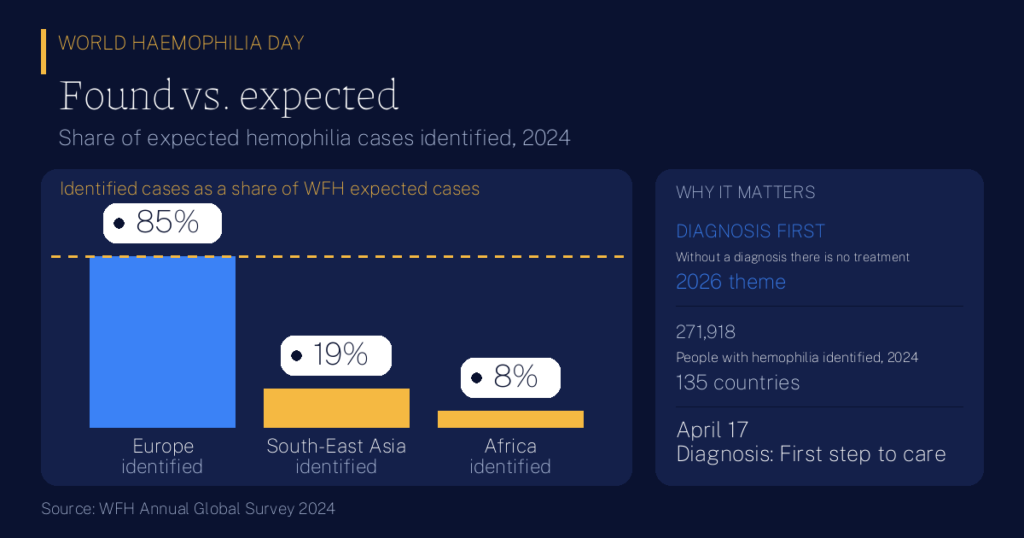
The WFH estimates that over three-quarters of people with hemophilia worldwide are undiagnosed, and that the gap is even larger for other bleeding disorders. The regional picture in the figure above shows how uneven that is. Using the WFH’s own estimate of 20.9 cases per 100,000 males, Europe has identified about 85 percent of the people expected, while Africa has identified about 8 percent. The WFH says the gaps are larger still for von Willebrand disease, for rare bleeding disorders, and for women and girls, whose symptoms are more easily missed. The report also states that the expected worldwide number of people with hemophilia is 850,000, which is why the WFH describes hundreds of thousands of people as lacking access to basic care.
Example 1: a region’s missing patients. Suppose a region has 10 million males. At 20.9 per 100,000, about 2,090 would be expected to have hemophilia. If only 8 percent were identified, about 170 would have a diagnosis, and roughly 1,900 would be living without a name for their condition. The numbers are round and illustrative, but they show why diagnosis comes before everything else.
Example 2: how it runs in a family. Take a mother who is a carrier of hemophilia A and a father without the condition. By standard X-linked inheritance, each son has a 1 in 2 chance of having hemophilia, and each daughter has a 1 in 2 chance of being a carrier. With four children, two sons and two daughters, the family would on average expect one son with hemophilia and one carrier daughter. This is illustrative, since every pregnancy is its own 1 in 2 chance. It also shows why a diagnosis helps the whole family, and why about one third of babies diagnosed with no family history can still arise.
What good care looks like
According to the CDC, the standard treatment for both types is to replace the missing clotting factor. Giving infusions on a regular basis, called prophylaxis, can prevent most bleeding episodes. For hemophilia A there is also a non-factor product that stands in for factor VIII, and gene therapy is an option for hemophilia A and B. Some people, about 15 to 20 percent of those with inherited hemophilia A or B, develop an antibody to the treatment, which makes care harder and needs specialist teams.
- 271,918people with hemophilia identified worldwide, 2024
- 135countries reported data for 2024
- Over 75%of people with hemophilia are undiagnosed, per the WFH
- 175+landmarks lit red for the 2025 campaign
Supply is the second gap. The same survey reports average factor VIII use of 1.22 international units per person, per capita across the population, in 2024. The WFH reports that countries differ widely, and the median across reporting countries was well below the mean. Treatment that exists on paper is not the same as treatment that reaches a child in a rural clinic.
Example 3: why regular treatment matters. Suppose a boy with severe hemophilia has about 20 joint bleeds a year and misses a week of school after each one. That is 20 weeks lost. If regular infusions prevent most of those bleeds, say 15 of 20, he loses 5 weeks instead, and his joints are spared repeated damage. The numbers are round and illustrative, but the CDC does state that prophylaxis can prevent most bleeding episodes.
What progress needs
The WFH sums up its vision as “Treatment for All.” WFH President Cesar Garrido puts the logic plainly: without diagnosis there is no treatment, and without treatment there is no progress. In practice that means trained laboratories that can test clotting factors, trained clinicians who think of a bleeding disorder, systems that register patients, and a steady supply of treatment. It also means paying attention to the people who are overlooked, especially women and girls and people with von Willebrand disease or rare bleeding disorders.
If you or someone in your family bruises easily, bleeds for a long time after small injuries, or has a relative with a known bleeding disorder, talk to a doctor. Specialized hemophilia treatment centers and national patient organizations can guide families through testing and care.
- 2022Access for All: Partnership. Policy. Progress
- 2026Diagnosis: First step to care
Key Takeaways
- Hemophilia is a clotting disorder. People with hemophilia A or B have low levels of factor VIII or factor IX, so bleeding does not stop as it should.
- It is inherited through the X chromosome. It mostly affects males, though females can be affected or be carriers.
- The count is far from complete. 271,918 people were identified in 2024, while the WFH estimates over three-quarters are undiagnosed.
- Where you live decides whether you are found. About 85 percent of expected cases are identified in Europe and about 8 percent in Africa.
- Treatment works when it arrives. Factor replacement and regular infusions can prevent most bleeding episodes.
- Other bleeding disorders and women are often missed. The WFH says diagnosis gaps are larger for them.
- Diagnosis comes first. That is the 2026 message, and it is why the world lights landmarks red on April 17.
How solid is this? Counts come from national reports collected by the WFH, cover only people who have been identified, and change each year. Expected cases are modeled estimates, and the report’s regional totals do not exactly match its stated worldwide estimate of 850,000. The worked examples use round, made-up numbers to show an idea. This article is for general information and is not medical advice. See also the International Days hub and the International Days Calendar.
More in Health
- World Federation of Hemophilia. World Hemophilia Day 2026 press release: Diagnosis: First step to care (2025).
- World Federation of Hemophilia. Report on the Annual Global Survey 2024 (October 2025).
- World Federation of Hemophilia. World Hemophilia Day 2026 theme revealed.
- World Federation of Hemophilia. Everything you need for World Hemophilia Day 2026.
- U.S. Centers for Disease Control and Prevention. About Hemophilia (March 2025).
- U.S. Centers for Disease Control and Prevention. How Hemophilia Is Inherited (May 2024).