Vaccines are the rare medical tool that works best when nothing happens. A child who is protected never falls ill, and the disease she avoided leaves no record. World Immunization Week, observed every year from April 24 to 30 and led by the World Health Organization (WHO), exists to make that invisible success visible and to ask a harder question: who is still being missed? Its 2026 theme is “For every generation, vaccines work.” This article follows the evidence, from what immunization has achieved to where coverage stands today and why millions of children still go without. For the wider global health agenda, see World Health Day.
Half a century of protection
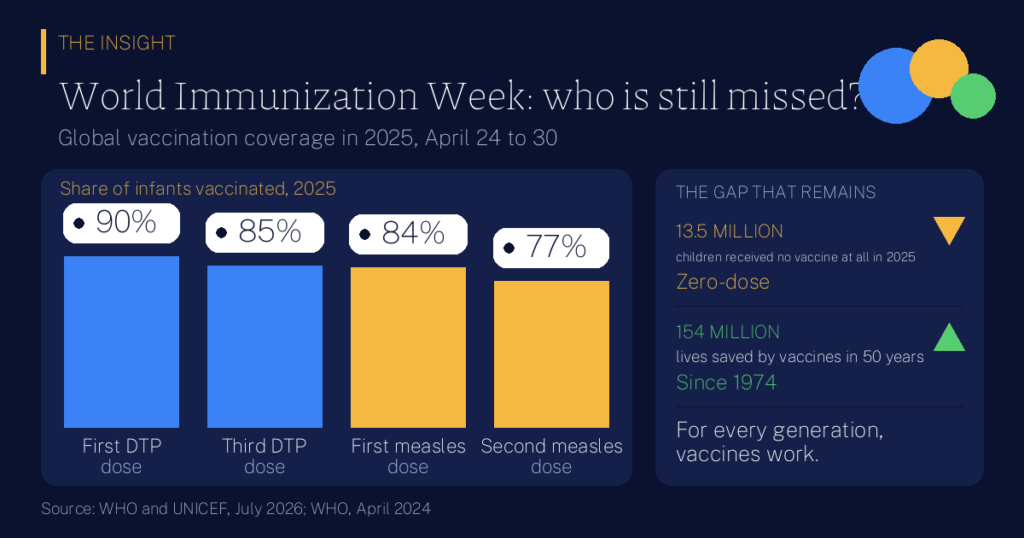
The story starts in 1974, when the World Health Assembly founded the Expanded Programme on Immunization. At that time, fewer than 5 percent of infants worldwide received routine immunization. Fifty years later, a study published in The Lancet and reported by WHO in April 2024 estimated that vaccination saved at least 154 million lives between 1974 and 2024. That is the equivalent of 6 lives every minute, for 50 years.
Most of those lives were very young. About 101 million were infants. The measles vaccine alone accounted for 60 percent of the total, nearly 94 million lives. The researchers, who looked at 14 diseases, also estimated that infant deaths fell by 40 percent globally and by more than 50 percent in the WHO African Region. Behind those totals is ordinary, repetitive work: nurses, community health workers, cold storage and supply chains that deliver the same small doses year after year.
Example 1: what 6 a minute adds up to. If vaccines save 6 lives every minute, simple arithmetic gives 360 an hour and 8,640 a day. The multiplication is illustrative, but it shows why a program that rarely makes headlines ranks among the most successful health efforts in history.
What “coverage” actually measures
Health officials track a few standard indicators. DTP1 is the share of infants who receive a first dose of the diphtheria, tetanus and pertussis vaccine, a rough measure of whether a child reached the health system at all. DTP3 is the share who complete the three-dose series. MCV1 and MCV2 count the first and second doses of the measles vaccine. A child is called zero-dose if she has never received a single dose of any vaccine.
The gaps between these numbers tell a story. A child who gets a first dose and then disappears from the clinic is a drop-out, not a zero-dose child, but both leave a community exposed. Good programs watch both.
The numbers behind the week
The latest WHO and UNICEF estimates, released in July 2026 and covering 185 countries, describe 2025. Global DTP1 coverage reached 90 percent, about 116 million infants. DTP3 stood at 85 percent, or 110 million. An estimated 13.5 million children were zero-dose, nearly 750,000 fewer than the previous year. And 7.3 million infants who received a first DTP dose dropped out before their first measles dose.
- 13.5 millionzero-dose children in 2025
- 7.3 millioninfants dropped out between DTP1 and measles
- 100countries kept DTP3 at 90% or more since 2019
- 31%of eligible girls had a first HPV dose in 2024, up from 17% in 2019
Two cautions apply. These are modeled estimates, and WHO notes they are revised each year, so a figure should not be compared with numbers in older reports. Data quality is also a concern: only 18 national immunization surveys were submitted in the latest round, down from 50 the year before.
The 2026 campaign page adds two framing facts. Vaccines now prevent more than 30 life-threatening diseases, and 20 million children missed at least one vaccine dose in 2024. In that same year, an estimated 14.3 million infants received no vaccine at all through routine immunization. Progress, in other words, is real, and so is the unfinished work.
Example 2: the 15 percent. Picture a region with 10,000 infants in a birth year. At 85 percent DTP3 coverage, 8,500 finish the series and 1,500 do not. Those 1,500 are not spread evenly. They tend to cluster in the same hard-to-reach villages and neighborhoods, which is where outbreaks take hold. The figures are round and illustrative.
Measles: the warning light
Measles shows what happens when coverage slips, because immunity gaps are quickly exposed. WHO estimated about 11 million infections and 95,000 deaths in 2024, most of them children under 5. The infection count was nearly 800,000 higher than in 2019. There is good news inside the bad: measles deaths fell 88 percent between 2000 and 2024, and nearly 59 million lives have been saved by the measles vaccine since 2000. In 2025, 57 countries reported large or disruptive outbreaks.
Reaching the children who are missed
The missed children are not random. In 2025, Sudan raised its DTP1 coverage by 35 percentage points, a sign of what recovery can look like, while South Africa’s DTP1 fell 20 points since 2019. Conflict, weak health systems and hesitancy all play a part, and WHO and UNICEF named conflict and hesitancy in the title of their latest release.
One answer has been the Big Catch-Up, launched during World Immunization Week 2023. By the end of implementation on March 31, 2026, it had delivered over 100 million vaccine doses to an estimated 18.3 million children aged 1 to 5 in 36 countries. Of those children, 12.3 million were zero-dose and 15 million had never received a measles vaccine. The 36 countries account for 60 percent of all zero-dose children worldwide.
Example 3: one catch-up day. Suppose a health worker visits a village and finds 200 children aged 1 to 5 whose records are incomplete. Of them, 120 have never had any vaccine, and 150 have never had measles protection. One visit with several vaccines, plus a note of when to return, can close most of that gap in a day. The numbers are made up for illustration, but the approach mirrors what the Big Catch-Up did at scale.
How the week is marked
Each year WHO and its partners use the week to call for renewed effort so that everyone, everywhere, can reach lifesaving vaccines through trusted health services that meet people’s needs. The 2026 campaign stresses building trust, sharing accurate information and strengthening confidence, under the hashtags #VaccinesWork and #WorldImmunizationWeek. The most practical step is personal: check that your own and your children’s vaccination records are up to date, and ask your health provider about any dose you are unsure of.
Key Takeaways
- Vaccines have saved an estimated 154 million lives. That is about 6 every minute over 50 years, mostly infants.
- Coverage is high but incomplete. In 2025, 90 percent of infants received a first DTP dose and 85 percent finished the series.
- Millions still get nothing. An estimated 13.5 million children were zero-dose in 2025, and 7.3 million dropped out before measles vaccination.
- Measles reveals the gaps first. About 11 million infections and 95,000 deaths occurred in 2024, even as deaths fell 88 percent since 2000.
- Catch-up works. The Big Catch-Up delivered over 100 million doses to 18.3 million children in 36 countries.
- Trust and records matter. Keeping vaccination cards current protects you, your family and your community.
How solid is this? Coverage and measles figures are modeled estimates from WHO and UNICEF and are revised each year, so compare them only within the same release. Lives-saved figures come from a 2024 modeling study. The three worked examples use round, made-up numbers. See also the International Days hub and the International Days Calendar.
More in Health
- World Health Organization. World Immunization Week 2026.
- WHO. Global immunization efforts have saved at least 154 million lives over the past 50 years (24 April 2024).
- WHO and UNICEF. Global childhood immunization coverage inches forward despite conflict and hesitancy (15 July 2026).
- WHO and UNICEF. Global childhood vaccination coverage holds steady, yet over 14 million infants remain unvaccinated (15 July 2025).
- WHO. Measles deaths down 88% since 2000, but cases surge (28 November 2025).
- WHO. Largest catch-up initiative delivers over 100 million childhood vaccinations (24 April 2026).