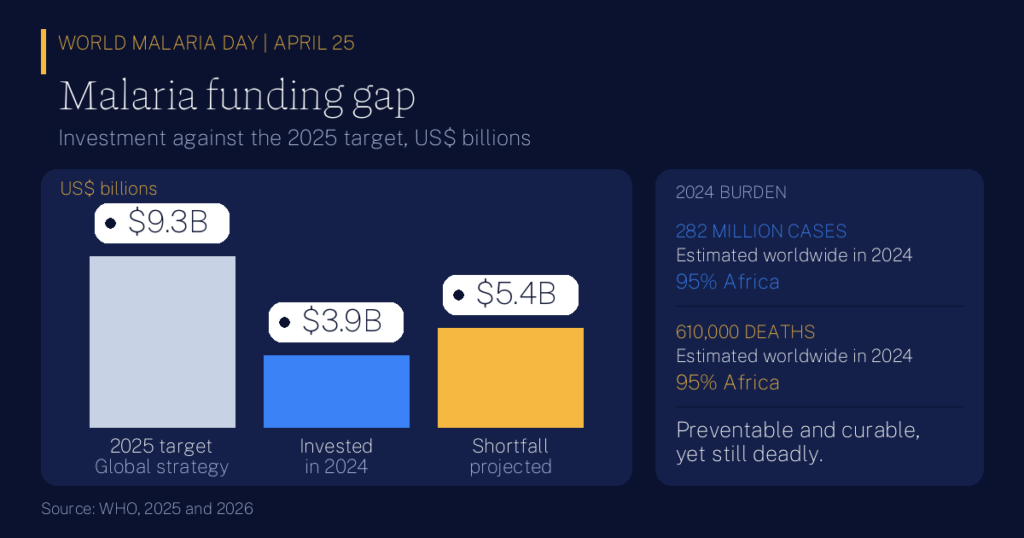
Malaria is preventable and curable, and yet in 2024 it still caused an estimated 610,000 deaths. That gap between what we know how to do and what actually happens is the reason World Malaria Day exists. Observed every April 25, it asks governments, scientists, health workers and ordinary families to look at one of the oldest diseases in human history and to finish the job. The story is not only grim. New tools are saving lives at a scale that was unimaginable a generation ago, which is exactly why the stakes of falling short are so high.
How the day began
World Malaria Day was instituted by WHO Member States during the World Health Assembly of 2007. The purpose was to give the world one date each year to focus attention, funding and political will on a disease that burdens some of the poorest places on Earth. WHO leads the observance, and each year it picks a theme that reflects the moment. Past themes track the arc of the fight: “Invest in the future. Defeat malaria” in 2013 and 2014, “Zero malaria starts with me” in 2019 and 2020, and “Malaria Ends with Us: Reinvest, Reimagine, Reignite” in 2025. The 2026 theme is “Driven to End Malaria: Now We Can. Now We Must.”
What malaria is and how it spreads
Malaria is caused by Plasmodium parasites, which people catch from the bite of an infected female Anopheles mosquito. It is not passed from person to person like a cold. The parasites multiply in the body and cause fever, chills and headache, and untreated illness can turn severe, especially in young children. Because the mosquito is the carrier, the strategy has two sides: stop the bites with nets and other vector control, and find and treat infections quickly with accurate tests and effective medicine. Everything in this article fits into one of those two jobs.
The numbers behind the day
WHO estimates that in 2024 there were 282 million malaria cases and 610,000 deaths in 80 countries. That was about 9 million more cases than the year before, an increase of about 3 percent, and deaths rose slightly from 598,000 in 2023. The burden is concentrated. About 95 percent of cases, 265 million, and about 95 percent of deaths, 579,000, were in the WHO African Region, and roughly three in four deaths in that region were children under 5.
- 282 millionestimated cases in 2024
- 610,000estimated deaths in 2024
- 47 + 1countries and one territory certified malaria-free
- 25countries rolling out malaria vaccines
Example 1: what a rate means. WHO gives the 2024 global death rate as 13.8 per 100,000 people, more than three times the global target of 4.5. Picture a district of 500,000 people. At 13.8 per 100,000 it would lose about 69 people a year. At the target rate it would lose about 22. The population is made up for illustration, but the gap, roughly 47 lives a year in a single district, shows what the target means in practice.
Tools that changed the odds
Since 2000, an estimated 2.3 billion malaria cases and 14 million deaths have been averted. In 2024 alone, WHO says new tools, including dual-ingredient bed nets and vaccines, helped prevent an estimated 170 million cases and 1 million deaths. Next-generation nets now make up 84 percent of all new nets distributed. Vaccines are the newest layer. WHO recommended the RTS,S vaccine in October 2021 and the R21/Matrix-M vaccine in October 2023, and 25 countries are now rolling them out to protect 10 million children a year. Vaccines work alongside nets, testing and treatment rather than replacing them, much as described in our piece on World Immunization Week.
Elimination is the long-term proof that the work pays off. WHO counts 47 countries and 1 territory certified malaria-free, and 37 countries reported fewer than 1,000 cases in 2024. Cabo Verde and Egypt were certified in 2024, and Georgia, Suriname and Timor-Leste in 2025. The 2030 goals are to cut case incidence and mortality by at least 90 percent and to eliminate malaria in at least 35 countries.
New threats, new answers
Progress is under pressure from the parasite and the mosquito themselves. Partial resistance to artemisinin, the backbone of modern treatment, is confirmed in Eritrea, Rwanda, Uganda and the United Republic of Tanzania, and WHO says resistance to antimalarial drugs is confirmed or suspected in at least 8 African countries. Pyrethroid resistance, which weakens traditional nets, is confirmed in 48 of 53 reporting countries. Some parasites have also lost the gene that standard rapid tests look for. These deletions have been reported in 46 endemic countries, and in the Horn of Africa up to 80 percent of cases were missed by tests that rely on that protein.
Example 2: a missed test. WHO recommends switching to alternative tests when more than 5 percent of cases are missed because of these gene deletions. Suppose a clinic sees 200 true malaria cases in a month. At the 5 percent line, about 10 patients leave untreated and still infectious. If the test misses 40 percent of cases, which is far below the worst figure WHO cites but still alarming, 80 patients are missed. The clinic is invented, and the numbers are round, but they show why better tests matter.
Science is answering. In April 2026 WHO prequalified three new rapid tests that look for a different protein, and it prequalified artemether-lumefantrine, the first malaria treatment designed for newborns and young infants weighing 2 to 5 kilograms. About 30 million babies are born each year in malaria-endemic areas of Africa, so the youngest patients finally have a medicine made for them.
The money question
Tools only work when they reach people. WHO reports that US$3.9 billion was invested in malaria in 2024, less than half of the US$9.3 billion target for 2025 in the Global technical strategy. The 2026 World Malaria Day page cites a projected shortfall of US$5.4 billion.
Example 3: the funding share. Scale the numbers down by a factor of one billion. A family that needs $9.30 a week for food but has only $3.90 is covering about 42 cents of every dollar of need. The figures are illustrative, but that is the proportion the world is funding, and it is why the day keeps returning to the words reinvest and reignite.
How the day is marked
Each April, ministries of health, national malaria programs, WHO regional offices and community groups hold events, launch campaigns and publish new data. Typical activities include net distribution drives, vaccination launches, school lessons and awareness messages that urge anyone with fever in a malaria area to get tested promptly. You can take part by sharing accurate information, supporting groups that deliver nets and care, or asking how your own government funds global health.
- 2013Invest in the future. Defeat malaria.
- 2016End Malaria for good
- 2019Zero malaria starts with me
- 2023Time to deliver zero malaria: invest, innovate, implement.
- 2025Malaria Ends with Us: Reinvest, Reimagine, Reignite
- 2026Driven to End Malaria: Now We Can. Now We Must.
Key Takeaways
- Malaria is preventable and curable. Even so, WHO estimates 610,000 people died of it in 2024.
- The burden is concentrated. About 95 percent of cases and deaths are in the WHO African Region, with children under 5 hit hardest.
- The tools are working. New nets and vaccines helped prevent an estimated 1 million deaths in 2024.
- Elimination is real. 47 countries and 1 territory are certified malaria-free, with five more certifications in 2024 and 2025.
- Resistance is the new front. Drug, insecticide and test resistance can undo gains if they are not tracked and answered.
- Money is the bottleneck. US$3.9 billion was invested in 2024 against a US$9.3 billion target.
- The newest babies now have a medicine. A treatment designed for newborns was prequalified in April 2026.
How solid is this? Case and death totals are modeled WHO estimates for 2024 and are revised with each World malaria report. WHO pages differ slightly on a few secondary figures, so this article uses only numbers that agree across sources. The rest of the world figures in the first chart are simple differences. The three worked examples use round, made-up numbers to show an idea. See also the International Days hub and the International Days Calendar.
More in Health
- WHO, Malaria fact sheet (updated December 2025)
- WHO, New tools saved a million lives from malaria last year but progress under threat as drug resistance rises (December 4, 2025)
- WHO, World malaria report 2025
- WHO, World Malaria Day
- WHO, World Malaria Day 2026
- WHO, WHO prequalifies first-ever malaria treatment for newborns and infants, adds new diagnostic tests (April 24, 2026)
- UN News, Malaria: Drug resistance and underfunding threaten progress (December 2025)