On the longest day of the year in the Northern Hemisphere, streets in many countries fill with sound that nobody has to pay to hear. A teenager plays a borrowed guitar on a corner, a choir sings on a church step, a brass band marches past a market. This is World Music Day, known in France, where it began, as the Fête de la Musique, and held every year on June 21. Unlike many days in this series, it was not born from a United Nations resolution. It was born from a government ministry with a simple and slightly radical idea: music should be everywhere, and anyone should be able to make it. Its spirit is cousin to International Jazz Day, but it is local, free and proudly amateur.
A minister, a motto and a survey
The story starts in October 1981, when Jack Lang, then France’s Minister of Culture, appointed Maurice Fleuret as director of music and dance. Fleuret’s motto was that music would be everywhere and the concert nowhere. Around that time, a Ministry of Culture survey found that about five million people in France, including one young person in two, played an instrument. The music already existed, in bedrooms, garages and kitchens. It simply was not on any stage.
Lang, Fleuret and Christian Dupavillon, an architect and stage designer in Lang’s office, imagined a large popular event that would bring that hidden music outdoors. The first Fête de la Musique took place on June 21, 1982, the day of the summer solstice. The rules were generous. The day would be free, open to every kind of music without a ranking of genres or practices, and open to professionals and amateurs alike. That openness is still the heart of the idea.
- 1981Maurice Fleuret becomes director of music and dance
- 1982First Fête de la Musique, June 21
- 1985The idea begins to travel, in the European Year of Music
- 1997A European charter for the Fête is signed in Budapest
- 2017More than 120 countries take part
What the name does and does not mean
Be careful with the label. World Music Day is an informal name for the way the French idea spread. The sources reviewed for this article describe the Fête as created by the French Ministry of Culture, not by a United Nations resolution, and we found no official UN designation for the day. Places use their own names. In the United States it is called Make Music Day, and its organizers reported people celebrating in dozens of countries and 105 American cities in 2022.
From one country to more than 120
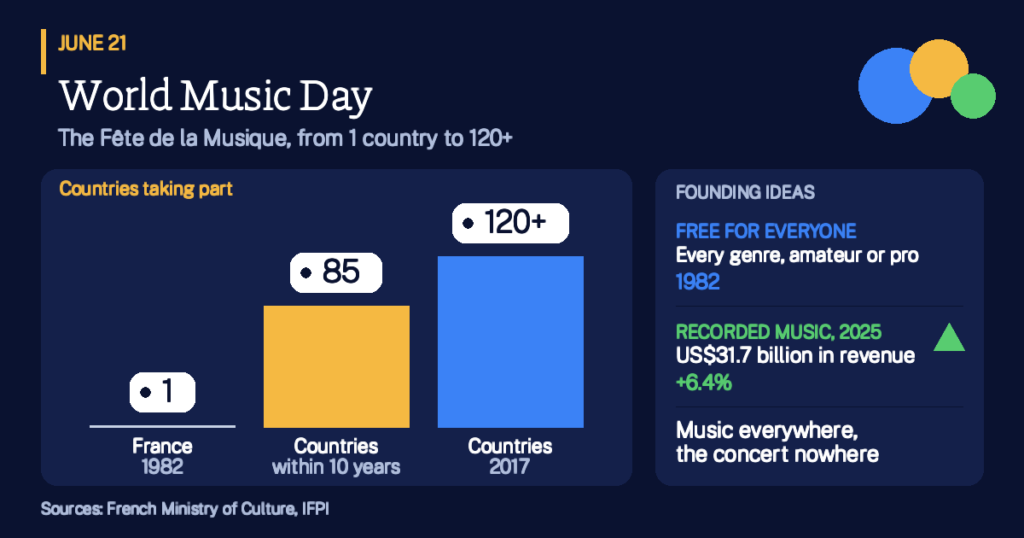
The idea traveled fast. It began to export itself in 1985, during the European Year of Music. According to the French Ministry of Culture, within less than ten years it had been taken up in 85 countries on five continents, and in 2017 more than 120 countries took part. In 1997 a charter for a European Fête de la Musique was signed in Budapest. The reason it spreads so easily is that it costs so little to adopt. It needs no central stage, no ticket office and no star. It needs people willing to play and neighbors willing to listen.
Example 1: one town, one afternoon. Imagine a small town where 10 amateur groups each play three 30-minute sets in public squares. That is 30 sets, or 15 hours of live music, with no ticket sold. The numbers are round and illustrative, but they show the point of the day: a lot of music appears when the barrier to entry disappears.
The economy behind the melody
The Fête celebrates music made for free, yet recorded music is a large industry. IFPI, the body that represents the recording industry, reported that global recorded music revenues grew 6.4 percent to US$31.7 billion in 2025, the eleventh year of growth in a row. Streaming brought in more than US$22 billion, or 69.6 percent of the total, and paid subscription streaming alone made up 52.4 percent. IFPI also counted 837 million paid streaming subscription accounts when it released the report in March 2026. Physical formats grew 8.0 percent in 2025, and vinyl rose 13.7 percent. These are industry trade figures, not what individual artists earn.
- US$31.7 billionglobal recorded music revenue, 2025
- 837 millionpaid streaming subscription accounts, March 2026 report
- 120+countries took part in the Fête, 2017
- 900+publications in a 2019 WHO Europe review of the arts and health
Example 2: a $100 slice. Suppose the industry’s recorded revenue were just $100. Using the 2025 shares, about $70 would come from streaming, of which roughly $52 would be paid subscriptions, and about $30 from everything else. The amounts are rounded and illustrative.
Why a song is more than entertainment
Public health bodies now take music seriously. In 2019 the World Health Organization’s Regional Office for Europe published a review of evidence from more than 900 publications on the arts and health, covering music, dance, singing, theater and film. As reported by UN News, it found that singing during pregnancy can strengthen mother-infant bonding, and that music chosen to inspire independence and self-empowerment helped people living with HIV stay on their treatment.
In 2023 WHO/Europe said that increasing evidence shows the arts can be an effective supplement to medical treatment and healing. Its examples included a choir in Hungary that forms part of rehabilitation for people recovering from respiratory illness. The word supplement matters. Music complements medicine; it does not replace it.
Example 3: a weekly choir. Picture a community choir of 20 people that meets once a week for 12 weeks. That is 240 attendances in a season, each one a reason to leave the house, breathe deeply and sing alongside others. The figures are round and illustrative, and they show why programs built on regular group singing are easy to organize and hard to replace.
Who is left out, and how to take part
A day built on public space and volunteers depends on things not everyone has: an instrument, a safe place to gather, free time and local permission. The 1982 survey suggests that musical skill is widespread. The missing ingredient is often a place to be heard, not talent. Ways to take part are modest: play or sing in a public place where it is allowed, join a community choir, attend a free local event, lend an instrument to someone who has none, or simply stop and listen. Check local rules about noise and public performance first.
Key Takeaways
- It began as a government idea with a human scale. France launched the Fête on June 21, 1982, so that music would be everywhere and the concert nowhere.
- Free and open is the rule. No ticket, no ranking of genres, and room for professionals and amateurs alike.
- It is not a UN day. We found no UN designation; the day is a French invention that others adopted.
- It spread because it is cheap to copy. More than 120 countries took part in 2017.
- Recorded music is big business. It earned US$31.7 billion in 2025, with streaming at 69.6 percent.
- Music supports health. WHO Europe describes the arts as an effective supplement to treatment, not a substitute.
How solid is this? History and spread figures come from the French Ministry of Culture and Make Music Day pages, and the 85-country figure carries no year in the source. Revenue figures are industry trade estimates from IFPI for 2025. The health findings are from WHO Europe reviews as summarized by UN News and WHO. The three worked examples use round, made-up numbers to show an idea. See also the International Days hub and the International Days Calendar.
More in Society