Most of us meet a pharmacist the same way: briefly, across a counter, with a question about a medicine. That small moment carries large stakes. Medicines cure infections, steady the heart and ease pain, yet used wrongly they can harm. World Pharmacists Day, observed every year on September 25, honors the professionals who stand at that point of risk and help people get the benefit without the harm. Unlike many days in this series, it is not a United Nations day. It is an awareness day led by the profession’s own global body, and it connects naturally to the global fight against antimicrobial resistance.
How the day began
The story starts in 1910, when the Dutch Society of Pharmacy proposed an international federation at the tenth International Congress of Pharmacy in Brussels. On September 25, 1912, the International Pharmaceutical Federation (FIP) was formally constituted under Dutch law. Nearly a century later, in 2009, the FIP Council meeting in Istanbul, Turkey, designated September 25 as World Pharmacists Day. FIP’s materials do not explain the choice, but the date matches the day the federation was founded.
Who the profession is
FIP describes itself as representing more than 5.5 million pharmacists, pharmacy educators and pharmaceutical scientists around the world, through 159 member organizations, 228 academic institutional members, six observer organizations and more than 4,600 individual members. It reports a presence in 157 countries and territories. FIP does not date these figures on its page, so read them as current self-reported totals, not audited headcounts. The 2026 edition used the theme “Empowering pharmacists for healthier futures,” and FIP reports that colleagues from at least 159 countries and territories took part. An earlier campaign, in 2018, put the point more simply: “Pharmacists: Your medicines experts.”
That phrase is the key to the day. A pharmacist is trained in what medicines do inside the body, how they interact, and how to use them safely. Dispensing is the visible part. The less visible part is checking, advising and catching problems before they reach the patient.
Why medicines need guardians
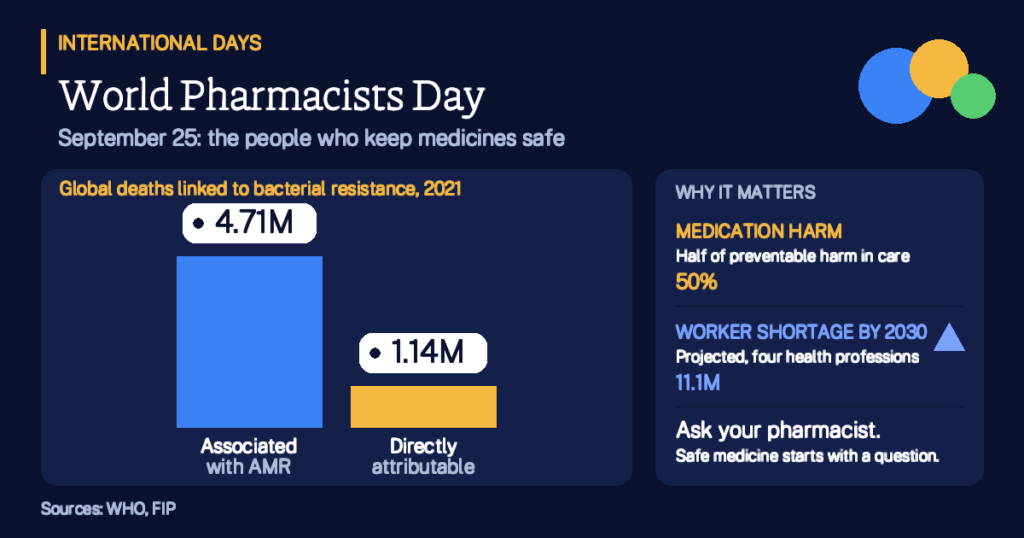
The World Health Organization (WHO) treats medication safety as a global priority. In 2017, at the Second Global Ministerial Patient Safety Summit in Bonn, Germany, it launched the Global Patient Safety Challenge, Medication Without Harm. Its aim is to reduce severe avoidable medication-related harm by 50 percent worldwide. WHO’s 2022 statement on the challenge says half of all preventable harm in medical care is medication related, and that a quarter of that harm is severe or life-threatening. WHO also says more than half of medication harm occurs when medicines are prescribed and when patients take them, because of inadequate monitoring. WHO estimates the global cost associated with medication errors at US$42 billion a year, though its pages give no year for that estimate.
Example 1: the duplicate pills. Imagine an 80-year-old who sees three doctors and takes eight medicines. Two of them turn out to be the same drug under different brand names. A pharmacist reviewing the full list spots the overlap and calls the prescriber, and the patient avoids a double dose. The numbers are round and illustrative, but this kind of review is exactly where a second trained pair of eyes pays off.
The antibiotic front line
Antimicrobial resistance, or AMR, happens when germs evolve so that medicines no longer kill them. WHO reports that bacterial AMR was associated with 4.71 million deaths worldwide in 2021, and that 1.14 million of those deaths were directly attributable to resistance. It also reports that about 1 in 6 laboratory-confirmed bacterial infections worldwide was resistant to antibiotics in 2023, based on its GLASS surveillance, which covered more than 23 million infections from over 100 countries. WHO supports countries in promoting appropriate use of antimicrobials. Because pharmacists handle antibiotics and advise patients on taking them, appropriate use is part of their daily work.
Example 2: the cold that needs no antibiotic. Suppose 100 people a week ask a pharmacy for antibiotics for coughs and colds, and 70 of them have a viral illness that antibiotics cannot treat. Explaining this, and suggesting rest, fluids or a doctor’s visit, keeps 70 unneeded courses from fueling resistance. The numbers are made up to show the idea, not measured data.
A workforce under pressure
Pharmacists are one of four professions in WHO’s 2026 national health workforce accounts, alongside doctors, nurses and midwives, and dentists. Together, their density rose from 44.8 per 10,000 people in 2006 to 67.9 in 2025, a rise of 52 percent. WHO still projects a global health worker shortage of 11.1 million by 2030 and says 67 countries will not have enough health workers to meet needs. These figures cover the four professions combined, not pharmacists alone. The 2026 report also found that nearly one in four doctors is over 55 and nearing retirement, a sign that health systems everywhere are stretched.
Example 3: one counter, one district. Imagine a district of 20,000 people with a single pharmacy that fills 100 prescriptions a day. If a careful check catches one problem in every 100 prescriptions, that is one avoided mistake a day, or about 300 in a year of 300 working days. Close that pharmacy and the district loses the check. The figures are round and illustrative.
How the day is marked
Each year FIP sets a theme and invites pharmacists, schools of pharmacy, patients and public bodies to join. Activities range from free blood pressure checks and medicine reviews to school talks and social media campaigns. You can take part simply: bring your medicines to a pharmacy and ask for a review, ask how to take a new prescription, and thank the person who explains it. The day is closely linked to universal health coverage, since a country cannot offer care for all without people trained to supply medicines safely.
Key Takeaways
- The day is the profession’s own. FIP’s Council in Istanbul designated September 25 in 2009, the date FIP was constituted in 1912.
- Medicines carry risk. WHO says half of preventable harm in care is medication related, and a quarter of that is severe or life-threatening.
- Safety needs checks. WHO’s Medication Without Harm challenge aims to cut severe avoidable harm by 50 percent.
- Resistance is a present danger. Bacterial AMR was linked to 4.71 million deaths in 2021, and 1.14 million were directly attributable.
- Antibiotic advice matters. Pharmacists help patients use these medicines only when needed and as directed.
- Workforce gaps are real. WHO projects a shortage of 11.1 million health workers by 2030.
- Ask your pharmacist. A short conversation about your medicines is one of the simplest safety steps available.
How solid is this? Pharmacy membership totals are self-reported by FIP and undated. The AMR figures are modeled estimates, the US$42 billion cost has no stated year, and the workforce figures cover four professions combined. The three worked examples use round, made-up numbers. See also the International Days hub and the International Days Calendar.
More in Health
- International Pharmaceutical Federation. World Pharmacists Day.
- International Pharmaceutical Federation. World Pharmacist Day (2018 news item).
- International Pharmaceutical Federation. Who we are.
- World Health Organization. Medication Without Harm.
- World Health Organization. WHO calls for urgent action by countries for achieving Medication Without Harm (16 September 2022).
- World Health Organization. Antimicrobial resistance.
- World Health Organization. One in four doctors nearing retirement age as WHO warns of global health workforce gap (2026).