Some crime announces itself. A great deal of the most damaging crime does the opposite: it moves quietly through banks, ports, parcels and phone screens, and it crosses borders faster than any single police force can follow. Every year on November 15, the United Nations asks the world to look at that hidden machinery. The date was chosen for a reason. It is the day in 2000 when the General Assembly adopted the treaty that still anchors the global response. The day is a close relative of the International Day against Illicit Trafficking in Cultural Property, which looks at one stolen slice of the same shadow economy.
A treaty first, then a day
On November 15, 2000, the General Assembly adopted the United Nations Convention against Transnational Organized Crime, known by its acronym UNTOC. It entered into force on September 29, 2003, the ninetieth day after the fortieth country deposited its instrument of ratification, acceptance, approval or accession. Three protocols add detail on human trafficking, migrant smuggling and firearms trafficking. By 2020 the Convention had 190 parties, which UNODC describes as one of the most widely ratified United Nations treaties.
The day itself is newer. Through resolution 78/267, adopted on March 21, 2024, the General Assembly decided to observe November 15 as the International Day for the Prevention of and Fight against All Forms of Transnational Organized Crime. UNODC says the day aims to raise awareness of the threats posed by transnational organized crime and to enhance international cooperation. Its background page also pays tribute to Judge Giovanni Falcone, whose sacrifice, it says, paved the way for the adoption of the Convention. In 2025, UNODC marked the day in Vienna with the 25th anniversary of the Convention, and the presidents of Austria and Italy joined its call for renewed global solidarity.
What transnational organized crime means
Organized crime is not just a gang. In plain terms, it describes groups that organize themselves to earn money or power from serious crimes, over time, and often across several countries. The word transnational is the key. A criminal network may grow a crop in one country, process it in another, move the money through a third and sell the product in a fourth. Each police force sees only its own piece. That is why a treaty matters: it gives countries a common language and shared tools so the pieces can be put back together.
UNODC’s background page for the day quotes a blunt theme, “Follow the money. Stop organized crime,” and notes that these crimes generate billions in illicit proceeds each year. Profit is the engine. Take away the profit and the business loses its reason to exist.
Example 1: following the money. Imagine a network that earns $1,000,000 in a year. Police seize one shipment worth $50,000, and the network treats it as a small cost of business. If investigators instead trace and freeze $600,000 held in accounts and property, the network loses the working capital it needs to buy its next shipment. The numbers are round and illustrative, but they show why the day’s message aims at money and not only at goods.
The numbers behind the drug trade
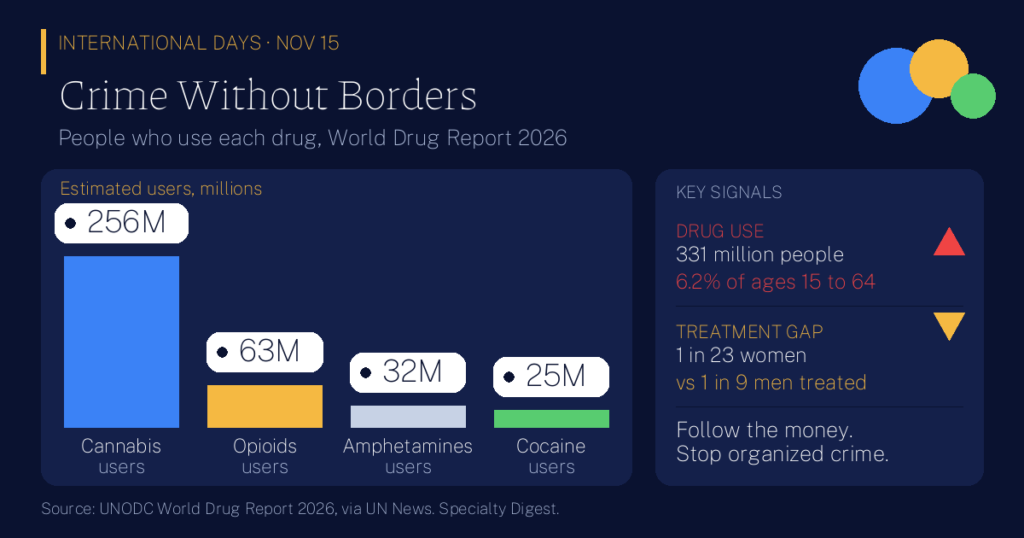
Drugs are the trade most people think of first, and the World Drug Report 2026, published in June 2026, gives the scale. An estimated 331 million people used drugs in 2024, equal to 6.2 percent of the world’s population aged 15 to 64, up from 5.2 percent a decade earlier. Cannabis is by far the most widely used drug, followed by opioids, amphetamines, cocaine and ecstasy. The groups overlap, because some people use more than one drug.
The supply side keeps changing. In 2024, authorities identified 755 new psychoactive substances, including 118 reported for the first time. The report says methamphetamine seizures have grown by an average of 13 percent each year, and that opium production in Myanmar rose from 420 tonnes in 2021 to more than 1,000 tonnes in 2025.
People are not cargo
Two of the Convention’s protocols deal with people. Human trafficking is exploitation: victims are recruited, moved or held through force, fraud or abuse of their vulnerability, and made to work or serve for someone else’s gain. Migrant smuggling is a different crime, the arranging of illegal border crossings for profit, though it can be dangerous in its own right. A third protocol, in force since July 3, 2005, targets the illicit trade in firearms.
UNODC’s Global Report on Trafficking in Persons, released in December 2024, was announced under the headline that detected victims were up 25 percent, with more children exploited and forced labor cases spiking. UN News reported that poverty, conflict and climate fuel the spike. Detected means found by authorities, so the true number is certainly higher. Behind each statistic is a person whose freedom was taken for someone else’s profit. Anyone who suspects trafficking should contact local emergency services or a national anti-trafficking hotline rather than intervene alone.
Example 2: three countries, one picture. Country A sees a shipment leave a port, Country B sees a bank transfer, and Country C finds a warehouse. Each agency holds one third of the picture. Through the shared legal channels the Convention created, they can match the pieces. The scenario is invented, but it shows the idea behind the treaty.
Who is left behind
Harm lands unevenly, and so does help. The 2026 drug report says only one in 23 women with drug use disorders receives treatment, compared with one in nine men. Communities already strained by poverty, conflict or weak institutions are the easiest targets for recruiters, traffickers and suppliers.
Example 3: the treatment gap. Suppose a district has 2,300 women and 900 men with drug use disorders. At the reported rates of one in 23 and one in nine, treatment reaches 100 women and 100 men. There are about two and a half times as many women in need, yet they receive the same number of places. The counts are round and illustrative, but they show how a ratio becomes a real gap.
Why cooperation matters
At the 2025 event, UNODC Executive Director Ghada Waly said, “Organized crime is more connected, more sophisticated, more profitable, and more dangerous than ever before,” and urged that “we must breathe new life into the UNTOC.” The Convention also set up a way to check itself. UNODC’s 2020 anniversary publication describes a review mechanism as recently established, with its review process due to launch in October 2020.
What you can do
Learn the signs of trafficking and exploitation, read reputable reporting rather than rumor, and support local anti-trafficking and drug treatment services. If you or someone you know needs help with drug use, local health services are the place to start.
Key Takeaways
- The day is a treaty anniversary. November 15 marks the 2000 adoption of the Convention, and resolution 78/267 made it a UN day in 2024.
- Transnational is the key word. Networks use borders to hide, so countries need shared rules.
- Money is the target. UNODC’s message is to follow the money.
- The drug picture is growing. An estimated 331 million people used drugs in 2024, 6.2 percent of ages 15 to 64.
- People are not goods. UNODC reported detected trafficking victims up 25 percent, and the true number is higher.
- Help is unequal. Only one in 23 women with drug use disorders gets treatment, against one in nine men.
How solid is this? Dates and the resolution come from UNODC and UN documents. The drug figures are UNODC estimates from the World Drug Report 2026 as reported by UN News, and they overlap. The party count of 190 is from 2020. The three worked examples use round, made-up numbers. See also the International Days hub and the International Days Calendar.
More in Society
- UN General Assembly. International Day for the Prevention of and Fight against All Forms of Transnational Organized Crime, resolution 78/267 (March 21, 2024).
- UNODC. International Day against Transnational Organized Crime: background.
- UNODC. Presidents of Austria, Italy join UNODC in calling for renewed global solidarity against transnational organized crime (November 2025).
- UNODC. The United Nations Convention against Transnational Organized Crime at 20 (2020).
- UN News. Global drug use reaches record high as increasingly potent synthetic drugs spread (June 2026), on the UNODC World Drug Report 2026.
- UNODC. Global Report on Trafficking in Persons 2024: detected victims up 25 per cent (December 2024).
- UN News. Poverty, conflict and climate fuel spike in trafficking victims: UN report (December 2024).