Every household makes waste, and most of us never see where it goes after the bin leaves the curb. The International Day of Zero Waste, observed every March 30, asks the world to look. It does not promise a planet with no rubbish. It sets a direction: stop waste at the source, keep materials in use for as long as possible, and handle what remains safely. The stakes are large, because waste touches climate, health, food and the cost of living all at once. It also connects to World Soil Day, since food scraps that return to the land as compost can feed the soil instead of ending up in a dump.
From a national idea to a UN day
The day has a short history. In 2022, Türkiye, together with 105 other member states, put forward a resolution at the United Nations General Assembly. It became resolution 77/161, which established March 30 as the International Day of Zero Waste. The day is jointly facilitated by the UN Environment Programme (UNEP) and the UN Human Settlements Programme (UN-Habitat), and it has been observed every year since 2023.
Each year carries its own emphasis. The second observance, in 2024, focused on waste management and sustainable production and consumption. In 2025 the theme was fashion and textiles. In 2026 the spotlight turned to food waste, which links food systems, climate action and sustainable development.
What zero waste actually means
Zero waste is a goal, not a claim that nothing will ever be thrown away. The idea is to design waste out in the first place, so that fewer resources are used and less is discarded. When something cannot be avoided, the next best step is to use it again, then to recycle it, and only last to burn it for energy or bury it. This ladder is often called the waste hierarchy, and it explains why the cleanest waste is the waste that never exists.
Example 1: the grocery bill. A family spends about $200 a month on groceries and throws away about one fifth of the food. That is roughly $40 a month, or $480 a year, spent on food nobody eats. Planning meals, storing food well and using leftovers could return much of that money. The numbers are round and illustrative.
The numbers behind the day
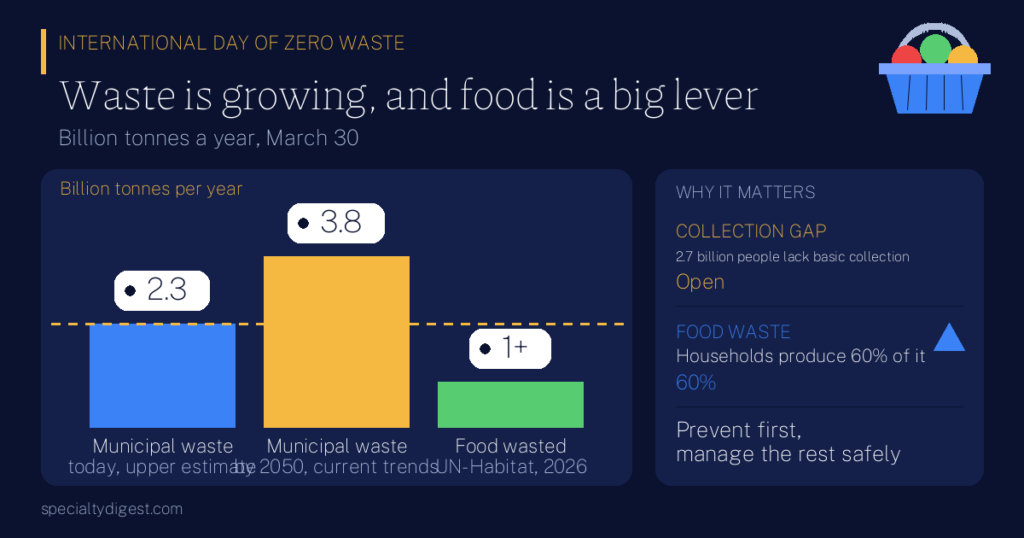
UNEP says humanity generates between 2.1 and 2.3 billion tonnes of municipal solid waste every year, and that the total could reach 3.8 billion tonnes by 2050 if current trends continue. Only around 60 percent of waste is managed in controlled facilities, which leaves a large share handled in ways that can pollute air, water and soil. An estimated 2.7 billion people lack access to basic solid waste collection. Waste management is also the third-largest source of methane emissions, and methane is a potent greenhouse gas.
- 2.7 billionpeople lack access to basic solid waste collection
- About 60%of waste is managed in controlled facilities
- 3rdlargest source of methane emissions is waste management
- $108.5 billionpossible annual net gain by 2050 from stronger waste management
That last figure matters. UNEP estimates that strengthening waste management could yield an annual net gain of $108.5 billion by 2050. Cleaner collection, fewer fires at open dumps, recovered materials and new jobs all count toward it. Zero waste is not only an environmental ideal. It is a plan that can pay for itself.
Example 2: a city’s compost program. Picture a city that collects 1,000 tonnes of waste a day, and suppose 40 percent of it is food and garden scraps. If the city composts half of those scraps, 200 tonnes a day stay out of the landfill, which is 73,000 tonnes a year, or a fifth of the city’s waste. These are round, made-up numbers, but they show how one program can shrink what a city buries while producing material that can restore soil.
Why 2026 looks at food
The 2026 observance put food waste in the spotlight. According to UN-Habitat, more than one billion tonnes of food are wasted, equal to 19 percent of the food available to consumers, and a further 13 percent is lost after harvest and before it reaches stores. Food loss and waste cost about $1 trillion a year and generate 8 to 10 percent of global greenhouse gas emissions. Food waste alone accounts for up to 14 percent of global methane emissions, which is why climate negotiators now discuss it alongside energy and transport.
Change is possible. UN-Habitat cites Japan, which reports a 53 percent reduction in total food loss and waste by 2022 compared with 2000, and the United Kingdom, which reports a 22 percent reduction in food waste since 2007. The global goal is to halve food waste by 2030, and doing so could cut methane emissions by up to 7 percent. A Food Waste Breakthrough was launched at COP30 in 2025 to speed up action.
Fashion, cities and the people who do the work
The 2025 theme was fashion and textiles. UNEP reports that the day that year reached more than 8 million people online, through more than 250 activities around the world. Textiles show how zero waste thinking reaches beyond the kitchen: the biggest saving often comes from wearing and repairing what already exists rather than recycling it later.
Example 3: the jacket. Say a jacket costs $60. Worn 30 times, it costs $2 per wear. Worn 60 times, thanks to a repaired zipper and a little care, it costs $1 per wear, and one fewer garment needs to be made and thrown away. The prices and wear counts are round and illustrative.
Cities carry much of the daily work. UN-Habitat’s 2026 observance highlighted cities and waste pickers, the workers who sort and recover materials, often informally, and it featured an initiative called 20 Cities Towards Zero Waste, linked to the Secretary-General’s Advisory Board on Zero Waste. A high-level event at United Nations Headquarters in New York brought together UNEP, UN-Habitat, Türkiye and the Zero Waste Foundation.
What progress needs
In his 2026 message, Secretary-General António Guterres said that consumers, retailers, cities and national governments each have a role, and he called for food waste to be addressed in climate and biodiversity plans. In practice that points to three kinds of action. Governments can set targets and build collection and treatment systems so that the 2.7 billion people without basic collection are reached. Businesses can design products that last and can be repaired. Households can plan meals, store food well, repair what they own and reuse what they can.
Key Takeaways
- Zero waste is a direction, not a promise. It aims to prevent waste first and manage the rest safely.
- The day is young but official. Resolution 77/161 created it, and the first observance was held on March 30, 2023.
- Waste is growing. UNEP says 2.1 to 2.3 billion tonnes a year could reach 3.8 billion tonnes by 2050.
- Many people are left out. About 2.7 billion lack basic collection, and only around 60 percent of waste is managed in controlled facilities.
- Food is a big lever. More than one billion tonnes are wasted, and households account for 60 percent of it.
- Progress has precedent. Japan reports a 53 percent cut in food loss and waste by 2022, and the United Kingdom a 22 percent cut since 2007.
- Start at home. Planning meals, repairing clothes and buying less all move the world toward zero waste.
How solid is this? Waste totals are estimates, and UNEP gives a range rather than a single figure. The food waste statistics are those cited by UN-Habitat on March 30, 2026, and the dollar and methane figures are modeled estimates. The three worked examples use round, made-up numbers to show an idea. See also World Soil Day, the International Days hub and the International Days Calendar.
More in Nature
- UN General Assembly. Resolution A/RES/77/161, International Day of Zero Waste (December 2022).
- UNEP. Zero Waste Day: History.
- UNEP. The Real Impact of Waste.
- UN-Habitat. Food waste in focus as the world marks the International Day of Zero Waste (March 30, 2026).
- UNEP. Unsustainable fashion and textiles in focus for International Day of Zero Waste 2025.