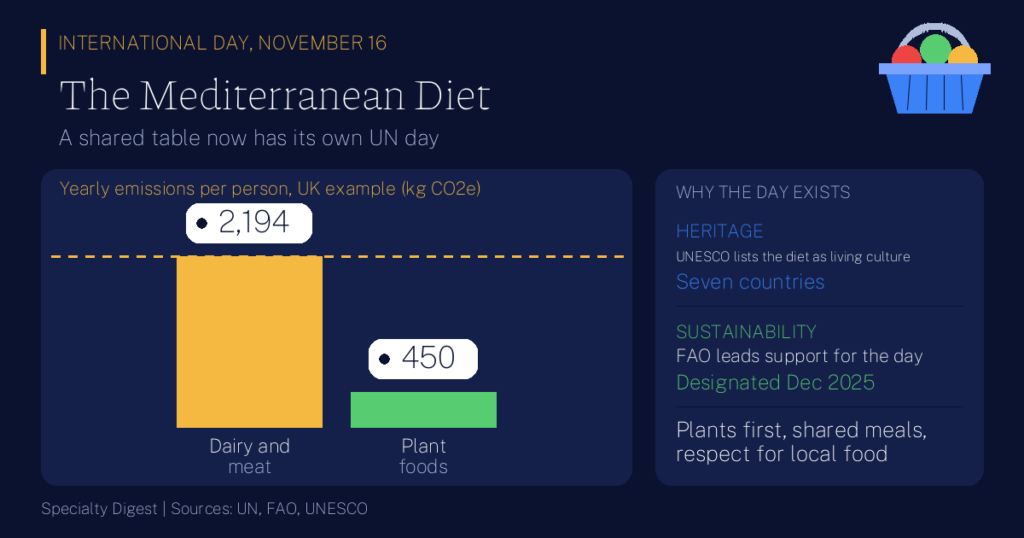
Some foods carry a culture with them. A shared table of bread, olive oil, beans, vegetables and fish is more than a list of ingredients: it is a way of cooking, farming, welcoming guests and passing knowledge from one generation to the next. The International Day of the Mediterranean Diet, set for November 16, is one of the newest days on the United Nations calendar, and 2026 is the first year it can be marked. Like the International Day for Tolerance, it celebrates what people share across borders, here through food.
How a menu became a United Nations day
The idea has two roots, one scientific and one cultural. On the science side, FAO notes that the American researcher Ancel Keys studied the link between diet and coronary heart disease in the 1960s, and the diet of Crete in the late 1960s is often used as the reference model. On the cultural side, UNESCO recognized the Mediterranean diet as intangible cultural heritage. An FAO publication reports that the first recognition came in November 2010 on nominations from Italy, Spain, Greece and Morocco, and UNESCO’s current record lists the 2013 inscription (decision 8.COM) with seven countries: Cyprus, Croatia, Spain, Greece, Italy, Morocco and Portugal.
The day itself came through FAO. The proposal was approved at the 44th session of the FAO Conference in 2025. Italy then presented a draft resolution for a core group of sponsors: Armenia, Croatia, Cyprus, France, Greece, Italy, Lebanon, Malta, Montenegro, Morocco, Portugal, San Marino, Spain and Tunisia. In December 2025 the General Assembly adopted draft resolution A/80/L.21, designating November 16 as the International Day of the Mediterranean Diet. FAO has the lead role in supporting the celebration, and the aim, in FAO’s words, is to foster awareness and appreciation of healthy diets, sustainability and territorial traditions.
What the term really means
There is no single official recipe. FAO describes core principles that stay the same across the region: fresh fruits and vegetables, whole grains, nuts, legumes and olive oil in the center, moderate amounts of seafood, poultry, dairy, meat and eggs, and limited sweets. Other FAO texts add olive oil in place of saturated fats and low red meat.
UNESCO stresses that the diet is a set of skills, knowledge, rituals, symbols and traditions. They cover crops, harvesting, fishing, animal husbandry, processing, cooking and, above all, the sharing and eating of food. Shared meals carry values of hospitality, neighborliness and respect for diversity. The record also credits women with passing on techniques and values, and describes markets as places where the tradition is practiced and handed down.
Example 1: a week of dinners. Imagine a family of four that cooks seven dinners a week and serves meat at six of them. If they move to meat at three dinners, with lentil stew, a vegetable tray with olive oil and a fish dish on the other nights, they have made a Mediterranean-style shift without a special ingredient. The numbers are round and illustrative, but they show that the pattern is a matter of proportion.
Heritage first, and honest about the evidence
Health is part of the story, but it helps to say who claims what. At a 2019 FAO event in Rome, FAO Director-General Qu Dongyu said traditional diets, including the Mediterranean, can lower cholesterol and help prevent heart disease and diabetes. That is the view of a UN official, and it fits the long line of research that began with Keys. The day, however, is built on awareness, sustainability and tradition, not on a medical promise.
The resolution was not without discussion. The General Assembly press release records that the text enjoyed consensus, while some delegates voiced concern about the proliferation of international days and about approaches that promote a single type of diet. Read in that light, the day is best understood as a celebration of a food culture and its values, not a rule for how everyone must eat.
Who can afford to eat well
A diet is only as good as the food people can reach. FAO’s 2026 regional overview for Europe and Central Asia, a region much wider than the Mediterranean, found that in 2024 about 59.6 million people could not afford a healthy diet, 3.1 million fewer than in 2023. It also reported that overweight among children under five reached 7.5 percent in 2024, above the global estimate of 5.5 percent, and that adult obesity rose from 16.7 percent in 2000 to 22.6 percent in 2022, against a global level of 15.8 percent.
Example 2: the price of the basket. Suppose a household spends $60 a week on food and swaps three meat dishes for beans and lentils that cost $8 less in total. Over a year that is about $400 saved, which could pay for olive oil, vegetables and fruit. The prices are made up for illustration, and real savings vary by place, but dried legumes are a classic budget protein.
A lighter footprint on the planet
FAO also treats the diet as a sustainability story. A chapter in an FAO book on sustainable diets, citing research through 2011, notes that a Mediterranean-type diet, built mainly on plant foods with a little meat, has a lower environmental effect than the average American diet. It also warns that rising meat consumption and industrialized food endanger the sustainability of food systems.
Example 3: a town at scale. Take a town of 10,000 people and apply the cited saving of about 590 kg of CO2 equivalent per person each year. The total would be roughly 5,900 tonnes a year. The town and the result are illustrative, since the study was for the United Kingdom and dietary savings differ everywhere.
How the day can be marked
The resolution does not prescribe a program, and FAO leads the support for celebrations. Natural ways to join in include a community meal built on seasonal produce, school cooking lessons, farmers markets, and local stories from the people who grow, fish and cook. The strongest observances honor the shared table, not a single menu.
- 7countries on UNESCO’s current record of the element
- 14states in the core group of sponsors named by FAO
- 59.6 millionpeople in Europe and Central Asia unable to afford a healthy diet, 2024
Key Takeaways
- It is a new day. The General Assembly designated November 16 in December 2025, so 2026 is the first year.
- Culture comes first. UNESCO describes skills, rituals and shared meals, not just ingredients.
- The pattern is plants first. Vegetables, fruit, legumes, nuts, whole grains and olive oil lead, with moderate animal foods.
- Health claims need attribution. FAO’s director-general links traditional diets to lower disease risk, while the day itself rests on tradition and awareness.
- Access matters. About 59.6 million people in Europe and Central Asia could not afford a healthy diet in 2024.
- The climate case is modeled. Plant-rich diets lower emissions in studies, though results differ by country.
- Celebrate without a rule. Some delegates cautioned against promoting a single diet, so share the table and respect local foods.
How solid is this? The date, resolution symbol and sponsor list come from the UN and FAO. The December 2025 adoption month is drawn from the UN press release and FAO’s announcement, and the exact meeting date is not restated here. The 2010 recognition comes from an FAO publication, and UNESCO’s own record lists 2013. Emission figures are modeled UK estimates and the regional health figures cover Europe and Central Asia, not only the Mediterranean. The three worked examples use round, made-up numbers. See also the International Days hub and the International Days Calendar.
More in Health
- United Nations, International Day of the Mediterranean Diet
- UN Meetings Coverage and Press Releases, GA/12747, General Assembly adopts 35 texts of its Third Committee (Eightieth session)
- FAO, FAO welcomes UN decision to establish an International Day of the Mediterranean Diet (December 2025)
- UNESCO Intangible Cultural Heritage, Mediterranean diet
- FAO, Putting Mediterranean and other traditional diets back on the consumer plate (2019)
- FAO, Europe and Central Asia: Regional Overview of Food Security and Nutrition (reported June 2026)
- FAO, Sustainable diets and biodiversity, Chapter 4: An example of a sustainable diet, the Mediterranean diet