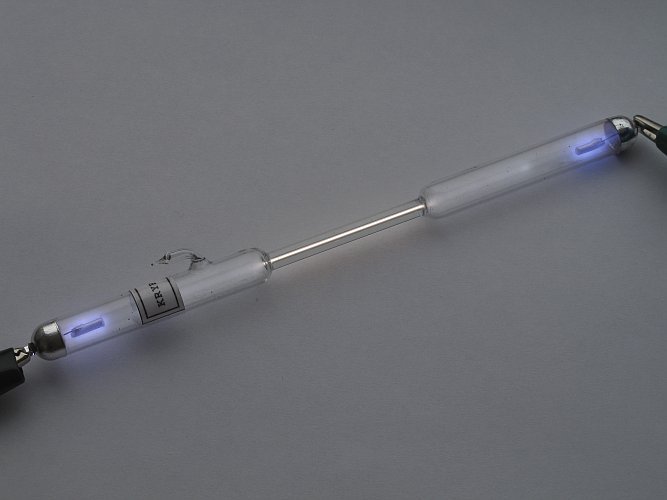
Krypton is the chemical element with atomic number 36 and the symbol Kr. It is a colorless, odorless noble gas in group 18 of the periodic table, and it is one of the rarest gases in Earth’s atmosphere. Krypton is used in energy-saving lighting, flash lamps and some lasers, and it once helped define the meter.
History of krypton
Krypton was discovered in 1898 by the British chemists William Ramsay and Morris Travers at University College London. They had already found argon, a gas extracted from air, and Ramsay was convinced that argon belonged to a new group of elements in the periodic table. They expected that other members of the group were hidden in the argon they had collected.
By liquefying the argon and letting it evaporate, they hoped to leave behind a heavier component, and they succeeded. On the afternoon of 30 May 1898 they isolated about 25 cubic centimeters of a new gas. They examined it in a spectrometer, an instrument that splits light from a glowing sample into its characteristic lines, and the atomic spectrum showed that it was a new element.
The name comes from the Greek word kryptos, meaning hidden, because the gas had been concealed in air and in the argon extracted from it.
Their work added to the family of noble gases, a group whose members are known for being very unreactive. In this case the atomic spectrum, not a chemical reaction, was the evidence that confirmed the new gas.
Properties of krypton
NIST lists the standard atomic weight of krypton as 83.798, with an uncertainty of 2 in the last digit. The electron configuration is [Ar] 3d10 4s2 4p6, which means the outer shell is completely filled. A full outer shell makes the noble gases very unreactive, and the Royal Society of Chemistry states that krypton does not react with anything except fluorine gas. Unlike the lighter gases in its group, such as helium and neon, krypton is reactive enough to form a few compounds, for example krypton fluoride.
Krypton is a colorless, odorless gas at 20 degrees Celsius. It condenses to a liquid at minus 153.4 degrees Celsius and freezes at minus 157.4 degrees Celsius. Its density as a gas is about 0.0034 grams per cubic centimeter.
PubChem lists a first ionization energy of 14.000 electronvolts, which is the energy needed to remove one electron from the atom, and an oxidation state of zero. The Royal Society of Chemistry gives a covalent radius of 1.16 angstroms and a non-bonded radius of 2.02 angstroms. An extra electron does not attach stably to a krypton atom, so the element has no electron affinity value, and no electronegativity is assigned to it.
The Royal Society of Chemistry lists ionization energies of 1350.757, 2350.367 and 3565.13 kilojoules per mole for the first three electrons removed from a krypton atom. Each value is higher than the last because it is harder to pull an electron away from an ion that is already positively charged, and the high first value reflects how tightly krypton holds its filled outer shell.
Occurrence and production of krypton
Krypton makes up only about 1 part per million of the atmosphere by volume, which places it among the rarest gases in the air. It is extracted by distillation of air that has been cooled until it becomes a liquid. Distillation separates a mixture by letting each component boil off at its own temperature, and in liquid air the different gases leave at different points, which allows krypton to be collected on its own.
Krypton is also a product of all nuclear reactors. Radioactive krypton therefore forms wherever uranium fission takes place, a fact that has been put to practical use, as described below.
Uses of krypton
Krypton is used commercially as a filling gas in energy-saving fluorescent lights. It is also used in some flash lamps for high-speed photography, where a very short and bright burst of light is needed to freeze fast movement. When krypton reacts with fluorine it forms krypton fluoride, and that compound is used in some lasers.
Radioactive krypton was used during the Cold War to estimate Soviet nuclear production. Because the gas is a product of every nuclear reactor, analysts found the Russian share by subtracting the amount that came from Western reactors from the total measured in the air.
Krypton also played a role in measurement. From 1960 to 1983, the isotope krypton-86 was used to define the standard measure of length. One meter was set at exactly 1,650,763.73 wavelengths of a particular line in the atomic spectrum of that isotope. The definition rested on a natural property of the atom, not on a metal bar kept in a vault, and it ended in 1983.
Isotopes of krypton
Isotopes are atoms of the same element with different numbers of neutrons. NIST lists six naturally occurring isotopes of krypton. Their abundances are krypton-78 at 0.355 percent, krypton-80 at 2.286 percent, krypton-82 at 11.593 percent, krypton-83 at 11.500 percent, krypton-84 at 56.987 percent and krypton-86 at 17.279 percent.
Krypton-84 is the most common isotope by a wide margin, and the Royal Society of Chemistry lists it as the key isotope of the element. The krypton-86 isotope is the one that was once used to define the meter. Radioactive isotopes of krypton are not part of this natural mixture, but they are formed in reactors.
NIST reports each abundance with an uncertainty, such as 15 in the last two digits for krypton-84, which shows how precisely the proportions have been measured.
Health and environmental effects of krypton
The Royal Society of Chemistry reports that krypton has no known biological role. The element’s environmental interest lies mainly in measurement and monitoring. Because radioactive krypton is released by nuclear reactors and can be detected in the air, it has served as an indicator of nuclear activity, as the Cold War estimates showed. This overview is general background and not advice.
Key facts
- Krypton has atomic number 36, symbol Kr, and sits in group 18 and period 4 of the periodic table.1
- Krypton is a gas at 20 degrees Celsius that boils at minus 153.4 degrees Celsius and makes up about 1 part per million of the atmosphere.1
- William Ramsay and Morris Travers isolated krypton in London on 30 May 1898.1
- From 1960 to 1983, one meter was defined as 1,650,763.73 wavelengths of a spectral line of krypton-86.1
- Krypton has six naturally occurring isotopes, and krypton-84 is the most abundant at about 56.987 percent.2
Quick checkWhy is krypton called hidden?Show answer
The name comes from the Greek word kryptos, meaning hidden. Ramsay and Travers found the gas concealed in the argon they had extracted from air in 1898.
Sources
- Royal Society of Chemistry, Periodic Table: Krypton, https://periodic-table.rsc.org/element/36/krypton
- National Institute of Standards and Technology, Atomic Weights and Isotopic Compositions for Krypton, https://physics.nist.gov/cgi-bin/Compositions/stand_alone.pl?ele=Kr&ascii=html&isotype=some
- National Center for Biotechnology Information, PubChem Periodic Table: Krypton (element 36), https://pubchem.ncbi.nlm.nih.gov/element/36
Editorially reviewed by Specialty Digest Editorial TeamLast reviewed November 4, 2026Researched and drafted with AI assistanceReport an issue