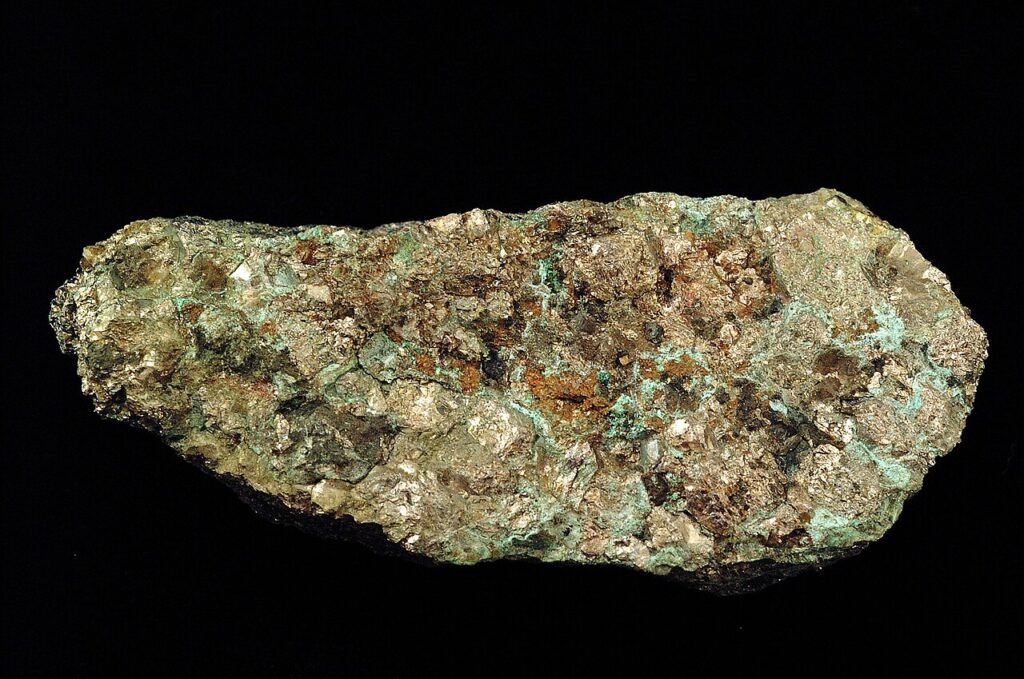
Cobalt is the chemical element with atomic number 27 and the symbol Co. It is a lustrous, silvery-blue, magnetic metal in group 9 of the periodic table. Cobalt has been valued for centuries as the source of a brilliant blue color, and today it is also important in strong magnets, high-temperature alloys and medicine.
History of cobalt
Compounds of cobalt were used long before the metal was known. The tomb of the Egyptian pharaoh Tutankhamun, who ruled from 1361 to 1352 BC, contained a small glass object colored deep blue with cobalt. Cobalt blue was known even earlier in China, where it was used for pottery glazes.
In 1730 the chemist Georg Brandt of Stockholm became interested in a dark blue ore from local copper workings. He eventually proved that it contained a metal nobody had recognized before, and he published his results in 1739. The Royal Society of Chemistry gives 1739 as the discovery date, while PubChem lists 1735, so the year depends on the source. For many years other chemists disputed his claim, arguing that his new element was really a compound of iron and arsenic. It was eventually recognized as an element in its own right.
The name comes from the German word kobald, meaning goblin. It was the name by which miners in Germany cursed the ore, which was sometimes mistaken for a silver ore.
Properties of cobalt
The Royal Society of Chemistry describes cobalt as a lustrous, silvery-blue metal. Early Chinese porcelain also used cobalt to give its blue glaze. Its closeness to iron in the periodic table shows in its magnetism and in its common oxidation states of plus 3 and plus 2, which are the same as the common states of iron.
Cobalt has a standard atomic weight of about 58.933, and NIST lists it as 58.933194 with an uncertainty of 4 in the last digit. A cobalt atom has 27 protons and an electron configuration of [Ar] 4s2 3d7, meaning the arrangement of argon plus two electrons in the 4s level and seven in the 3d level.
At room temperature cobalt is a solid with a density of 8.86 grams per cubic centimeter. PubChem gives a melting point of 1,768 kelvins, about 1,495 degrees Celsius, and a boiling point of 3,200 kelvins, about 2,927 degrees Celsius. Cobalt is a transition metal whose common oxidation states are plus 3 and plus 2. An oxidation state is a number that tracks how many electrons an atom has lost or shared in a compound.
Like iron, cobalt can be magnetized. PubChem also records an electronegativity of 1.88 on the Pauling scale, a first ionization energy of 7.881 electronvolts, an electron affinity of 0.661 electronvolts and an atomic radius of 192 picometers.
Occurrence and production of cobalt
Cobalt is found in the minerals cobaltite, skutterudite and erythrite. Important ore deposits lie in the Democratic Republic of the Congo, Canada, Australia, Zambia and Brazil. Most cobalt is formed as a by-product of nickel refining, which means that it is recovered while a different metal is the main target of the mining operation.
Large reserves of several transition metals, including cobalt, also lie in nodules on the floors of the deepest oceans. The nodules are made of manganese minerals that take millions of years to form, and together they contain many tonnes of cobalt.
Uses of cobalt
Because cobalt can be magnetized, it is used to make magnets. Alloying it with aluminum and nickel produces particularly powerful ones. An alloy is a mixture of a metal with other elements, made to improve strength or other properties. Other alloys of cobalt are used in jet turbines and gas turbine generators, where strength at high temperature is important.
Cobalt metal is sometimes used in electroplating, the process of coating one metal with another, because of its attractive appearance, hardness and resistance to corrosion. Cobalt salts have been used for centuries to produce brilliant blue colors in paint, porcelain, glass, pottery and enamels.
The radioactive form cobalt-60 is an important source of gamma rays. It is widely used in cancer treatment, as a tracer and in radiotherapy, and in some countries it is used to irradiate food to preserve it.
Isotopes of cobalt
NIST lists a single stable isotope for cobalt, cobalt-59, which makes up all of the natural element. An isotope is a form of an element with a particular number of neutrons, and the 59 is the combined count of protons and neutrons. Elements with one natural isotope are called monoisotopic, so the standard atomic weight of cobalt is the mass of a single cobalt-59 atom.
Cobalt-60 is a radioactive isotope, one whose nuclei are unstable and give off radiation as they change. It is an important source of gamma rays, a very energetic form of electromagnetic radiation, and it is the isotope behind the medical and food-irradiation uses described above. NIST’s table for cobalt lists only the one stable entry, unlike zinc, which has five.
Cobalt in life and the environment
Cobalt is an essential trace element and forms part of the active site of vitamin B12, the part of the molecule where its chemical work takes place. The amount people need is very small, and the human body contains only about 1 milligram. Cobalt salts can be given to certain animals in small doses to correct mineral deficiencies. The Royal Society of Chemistry also states that cobalt is carcinogenic in large doses.
A very small amount of cobalt, about 1 milligram in the whole body, is enough to fill its role in the vitamin, which shows how little of some elements living things need.
The use of radioactive cobalt-60 in medicine and food irradiation is directed by trained professionals and regulators. The information here is general background rather than health advice.
Key facts
- Array
In the news
- BusinessGold in 2025: USGS Reports a Record $3,300 Average Price and 3,300 Tons Mined
- BusinessU.S. Mineral Production Hits $112 Billion in USGS 2026 Summaries
- BusinessCobalt in 2025: USGS Shows Congo Supplies Nearly Three Quarters After an Export Ban and Quotas
- TechnologyHow Do Electric Car Batteries Actually Work?
Quick checkWhere does the name cobalt come from?Show answer
It comes from the German word kobald, meaning goblin, the name German miners gave to the troublesome ore from which cobalt was later extracted.
Sources
- Array
Editorially reviewed by Specialty Digest Editorial TeamLast reviewed November 4, 2026Researched and drafted with AI assistanceReport an issue