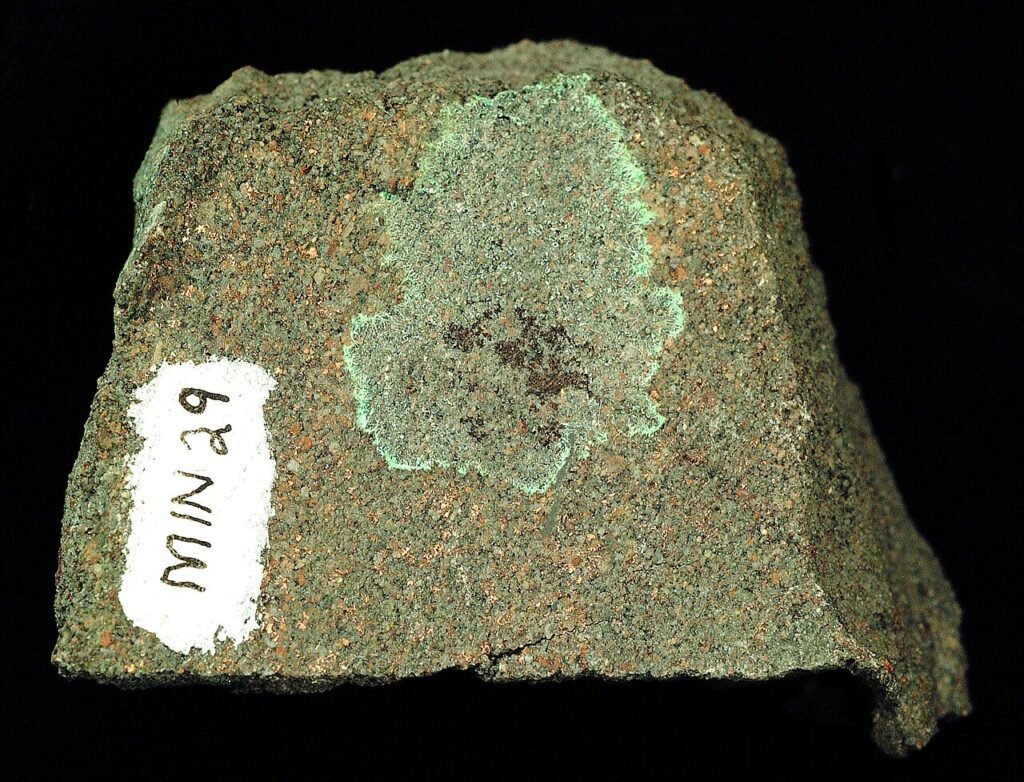
Copper is the chemical element with atomic number 29 and the symbol Cu. It is a reddish-gold metal in group 11 of the periodic table that is easily worked and drawn into wire. Copper conducts both heat and electricity very well, and most of it is used in electrical equipment, construction and industrial machinery.
History of copper
Copper has no recorded discoverer, because people have used it since prehistory. The Royal Society of Chemistry notes that copper beads more than ten thousand years old have been excavated in northern Iraq, presumably made from native copper, which is copper found naturally as a metal in nuggets. Historically, copper was the first metal to be worked by people.
Copper was widely used in the ancient world as bronze, its alloy with tin, which was made into cutlery, coins and tools. The discovery that copper could be hardened with a little tin gave its name to the Bronze Age. In China, bronze was used to make bells. The name of the element comes from the Old English word coper, which in turn comes from the Latin phrase Cyprium aes, meaning a metal from Cyprus.
Copper is not difficult to extract from its ores, but mineable deposits were relatively rare. Some mines, such as the one at Falun in Sweden, date from the 1200s and were the source of great wealth. One old method of extraction was to roast the sulfide ore and then leach out, with water, the copper sulfate that formed. The solution was trickled over scrap iron, and copper deposited on the iron as a flaky layer that was easily removed.
Properties of copper
Copper has a standard atomic weight of about 63.546, which NIST lists with an uncertainty of 3 in the last digit. A copper atom has 29 protons and an electron configuration of [Ar] 4s1 3d10, meaning the arrangement of argon plus one electron in the 4s level and ten in the 3d level.
At room temperature copper is a solid with a density of 8.933 grams per cubic centimeter. PubChem gives a melting point of 1,357.77 kelvins, about 1,085 degrees Celsius, and a boiling point of 2,835 kelvins, about 2,562 degrees Celsius. Copper is a transition metal, and its common oxidation states are plus 2 and plus 1. An oxidation state is a number that tracks how many electrons an atom has lost or shared in a compound.
Copper has a single electron in its 4s level and a full set of ten in its 3d level, a slightly different arrangement from that of its neighbor nickel, which has two in the 4s level and eight in the 3d level.
PubChem also records an electronegativity of 1.9 on the Pauling scale, a first ionization energy of 7.726 electronvolts, an electron affinity of 1.228 electronvolts and an atomic radius of 140 picometers. The Royal Society of Chemistry describes the metal as reddish gold and says it can be drawn into wires.
Occurrence and production of copper
Copper does occur naturally as a metal, but by far the greatest source is minerals such as chalcopyrite and bornite. It is obtained from these ores and minerals by smelting, leaching and electrolysis. Smelting heats an ore to separate the metal, leaching dissolves the metal out of the ore with a liquid, and electrolysis uses an electric current to deposit pure metal from a solution.
The major copper-producing countries are Chile, Peru and China. Copper refining also gives rise to other elements. Selenium is obtained mostly from the muds left behind when copper is electrolytically refined, and arsenic is produced mostly as a by-product of copper and lead refining.
Uses of copper
Most copper is used in electrical equipment such as wiring and motors, because it conducts both heat and electricity very well and can be drawn into wire. It also has uses in construction, including roofing and plumbing, and in industrial machinery such as heat exchangers, which move heat from one fluid to another.
Copper has traditionally been one of the metals used to make coins, along with silver and gold. It is the most common of the three and therefore the least valued. All United States coins are now made of copper alloys, and gun metals also contain copper. An alloy is a mixture of a metal with other elements, made to improve strength or other properties.
Copper compounds have specialized uses. Copper sulfate is widely used as an agricultural poison and as an algicide in water purification. Compounds such as Fehling’s solution are used in chemical tests for sugar.
Copper’s electrical conductivity is the reason that so much mined copper ends up in wiring and motors.
Isotopes of copper
NIST lists two stable isotopes of copper: copper-63 and copper-65. Copper-63 is the more abundant, at about 69.15 percent of natural copper, and copper-65 makes up the remaining 30.85 percent. An isotope is a form of an element with a particular number of neutrons, and the number after the name is the combined count of protons and neutrons. Since the two isotopes occur in roughly a seven to three ratio, the standard atomic weight of copper falls between 63 and 65, at about 63.5.
Copper in life and the environment
Copper is an essential element. An adult human needs around 1.2 milligrams of copper a day to help enzymes transfer energy in cells. Excess copper is toxic. Genetic diseases such as Wilson’s disease and Menkes’ disease can affect the body’s ability to use copper properly.
Unlike mammals, which use iron in hemoglobin to carry oxygen around the body, some crustaceans use copper complexes for this purpose. The agricultural and water-treatment uses of copper sulfate also show how a metal that supports life in small amounts can act as a poison to algae and pests at higher doses. The information here is general background rather than health advice.
Key facts
- Array
Related concepts
In the news
- BusinessPotash in 2025: USGS Shows Canada Makes 31 Percent as U.S. Imports 92 Percent
- BusinessLead in 2025: USGS Shows China Mines 42 Percent as U.S. Import Reliance Rises
- BusinessManganese in 2025: USGS Shows South Africa Mines 38 Percent and the U.S. Imports All It Uses
- BusinessU.S. Mineral Production Hits $112 Billion in USGS 2026 Summaries
- BusinessSilver in 2025: USGS Reports a $38 Average Price and a Continued Supply Deficit
Quick checkWhy is copper used in electrical wiring?Show answer
Copper conducts both heat and electricity very well and can be drawn into wire, so most of it is used in electrical equipment such as wiring and motors.
Sources
- Array
Editorially reviewed by Specialty Digest Editorial TeamLast reviewed November 4, 2026Researched and drafted with AI assistanceReport an issue