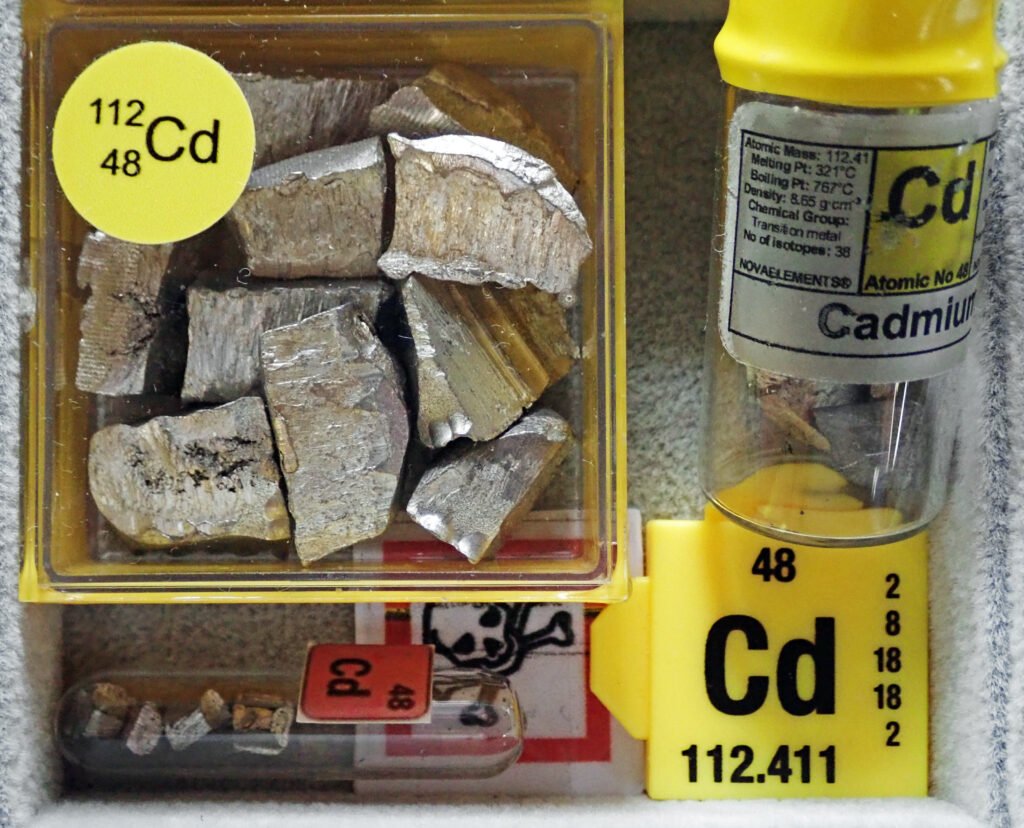
Cadmium is the chemical element with atomic number 48 and the symbol Cd. It is a silvery transition metal with a bluish tinge in group 12 of the periodic table. Cadmium is toxic and carcinogenic, and most of the metal produced has gone into rechargeable nickel-cadmium batteries, although many of its uses are now being limited.
History of cadmium
Cadmium was found by accident in Germany in the early nineteenth century. At that time, the apothecaries of Hanover made zinc oxide by heating a natural form of zinc carbonate called cadmia. Sometimes the product was discolored instead of being pure white. Friedrich Stromeyer of Göttingen University looked into the problem and traced the discoloration to a component that he could not identify and that he deduced must be an unknown element.
Stromeyer separated the unknown substance as a brown oxide. By heating it with lampblack, which is a form of carbon, he produced a sample of a blue-grey metal. He named it cadmium after the name for the mineral. That was in 1817.
Meanwhile, two other Germans, Karl Meissner in Halle and Karl Karsten in Berlin, were working on the same problem. They announced their discovery of cadmium the following year. The year 1817 is the date usually given for the discovery.
Properties of cadmium
NIST gives the standard atomic weight of cadmium as 112.414. The electron configuration is [Kr] 4d10 5s2, and the common oxidation state listed by PubChem is plus 2, which corresponds to the loss of the two outer electrons. Cadmium is a solid at 20 degrees Celsius. It melts at 321.069 degrees Celsius and boils at 767 degrees Celsius. Its density is 8.69 grams per cubic centimeter.
PubChem lists an electronegativity of 1.69, on the Pauling scale, which expresses on a relative scale the tendency of an atom to attract electrons toward itself, and a first ionization energy of 8.994 electronvolts. The atomic radius is given as 158 picometers. Cadmium sits in group 12 directly below zinc, and its plus 2 chemistry is similar, which is consistent with cadmium turning up inside zinc minerals such as sphalerite. The Royal Society of Chemistry describes the appearance of the metal as silvery with a bluish tinge to its surface.
Occurrence and production of cadmium
The only mineral that contains significant quantities of cadmium is greenockite, which is cadmium sulfide. Cadmium is also present in small amounts in sphalerite, a zinc mineral. Because the element is so closely tied to zinc, almost all commercially produced cadmium is obtained as a by-product of zinc refining. Its supply therefore depends on how much zinc is processed, not on a mining industry of its own. A by-product is a material recovered while something else is being made. Zinc ore is refined for zinc, and the cadmium that accompanies it is separated during the same refining and sold separately.
Uses of cadmium
The largest use of cadmium has been in batteries, and its other uses rest on its ability to protect steel from corrosion and on its absorption of neutrons. The Royal Society of Chemistry reports that 80 percent of the cadmium currently produced is used in rechargeable nickel-cadmium batteries. These are gradually being phased out and replaced with nickel metal hydride batteries, as a result of concern about the metal’s toxicity. A rechargeable cell is one in which the chemical reaction that supplies current can be reversed by passing a current back through it, so that the cell can be used again.
Cadmium was often used to electroplate steel, which means coating it with a thin layer of metal to protect it from corrosion. It is still used today to protect critical components of aircraft and oil platforms. Other past uses included phosphors, which are materials that glow when electrons strike them, in cathode ray tube color television sets and yellow, orange and red pigments.
Cadmium also absorbs neutrons. For that reason it is used in rods in nuclear reactors, where inserting or withdrawing the rods helps to control atomic fission. This is the opposite of the property that makes zirconium useful in reactors, since cadmium is chosen precisely because it takes neutrons out of the process.
Isotopes of cadmium
Isotopes are atoms of the same element with different numbers of neutrons. NIST lists eight naturally occurring isotopes of cadmium: cadmium-106 at 1.25 percent, cadmium-108 at 0.89 percent, cadmium-110 at 12.49 percent, cadmium-111 at 12.80 percent, cadmium-112 at 24.13 percent, cadmium-113 at 12.22 percent, cadmium-114 at 28.73 percent and cadmium-116 at 7.49 percent.
NIST attaches the largest uncertainty, 42 in the last two digits, to the cadmium-114 value. Cadmium-114 is the most abundant, and the Royal Society of Chemistry lists it as the key isotope. With eight isotopes in its natural mixture, cadmium has no single dominant form, and the standard atomic weight of 112.414 reflects a blend of them.
Health and environmental effects of cadmium
The Royal Society of Chemistry describes cadmium as toxic, carcinogenic and teratogenic, which means that it can disturb the development of an embryo or fetus. It notes that there are moves to limit its use as a result. On average, people take in as little as 0.05 milligrams per day, but cadmium accumulates in the body, and on average about 50 milligrams is stored. That store is about a thousand times the average daily intake, which illustrates how the metal builds up over time.
Before the dangers were fully understood, welders and other metal workers were at risk of becoming ill. In 1966 some welders working on the Severn Road Bridge in Britain became ill from breathing in cadmium fumes. The phase-out of nickel-cadmium batteries reflects this recognition of the hazard. This overview is general background and not advice.
Key facts
- Cadmium has atomic number 48, symbol Cd, and sits in group 12 and period 5 of the periodic table.1
- Cadmium melts at 321.069 degrees Celsius, boils at 767 degrees Celsius and has a density of 8.69 grams per cubic centimeter.1
- Friedrich Stromeyer discovered cadmium in 1817 while investigating discolored zinc oxide.1
- Almost all commercial cadmium is obtained as a by-product of zinc refining.1
- Cadmium has eight naturally occurring isotopes, and cadmium-114 is the most abundant at 28.73 percent.2
This entry explains a medical term. It is not medical advice. If you are concerned about your health, speak with a qualified health professional.
Related concepts
Quick checkWho discovered cadmium?Show answer
Friedrich Stromeyer of Göttingen University discovered it in 1817 while tracing the discoloration of zinc oxide, and Karl Meissner and Karl Karsten announced the same finding the next year.
Sources
- Royal Society of Chemistry, Periodic Table: Cadmium, https://periodic-table.rsc.org/element/48/cadmium
- National Institute of Standards and Technology, Atomic Weights and Isotopic Compositions for Cadmium, https://physics.nist.gov/cgi-bin/Compositions/stand_alone.pl?ele=Cd&ascii=html&isotype=some
- National Center for Biotechnology Information, PubChem Periodic Table: Cadmium (element 48), https://pubchem.ncbi.nlm.nih.gov/element/48
Editorially reviewed by Specialty Digest Editorial TeamLast reviewed November 4, 2026Researched and drafted with AI assistanceReport an issue