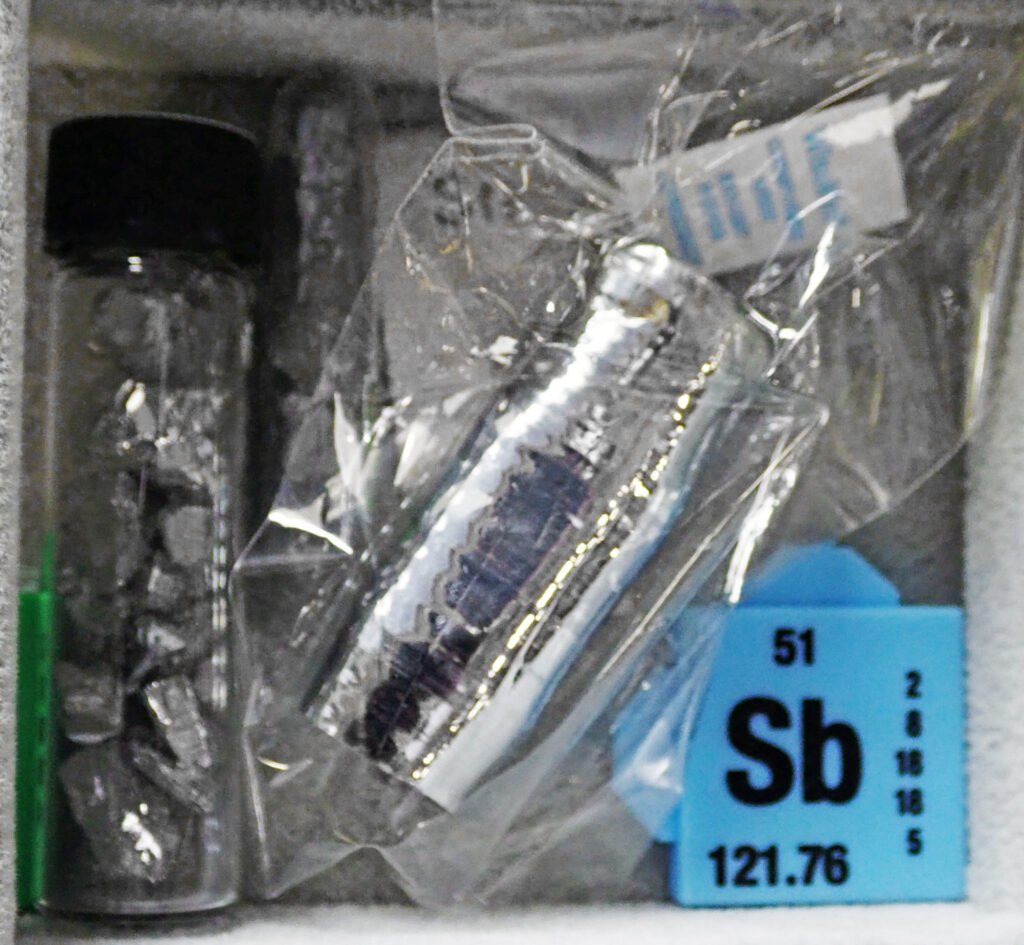
Antimony is the chemical element with atomic number 51 and the symbol Sb. It is a silvery, hard and brittle metalloid in group 15 of the periodic table. Antimony has been used since antiquity in cosmetics and pigments, and today it is alloyed with lead and added to flame-retardant materials.
History of antimony
Antimony has no single discoverer, because the element and its compounds were known to the ancients. The Royal Society of Chemistry reports that a 5,000-year-old antimony vase is held in the Louvre in Paris. Antimony sulfide, Sb2S3, is mentioned in an Egyptian papyrus of the sixteenth century BC.
The black form of this compound occurs naturally as the mineral stibnite. It was used as mascara and known as kohl. Another pigment known to the Chaldean civilization, which flourished in what is now southern Iraq in the sixth and seventh centuries BC, was yellow lead antimonite. It has been found in the glaze of ornamental bricks at Babylon that date from the time of Nebuchadnezzar, who lived from 604 to 561 BC.
In medieval times antimony became widely used, mainly to harden lead for type. Some antimony was also taken medicinally as a laxative pill, which could be recovered and used again. That sulfide pigment makes antimony one of the earliest elements used in cosmetics.
Antimony is therefore best described as a long-used element whose discovery is a matter of archaeology and not of a single laboratory announcement. Its place in the periodic table was settled much later, when chemists could recognize it as an element in its own right.
Properties of antimony
Antimony is a metalloid, which the Royal Society of Chemistry calls a semi-metal. A metalloid is an element whose properties lie between those of metals and nonmetals. In its metallic form, antimony is silvery, hard and brittle. NIST gives its standard atomic weight as 121.760, with an uncertainty of 1 in the last digit. That value is the average of its two isotopes, weighted by how common each one is.
Antimony is a solid at 20 degrees Celsius. It melts at 630.628 degrees Celsius and boils at 1587 degrees Celsius, and it has a density of 6.68 grams per cubic centimeter. The electron configuration is [Kr] 4d10 5s2 5p3, and PubChem lists plus 5, plus 3 and minus 3 as the common oxidation states.
In kelvin, the melting point is 903.778 and the boiling point is 1860. This in-between character helps explain why antimony appears both in alloys and in semiconductor devices. The oxidation states reflect the five outer electrons. Antimony can give up three or all five of them to form positive ions, or in some compounds it can take up three electrons and behave as a negative ion. PubChem lists a Pauling electronegativity of 2.05, a first ionization energy of 8.64 electronvolts and an electron affinity of 1.07 electronvolts. The atomic radius is given as 206 picometers.
Occurrence and production of antimony
Antimony is not an abundant element, but it is found in small quantities in more than 100 mineral species. It is most often found as antimony(III) sulfide, and it can also occur as the native metal, meaning in pure form in the ground. Because each of those minerals holds only small quantities, antimony is obtained mainly from the sulfide.
The metal is extracted by roasting the antimony(III) sulfide to turn it into the oxide, and then reducing the oxide with carbon. Roasting means heating in air so that the sulfur is driven off and the metal combines with oxygen, and reduction with carbon then removes that oxygen again. The Royal Society of Chemistry states that China produces 88 percent of the world’s antimony, and that other producers include Bolivia, Russia and Tajikistan. Production shares change over time, so that figure describes the source at the time it was published.
Uses of antimony
Antimony is used in the electronics industry to make some semiconductor devices, such as infrared detectors and diodes. Infrared detectors respond to heat radiation that the eye cannot see. Its most common role in metals, however, is to harden them. It is alloyed with lead or other metals to improve their hardness and strength, and a lead-antimony alloy is used in batteries.
Other uses of antimony alloys include type metal for printing presses, bullets and cable sheathing. Type metal links the modern element directly to its medieval use, when antimony hardened lead for type.
Antimony compounds are used to make flame-retardant materials, paints, enamels, glass and pottery. In flame-retardant materials, the compound is added to the product so that it resists burning. The use of antimony compounds in paints, enamels, glass and pottery continues a tradition of antimony pigments that goes back to Babylon.
In short, the metal contributes hardness, while its compounds contribute flame resistance and color.
Isotopes of antimony
Isotopes are atoms of the same element with different numbers of neutrons. NIST lists two naturally occurring isotopes of antimony. Antimony-121 accounts for 57.21 percent of natural antimony and antimony-123 for 42.79 percent. Each value has an uncertainty of 5 in the last digit.
The Royal Society of Chemistry lists antimony-121 as the key isotope. With two main isotopes of similar abundance, antimony has a standard atomic weight that falls between 121 and 123, closer to the lighter isotope because it is somewhat more abundant.
Health and environmental effects of antimony
The Royal Society of Chemistry states that antimony and many of its compounds are toxic. The historical medicinal use of antimony compounds, such as the reusable laxative pill, is a medieval practice described in the history of the element. Today the main uses build the metal and its compounds into alloys, glass, ceramics and flame-retardant materials.
The information here is general background and not advice. For guidance on handling or exposure, readers should consult official health and safety agencies.
More in Chemistry
Key facts
- Antimony has atomic number 51, symbol Sb, and sits in group 15 and period 5 of the periodic table.1
- Antimony melts at 630.628 degrees Celsius, boils at 1587 degrees Celsius and has a density of 6.68 grams per cubic centimeter.1
- Antimony sulfide is mentioned in an Egyptian papyrus of the sixteenth century BC, and a 5,000-year-old antimony vase is held in the Louvre.1
- Antimony has two naturally occurring isotopes, antimony-121 (57.21 percent) and antimony-123 (42.79 percent).2
- Antimony is mostly found as antimony(III) sulfide and is extracted by roasting it to the oxide and reducing with carbon.1
Related concepts
In the news
Quick checkWhat was antimony used for in ancient times?Show answer
The black antimony sulfide mineral stibnite was used as mascara known as kohl, and yellow lead antimonite was used as a pigment in glazed bricks at Babylon.
Sources
- Royal Society of Chemistry, Periodic Table: Antimony, https://periodic-table.rsc.org/element/51/antimony
- National Institute of Standards and Technology, Atomic Weights and Isotopic Compositions for Antimony, https://physics.nist.gov/cgi-bin/Compositions/stand_alone.pl?ele=Sb&ascii=html&isotype=some
- National Center for Biotechnology Information, PubChem Periodic Table: Antimony (element 51), https://pubchem.ncbi.nlm.nih.gov/element/51
Editorially reviewed by Specialty Digest Editorial TeamLast reviewed November 4, 2026Researched and drafted with AI assistanceReport an issue