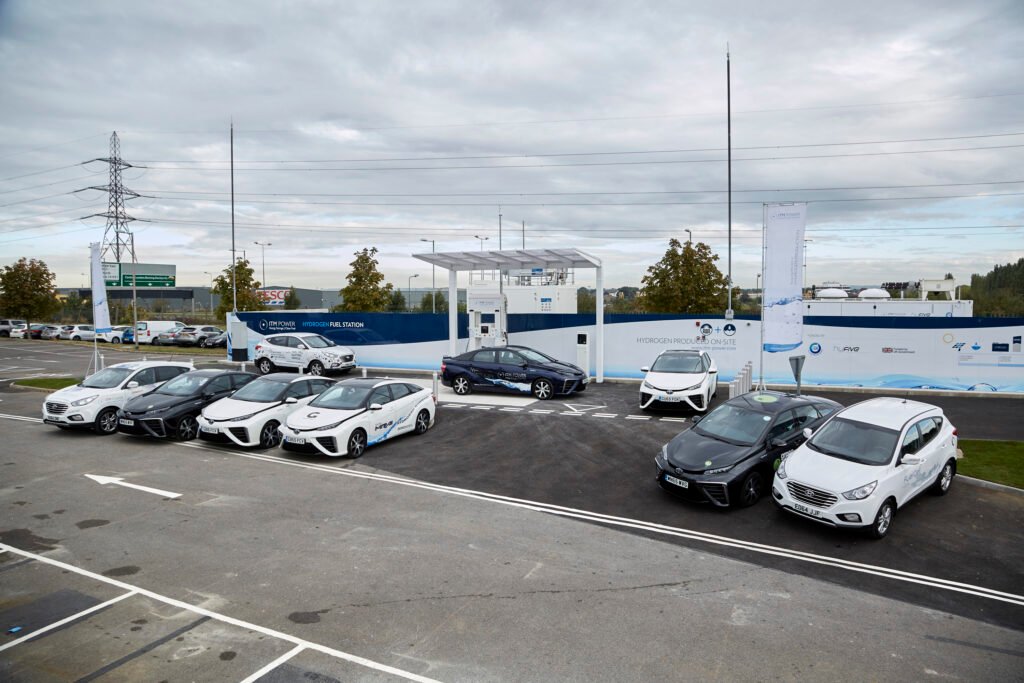
Hydrogen fuel technology covers the methods used to produce, store, deliver and use hydrogen as an energy source. Hydrogen is an energy carrier, meaning it stores, moves and delivers energy that was produced from other sources. When it is consumed in a fuel cell, the only products are electricity, water and heat. The chemical element itself is described in the entry on hydrogen, while this entry focuses on how it is used as a fuel.
How hydrogen fuel technology works
The central device is the fuel cell, which the U.S. Department of Energy (DOE) says uses the chemical energy of hydrogen or other fuels to efficiently produce electricity. A fuel cell has two electrodes, an anode and a cathode, with an electrolyte between them. Hydrogen is fed to the anode and air to the cathode.
At the anode, a catalyst separates hydrogen molecules into protons and electrons. The electrons travel through an external circuit, which creates a flow of electricity, while the protons move through the electrolyte to the cathode. There they combine with oxygen and the electrons to form water and heat.
Fuel cells work like batteries, but they do not run down or need recharging. They produce electricity and heat as long as fuel is supplied. DOE says they can convert the chemical energy in the fuel directly into electrical energy with efficiencies capable of exceeding 60 percent, and they are quiet because they have few moving parts. A hydrogen fuel cell emits only water at the point of use and no air pollutants that cause smog.
Production of hydrogen fuel
Hydrogen is rarely found free in nature in useful amounts, so it has to be made. DOE says it can be produced from natural gas, nuclear power, biomass, and renewable power such as solar and wind. The most common methods today are natural gas reforming and electrolysis.
Thermal processes, mainly steam reforming, react steam with a hydrocarbon fuel at high temperature to produce hydrogen. DOE says about 95 percent of all hydrogen is produced from steam reforming of natural gas, though the figure changes as production shifts. Because hydrocarbons contain carbon, reforming produces carbon dioxide as a by-product, so the climate effect of hydrogen fuel depends heavily on how it is made. See natural gas for more on this feedstock.
Electrolysis splits water into hydrogen and oxygen in a device called an electrolyzer, which works like a fuel cell in reverse. When the electricity comes from renewable energy, the resulting hydrogen carries a far smaller carbon footprint. Solar-driven processes use light directly, through photobiological, photoelectrochemical or solar thermochemical methods, and biological processes use microbes such as bacteria and microalgae.
Storage and delivery of hydrogen
Hydrogen has a low energy density by volume, so storing enough for a useful driving range is a central challenge. The DOE Alternative Fuels Data Center explains that, to achieve the range of conventional vehicles, hydrogen is stored onboard as a compressed gas in high-pressure tanks. Most current applications use tanks at either 5,000 or 10,000 pounds per square inch (psi), known as H35 and H70 after their pressures in megapascals.
Light-duty fuel cell electric vehicles sold by manufacturers carry 10,000 psi tanks, and retail dispensers, mostly at gasoline stations, can fill them in 3 to 5 minutes. Fuel cell buses use 5,000 psi tanks that take 10 to 15 minutes to fill. Other storage methods are under development, including bonding hydrogen chemically with a material such as a metal hydride or with low-temperature sorbents.
Applications of hydrogen fuel technology
DOE says hydrogen can be used in cars, in homes and for portable power. Fuel cells can power systems as large as a utility power station and as small as a laptop computer. They are used in transportation, in buildings and, in reversible systems, for long-term energy storage for the grid, a role discussed in energy storage.
DOE describes fuel cells as unique in the variety of their potential applications, because they can use a wide range of fuels from numerous feedstocks. The same basic device can therefore serve vehicles, buildings and grid storage.
In transport, hydrogen powers fuel cell electric vehicles and hydrogen internal combustion engine vehicles. Light-duty fuel cell vehicles are available in limited quantities in localized regions around the world, and the market is also emerging for buses and material handling equipment. Fuel cell vehicles are one form of electric vehicle, since an electric motor drives the wheels. The Alternative Fuels Data Center adds that opportunities to use hydrogen fuel cells to produce power for charging battery electric vehicles are also being investigated.
Advantages and disadvantages of hydrogen fuel technology
The advantages include clean operation at the point of use, high efficiency in fuel cells, quiet running and the flexibility to make hydrogen from many domestic resources. Fueling is quick compared with many battery charging sessions, and fuel cells can scale from small devices to power plants.
The disadvantages are mostly about the supply chain. Production today relies mainly on natural gas, so emissions depend on the source. Compressed storage requires heavy high-pressure tanks, and fueling infrastructure is limited. The DOE Alternative Fuels Data Center reports that as of 2024 California had 54 retail hydrogen stations open to the public, plus one in Hawaii, serving nearly 15,000 fuel cell vehicles. Where stations are few, owners cannot easily refuel.
Hydrogen fuel cell vehicles vs. battery-electric vehicles
Both types of vehicle use electric motors, but they hold energy differently. A battery-electric vehicle stores electricity in a battery pack, commonly based on lithium-ion battery chemistry, and is recharged from the grid. A fuel cell vehicle stores hydrogen in a tank and makes electricity on board. Hydrogen suits uses that need quick refueling and long operating hours, while batteries benefit from the existing electrical network. Each option has trade-offs in cost, infrastructure and the carbon intensity of its energy source.
Key facts
- A hydrogen fuel cell produces electricity, water and heat, and DOE says fuel cell efficiencies can exceed 60 percent.2
- DOE says about 95 percent of hydrogen is produced by steam reforming of natural gas.1
- Light-duty fuel cell vehicles use 10,000 psi tanks, which can be filled in 3 to 5 minutes.3
- As of 2024, California had 54 retail hydrogen stations open to the public.3
Related concepts
Quick checkWhat are the only products of a hydrogen fuel cell?Show answer
When hydrogen is the fuel, a fuel cell produces electricity, water and heat. It emits no air pollutants at the point of use.
Sources
- U.S. Department of Energy, Hydrogen Fuel Basics, https://www.energy.gov/eere/fuelcells/hydrogen-fuel-basics
- U.S. Department of Energy, Fuel Cells, https://www.energy.gov/eere/fuelcells/fuel-cells
- U.S. Department of Energy Alternative Fuels Data Center, Hydrogen Basics, https://afdc.energy.gov/fuels/hydrogen-basics
Editorially reviewed by Specialty Digest Editorial TeamLast reviewed November 4, 2026Researched and drafted with AI assistanceReport an issue