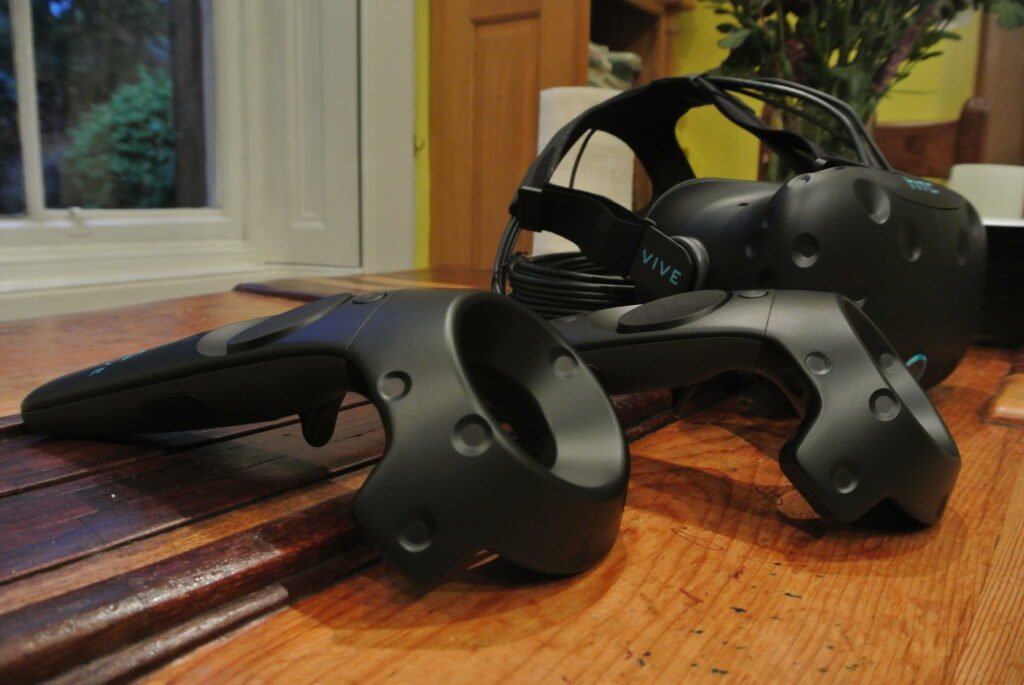
Virtual reality (VR) is a technology that places a person inside a computer-generated, three-dimensional environment they can look around in and interact with. The U.S. Food and Drug Administration (FDA) describes it as an immersive virtual world that may need a headset to replace the user’s view of their real surroundings completely with a simulated one. VR is used for games and entertainment, and also for training, education, design and some forms of medical care.
History of virtual reality
An early forerunner was the Sensorama Simulator, patented by Morton Heilig. The application was filed on 10 January 1961 and the patent was granted on 28 August 1962, as U.S. Patent 3,050,870.
In 1968, the computer scientist Ivan Sutherland published “A head-mounted three dimensional display,” describing a headset that showed computer graphics. An EBSCO overview calls it the first head-mounted device able to track which way the user was looking. In the 1970s, Sutherland and David Evans developed a computer graphics scene generator, and force feedback was added to gloves and wands. Jaron Lanier and Thomas Zimmerman developed sensing gloves that recognized finger and hand movements. Myron Krueger coined the term artificial reality in 1983, and Lanier popularized virtual reality as a technical term during the 1980s.
In 1981, the U.S. space agency NASA combined Sony liquid crystal display portable television screens with special optics to make a stereoscopic headset, the Virtual Visual Environment Display. NASA then assembled what the overview calls the first virtual reality system, adding a host computer, a graphics computer and a noncontact position-tracking system. Scott Fisher and Elizabeth Wenzel developed hardware for three-dimensional virtual sound in 1988, and Fisher later folded sound, a headset and sensor gloves into the Virtual Interactive Environment Workstation. In the late 1980s, Lanier built a system for two simultaneous users called Reality Built for Two.
The first conference on virtual reality took place in Montpellier, France, in March 1992, and the Institute of Electrical and Electronics Engineers held its first in Seattle in September 1993. Commercial VR games appeared in the 1990s, but attempts by Sega and Nintendo to make the technology profitable failed. Interest returned in 2012, when the company Oculus promoted a headset for computer gamers; Facebook later bought it for about $2 billion. Oculus and HTC Vive led a surge of popularity in the late 2010s. Apple released its Vision Pro headset in 2024 at $3,499, compared with $500 for the Meta Quest 3.
How virtual reality works
A VR system joins software, hardware and sensing devices into a human-computer interface. A computer renders the three-dimensional scene and sound, a head-mounted display presents a separate image to each eye, and sensors measure where the user is and where they are looking. When the user turns their head, the system updates the view, which is why the image appears to stay fixed in space.
The more of the senses a system engages, the more convincing the experience. Most systems stimulate sight and hearing, and many add touch and other bodily sensations, through gloves, wands and other devices. Computing speed and fast image processing matter because delays between a movement and the updated image would break the illusion.
Types of virtual reality
VR systems differ mainly in how many senses they cover and how fully they surround the user. At one end are headset systems that replace the view completely, as in the FDA definition. At the other are setups with a screen and limited input devices. In a narrower sense, virtual reality means a fully simulated world, which separates it from augmented reality, which adds digital content to a real scene, and from telepresence, which recreates a real remote situation for people elsewhere. A broader use of the term covers all three. How real a simulation must feel also varies: pilot training needs a result almost indistinguishable from reality, while a game can differ greatly from the real world.
Applications of virtual reality
EBSCO lists uses that include pilot and astronaut training, entertainment, communication, teleoperation, manufacturing, medical and surgical training, experimental psychology, psychotherapy, education, science, architecture and the arts. In medical training, VR lets practitioners rehearse procedures in a safe, repeatable setting. In manufacturing and maintenance, VR training can reduce the risk workers are exposed to.
The FDA says AR and VR could change how and where care is delivered, including remotely, an area related to telemedicine. It keeps a public list of AR and VR medical devices authorized for marketing in the United States. Devices on the list have met the agency’s premarket requirements, including a review of safety and effectiveness for the intended use.
Advantages and disadvantages of virtual reality
VR’s main advantage is control. A simulation can be repeated, paused and made safe, which suits training for tasks that are dangerous, expensive or rare. It can also let people experience places or situations they cannot visit.
The drawbacks include cost, as headset prices show, and open questions about effects on users. The overview notes concerns about social isolation and the psychological impact of immersive experiences. For medical uses, the FDA stresses that devices are evaluated for safety and effectiveness, so claims of benefit need evidence.
Virtual reality vs. augmented reality
Virtual reality replaces what a person sees with a simulated world, while augmented reality keeps the real surroundings in view and layers digital content on top. VR usually requires a headset that blocks out the room, and AR can run on a phone or on transparent glasses. The two share many parts, including tracking sensors and graphics hardware, and some modern headsets can switch between them.
More in Computer Science
Key facts
- The FDA defines VR as an immersive virtual world experience that may use a headset to replace the user view with a simulated one.1
- Morton Heilig filed the Sensorama Simulator patent on 10 January 1961, and it was granted on 28 August 1962.4
- Ivan Sutherland published A head-mounted three dimensional display in 1968.3
- NASA built the Virtual Visual Environment Display in 1981 from Sony LCD television screens.2
- The FDA publishes a list of AR and VR medical devices authorized for marketing in the United States.1
Related concepts
Quick checkHow is virtual reality different from augmented reality?Show answer
Virtual reality replaces the real view with a simulated world, usually through a headset. Augmented reality keeps the real surroundings in view and adds digital content on top.
Sources
- 1. U.S. Food and Drug Administration, Augmented Reality and Virtual Reality in Medical Devices, https://www.fda.gov/medical-devices/digital-health-center-excellence/augmented-reality-and-virtual-reality-medical-devices
- 2. EBSCO Research Starters, Virtual Reality, https://www.ebsco.com/research-starters/computer-science/virtual-reality
- 3. Ivan E. Sutherland, A head-mounted three dimensional display, Proceedings of the 1968 Fall Joint Computer Conference, https://doi.org/10.1145/1476589.1476686
- 4. M. L. Heilig, Sensorama Simulator, U.S. Patent 3,050,870, granted August 28, 1962, https://patents.google.com/patent/US3050870A/en
Editorially reviewed by Specialty Digest Editorial TeamLast reviewed November 4, 2026Researched and drafted with AI assistanceReport an issue