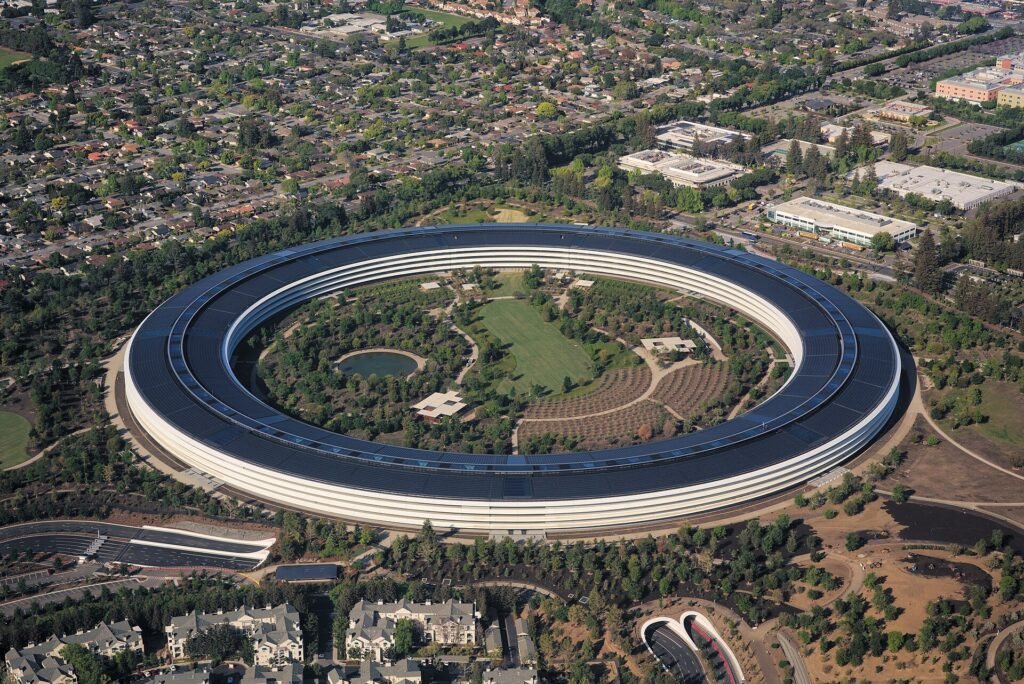
Apple Inc. is an American technology company based in Cupertino, California, that designs, manufactures and markets smartphones, personal computers, tablets, wearables and accessories, and sells a range of related services. In its fiscal 2026, which ended on September 26, 2026, it reported net sales of $478.8 billion, according to its annual report filed with the U.S. Securities and Exchange Commission (SEC).
History of Apple
Apple was founded in 1976 by Steve Jobs, Steve Wozniak and Ronald Wayne. The Computer History Museum holds a photograph dated April 1976 that shows Jobs and Wozniak with the Apple I, the company’s first product. Wozniak designed the Apple I as a pre-assembled circuit board that hobbyists could connect to a television.
The Apple II followed in 1977 and was sold as a complete computer with a built-in keyboard and color graphics. Apple became a public company with an initial public offering (IPO) on the Nasdaq exchange in December 1980. An IPO is the first sale of a company’s shares to outside investors.
The Macintosh, introduced in January 1984, brought a graphical user interface and a mouse to a wider audience. Jobs left the company in 1985 after a dispute with its chief executive, John Sculley, and returned in 1997.
The iPhone arrived in 2007 and the iPad in 2010. Jobs died in 2011, and Tim Cook succeeded him as chief executive in August of that year. Cook still held that role when Apple announced its fiscal 2025 results on October 30, 2025.
Products and services of Apple
Apple’s annual report groups its hardware into four lines. The iPhone is its line of smartphones that run the iOS operating system. The Mac is its line of personal computers, and the iPad is its line of tablets that run iPadOS.
The fourth line is called Wearables, Home and Accessories. The filing says it includes smartwatches, wireless headphones and spatial computers, along with Apple-branded and third-party accessories.
Services are the second major part of the business. The filing lists advertising, AppleCare, cloud services and other offerings. AppleCare is a fee-based support program that gives customers priority access to technical help and repairs. The company also says it will provide expanded access to Apple Intelligence and Siri features, which rely on artificial intelligence.
Services net sales were $123.3 billion in fiscal 2026, up 13 percent from $109.2 billion in fiscal 2025. Services are a growing share of revenue because customers pay for them repeatedly, unlike a device that is bought once every few years.
Corporate structure and operations
Apple’s headquarters are at One Apple Park Way in Cupertino. Its fiscal year is the 52- or 53-week period that ends on the last Saturday of September, so a fiscal year does not match the calendar year.
As of September 26, 2026, the company had approximately 167,000 full-time equivalent employees. Its annual report breaks net sales into geographic regions, including the Americas, Europe, Japan and the rest of Asia Pacific.
The Americas segment grew in fiscal 2026 because of higher sales of iPhone, Services and Mac, according to the filing. Japan net sales rose 8 percent to $30.9 billion, and the rest of Asia Pacific rose 18 percent to $39.9 billion.
The company’s financial results have grown in each of the last three fiscal years. Net sales were $391.0 billion in fiscal 2024, $416.2 billion in fiscal 2025 and $478.8 billion in fiscal 2026. Net income rose from $93.7 billion to $112.0 billion and then to $132.2 billion over the same years.
Apple’s October 2025 results release said its installed base of active devices, meaning the number of Apple devices in use, reached a new all-time high across all product categories and geographic segments. The release also described fiscal 2025 as a record year, with revenue of $416 billion.
Impact of Apple
Apple’s products helped shape how people use computers and phones. The Macintosh popularized the graphical user interface, which lets users work with windows and icons instead of typed commands. The iPhone turned the smartphone into a general-purpose device for apps, photos, payments and communication.
The App Store, Apple’s marketplace for iPhone and iPad software, has become an important channel for software developers. Its rules affect how developers reach customers and how they are paid, which is why they have drawn regulatory and legal attention in several countries.
Apple also depends on a large network of suppliers and on the semiconductor industry for the chips in its devices. The annual report treats supply and component availability as ongoing business risks.
Criticism and controversies
Epic Games sued Apple in a California federal court, alleging that the operation of the App Store violated federal and state antitrust laws and California’s unfair competition law. The court found that some of Apple’s App Review Guidelines violated California’s unfair competition law and issued an injunction in 2021. That order bars Apple from prohibiting developers from including buttons, external links or other calls to action that direct customers to other ways of paying. On April 30, 2025, the court found Apple in violation of the 2021 injunction.
In the European Union, Apple changed iOS, iPadOS, the App Store and Safari to comply with the Digital Markets Act. The changes include alternative app distribution and alternative payment processing. Apple’s annual report says the European Commission has challenged its compliance plan and that the law allows significant fines.
Apple was also involved in a long-running European tax case. In 2016 the Commission decided that Ireland had given Apple illegal state aid through tax rulings, and it ordered Ireland to recover additional taxes for 2003 to 2014. Apple recorded a one-time income tax charge in the fourth quarter of fiscal 2024 after a European court ruling in its favor was reversed.
Finally, the annual report notes that a U.S. antitrust case against Google could affect Apple. Apple earns licensing revenue from search arrangements with Google, and the filing says remedies that limit those terms could materially reduce that revenue.
More in Computer Science
Key facts
- Apple Inc. is headquartered in Cupertino, California, and designs smartphones, personal computers, tablets, wearables, accessories and related services.1
- Apple reported net sales of $478.8 billion in fiscal 2026, up 15 percent from $416.2 billion in fiscal 2025, and net income of $132.2 billion.1
- Services net sales were $123.3 billion in fiscal 2026, up 13 percent from the prior year.1
- Apple had approximately 167,000 full-time equivalent employees as of September 26, 2026.1
- A Computer History Museum photograph dated April 1976 shows Steve Jobs and Steve Wozniak with the Apple I.3
Related concepts
In the news
Quick checkWhat are the main product lines in Apple annual report?Show answer
iPhone, Mac, iPad, and Wearables, Home and Accessories, plus services such as advertising, AppleCare and cloud services.
Sources
- Apple Inc., Form 10-K for the fiscal year ended September 26, 2026 (SEC EDGAR), https://www.sec.gov/Archives/edgar/data/320193/000032019326000026/aapl-20260926.htm
- Apple Newsroom, Apple reports fourth quarter results, October 30, 2025, https://www.apple.com/newsroom/2025/10/apple-reports-fourth-quarter-results/
- Computer History Museum, Steve Jobs and Steve Wozniak with Apple-1 Computer (catalog 102660089), https://www.computerhistory.org/collections/catalog/102660089
Editorially reviewed by Specialty Digest Editorial TeamLast reviewed November 4, 2026Researched and drafted with AI assistanceReport an issue