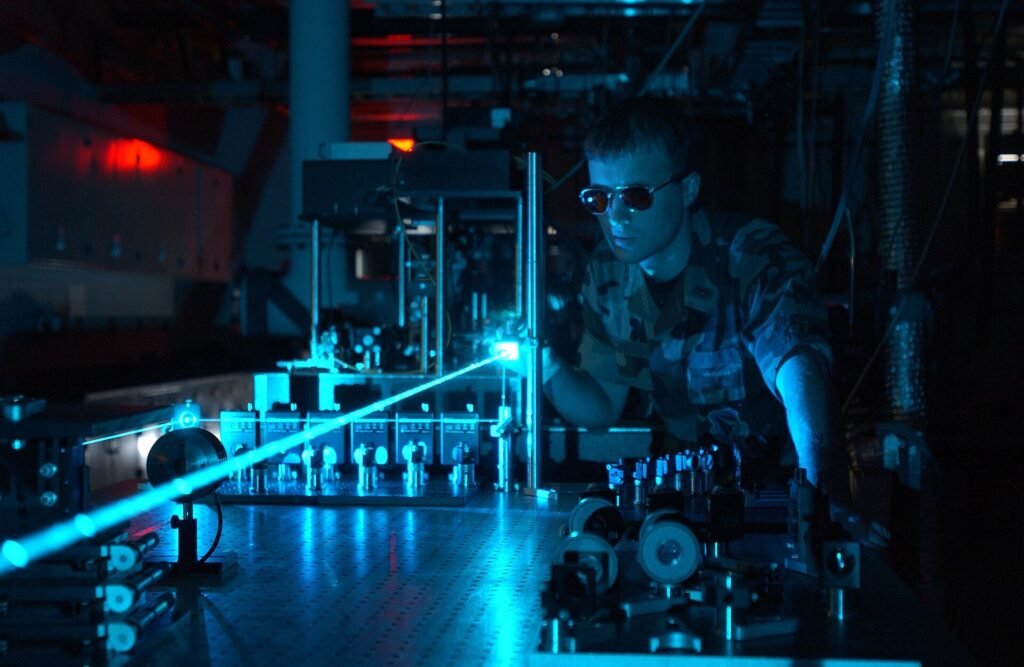
A laser is a device that produces a narrow, intense beam of light with a single, well-defined wavelength by stimulating atoms or molecules to release light in step with one another. The word is an acronym for light amplification by stimulated emission of radiation, and the light it produces is called coherent.
History of the laser
The key idea came from Albert Einstein, who introduced the concept of stimulated emission in 1917. He found that atoms that absorb radiation can also be stimulated by incoming radiation to emit more of the same kind, which is a potential route to amplification. The Nobel Committee for Physics later noted that the process was long regarded as purely theoretical, because absorption dominates under normal conditions.
Amplification becomes possible only when more atoms sit in a high energy state than in a lower one, a condition called an inverted population. Creating that condition was the essential step. It was first achieved with microwaves, in the maser, through investigations carried out simultaneously and independently by Charles Townes and co-workers at Columbia University and by Nikolay Basov and Aleksandr Prokhorov at the Lebedev Institute in Moscow, with the first papers published around 1954.
The optical version was analyzed in 1958, by Arthur Schawlow and Townes and at the Lebedev Institute, and the first working laser followed two years later. The Committee pointed out that moving from microwaves to visible light meant a 100,000-fold increase in frequency, so the laser could be regarded as an essentially new invention. Townes, Basov and Prokhorov shared the 1964 Nobel Prize in Physics for the work that led to the maser and laser principle.
Development continued. In 1985 Gerard Mourou and Donna Strickland published chirped pulse amplification, which produced the shortest and most intense laser pulses then created. Arthur Ashkin used laser light to capture living bacteria without harming them in 1987. All three shared the 2018 Nobel Prize in Physics.
How a laser works
Every laser stores energy from an external source and releases it as light. The FDA lists an electrical discharge, a chemical reaction and powerful optical illumination as examples of such sources. A basic laser consists of a laser medium, which can be a solid, a gas or a semiconductor, placed between a pair of mirrors.
When the medium is energized, light emitted by some atoms stimulates others to emit with the same phase and frequency. The mirrors send the light back and forth through the medium many times, and the stimulated radiation grows like an avalanche. One mirror is made slightly transparent, so part of the amplified light escapes as a beam.
Ordinary sources such as the sun or a light bulb emit a mixture of wavelengths in all directions. Laser light has a specific wavelength, and the amplification of that wavelength gives a narrow beam that travels in one direction. Even at large distances, that focus can still deliver very high intensity to a small area.
Types of lasers
The first working type used a ruby rod a few inches long with silvered ends as mirrors. Chromium ions in the ruby, which also give it its red color, are responsible for the laser effect, and a xenon flash lamp supplies the energy. Such solid-state lasers emit short, powerful pulses.
Gas lasers, in which light is emitted from a gas excited by an electric discharge, can produce a continuous beam with a very sharply defined wavelength. The Nobel Committee noted that this property allowed lengths and velocities to be measured with a precision that had not been attainable before.
Laser diodes are semiconductor devices and are common in consumer equipment. The FDA separates them from light-emitting diodes, which are not laser products.
Applications of lasers
The FDA lists many everyday and industrial uses. They include optical disk players and recorders, bar code readers, printers and copiers, laser pointers, and the fiber-optic systems that carry telephone, video and computer network traffic. Industry uses lasers for cutting, welding, engraving and marking, and laboratories use them for measurements and research.
Medicine is another field. Lasers designed for medical procedures are regulated as devices, and the Nobel Committee in 2018 noted that chirped pulse amplification is used in the millions of corrective eye surgeries done every year. Optical tweezers, which hold particles, viruses and living cells with a laser beam, are now widely used to study the machinery of life.
Laser ranging is a further application. Instruments such as NASA’s ICESat-2 time laser pulses to measure surface height, an approach described in the entry on LiDAR, and the light that carries internet traffic in fiber optics is typically produced by lasers.
Advantages and disadvantages of lasers
The FDA says laser products improve the quality, precision, accuracy, security and reliability of many products, materials, communications and data handling systems. A beam that stays narrow can also be controlled very precisely, which is why it suits tasks as different as scanning a bar code and shaping tissue.
The same concentration creates hazards. The FDA recognizes four major hazard classes, I to IV, with subclasses IIa, IIIa and IIIb. Class I products, such as laser printers and CD players, are considered non-hazardous, though the hazard rises if the beam is viewed with magnifiers, binoculars or telescopes. Class IV lasers pose an immediate skin and eye hazard from the direct or reflected beam and may also present a fire hazard.
The FDA adds that laws and standards require engineering controls and risk communication for each class, but no control is completely effective if a laser is used improperly. The Nobel Committee also stressed in 1964 that the extreme power concentration of a laser is limited to short times and small volumes, and that the long-range “death ray” remains a myth.
Laser vs. LED
A light-emitting diode and a laser diode both turn electricity into light in a semiconductor, but their output differs. An LED emits light over a range of wavelengths in many directions, while a laser diode emits a narrow, coherent beam of one wavelength.
The distinction also matters for regulation. According to the FDA, LEDs are different from laser diodes and are not subject to the federal laser product performance standard.
Key facts
- Laser stands for light amplification by stimulated emission of radiation.1
- Einstein introduced the concept of stimulated emission in 1917.2
- The first working laser followed two years after the 1958 analysis of the optical maser.2
- Townes, Basov and Prokhorov shared the 1964 Nobel Prize in Physics for the maser-laser principle.2
- The FDA recognizes four major laser hazard classes, I to IV, and LEDs are not subject to the federal laser product standard.1
- Chirped pulse amplification (1985) and optical tweezers (1987 use on bacteria) won the 2018 Nobel Prize in Physics.3
Related concepts
In the news
- BusinessGallium in 2025: USGS Shows U.S. Metal Imports More Than Double as China Holds 99 Percent
- ScienceDragonfly Completes Its First Simulated Flight Ahead of a Titan Launch
- ScienceJuice Flew Past Earth: DLR Reports 740 Images on the Way to Jupiter
- TechnologyNASA’s CASALS Lidar Fills Gaps in 3D Maps of Earth’s Surface
- ScienceBepiColombo Reaches Mercury: ESA’s Orbit Insertion Plan for November 21, 2026
Quick checkWhat does the word laser stand for?Show answer
Light amplification by stimulated emission of radiation.
Sources
- 1. U.S. Food and Drug Administration, Laser Products and Instruments, https://www.fda.gov/radiation-emitting-products/home-business-and-entertainment-products/laser-products-and-instruments
- 2. The Nobel Prize in Physics 1964, Presentation Speech, https://www.nobelprize.org/prizes/physics/1964/ceremony-speech/
- 3. The Nobel Prize in Physics 2018, Press release, https://www.nobelprize.org/prizes/physics/2018/press-release/
- 4. NASA ICESat-2, Space Lasers, https://icesat-2.gsfc.nasa.gov/space-lasers
Editorially reviewed by Specialty Digest Editorial TeamLast reviewed November 4, 2026Researched and drafted with AI assistanceReport an issue