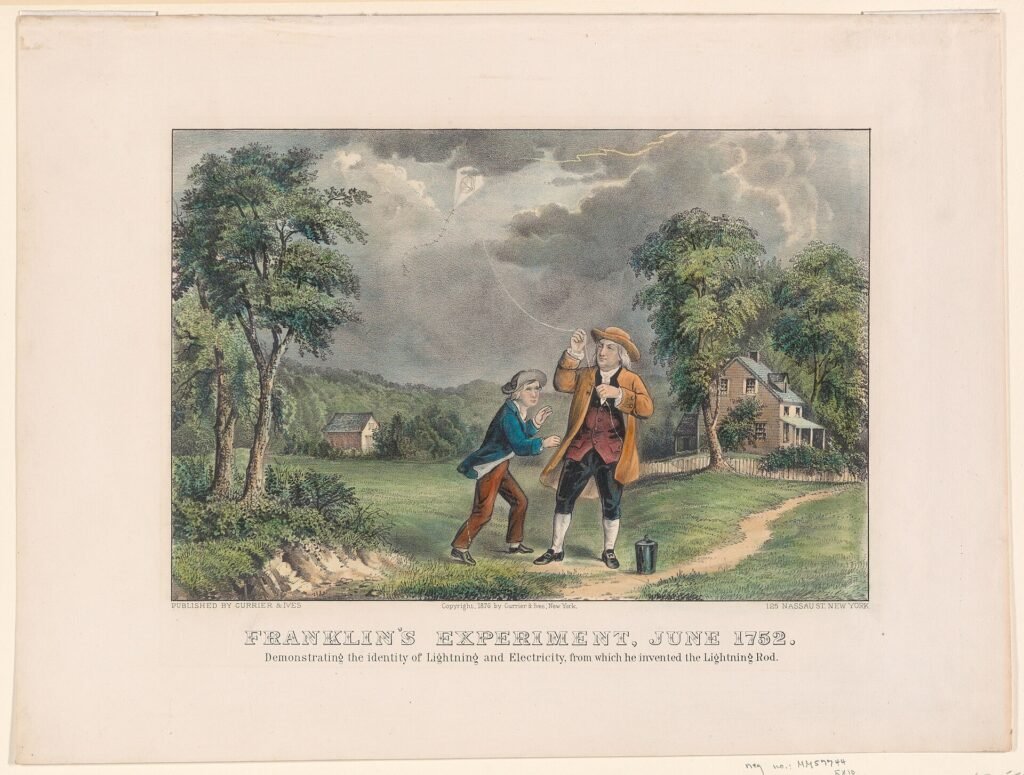
A lightning rod is a metal rod fixed to the top of a structure and joined by a heavy conductor to the ground, so that a lightning strike follows a safe path instead of passing through the building. Benjamin Franklin developed the idea around 1750, and a Czech priest built a similar grounded apparatus in 1754.
History of the lightning rod
Franklin met other scientists’ electrical experiments in Boston in 1746 and soon turned his home into a small laboratory. In 1747 he began using the terms positive and negative for electric charge, and in 1749 he listed ways in which lightning resembled electricity, such as its color, its crooked path and its crackling noise. By 1750 he was thinking about protecting buildings and had observed that a sharp iron needle drew electricity away from a charged metal sphere.
Franklin wrote about his findings in letters to Peter Collinson, a friend in London who arranged for them to be published. In one passage he asked whether the power of points might serve to preserve houses, churches and ships from lightning, and he suggested fixing upright iron rods, sharpened to a point, on the highest parts of houses, churches and ships. He believed they would draw the electrical fire silently out of a cloud before it came close enough to strike. In June 1752 he tested the link between lightning and electricity in Philadelphia with a kite and a metal key. He never wrote about the kite experiment himself, and the only account was written by someone else about 15 years later.
Franklin’s rods spread through the colonies and Europe. British scientists favored blunt-tipped rods, reasoning that sharp ones would invite strikes, and King George III had his palace fitted with a blunt one. Choosing a pointed rod became a political statement in the colonies. The rod on the dome of the Maryland State House was the largest Franklin rod fitted to a building in his lifetime, and it has had only one recorded case of lightning damage.
Who invented the lightning rod?
Credit is divided. Franklin is the best-known figure and the first to describe a rod as a way to protect buildings, but the Czech priest and scientist Prokop Diviš built a grounded apparatus earlier in some accounts. Diviš worked as a parish priest in Přímětice, near Znojmo, and erected his “weather machine” there on June 15, 1754.
It was an iron cross on a pole about 40 meters tall. The structure carried 12 metal boxes of iron filings and 400 metal spikes and was joined to the ground by three chains. Diviš meant it to balance the tension between sky and earth and so prevent discharges, which is a different idea from Franklin’s plan to divert a strike. Diviš recorded his observations during storms and wrote a treatise on atmospheric electricity that he dedicated to Empress Maria Theresa. In the drought of 1759, villagers blamed the machine and destroyed it, and he did not rebuild it. Replicas stand at the Prokop Diviš memorial in Přímětice, near his birthplace at Helvíkovice and on the roof of a theater in Žamberk.
Radio Prague places Franklin’s first pole-mounted grounded rod in Philadelphia six years after Diviš’s device. The Franklin Institute gives no installation date, and many popular accounts link the invention to the 1752 kite experiment, so the dates differ by source. The two men appear to have worked independently, on different principles.
How a lightning rod works
The National Weather Service explains that a lightning rod does not prevent lightning from striking a structure. It intercepts a strike, gives the current a conductive path, usually a copper or aluminum cable, and disperses the energy into the ground through a grounding network. All parts must be properly bonded together to reduce the chance of sparks or side flashes.
The goal is to protect a building and, in particular, to prevent a lightning-caused fire. Materials such as copper carry the current well, and the older rods that Franklin described were made of iron.
Types of lightning protection
Early debates centered on the shape of the tip, pointed in Franklin’s design and blunt in the English preference. Today the rod is one part of a complete lightning protection system. The Weather Service notes that a full system also includes surge protection devices on incoming power, data and communication lines, because lightning can enter a building through wires and pipes, and that gas piping may need protection too.
The same agency says systems should follow the national safety standards of the Lightning Protection Institute, the National Fire Protection Association and Underwriters Laboratories. These bodies set requirements that go beyond the rod itself, including how circuits tie into electrical wiring in a building.
Impact of the lightning rod
The lightning rod was an early example of science producing a practical safety device. By the end of Franklin’s lifetime it protected public buildings and homes, and the pointed rod became a symbol of the ingenuity and independence of the new United States.
It also fed a wider change in understanding. Franklin’s 1752 test, in which charge gathered on a key at the end of a kite string, convinced him that lightning was a form of electricity. That belief gave the rod its scientific footing, since a conductor can carry away an electric charge.
Uses of lightning rods today
Lightning rods and their protection systems are fitted to houses, churches, tall buildings, ships and other structures. They reduce the risk of a direct strike causing a fire, but they do not make a building immune to damage. This entry is general background rather than safety or installation advice, and anyone planning protection should follow the standards named above.
More in Electrical Engineering
Key facts
- Benjamin Franklin proposed sharpened iron rods on houses, churches and ships to protect them from lightning.1
- Franklin carried out his kite and key experiment in Philadelphia in June 1752; the only account was written about 15 years later.1
- Prokop Diviš erected a grounded "weather machine" at Přímětice on June 15, 1754.2
- A lightning rod does not prevent strikes; it intercepts one and carries the current to the ground through a conductor and grounding network.3
- Complete systems also include surge protection and should follow standards from the Lightning Protection Institute, NFPA and Underwriters Laboratories.3
Related concepts
Quick checkWho invented the lightning rod?Show answer
Benjamin Franklin is credited with proposing it around 1750, but the Czech priest Prokop Diviš built a grounded device in 1754, so credit is shared and the dating of Franklin's first installed rod differs by source.
Sources
- The Franklin Institute, Franklin's Lightning Rod, https://fi.edu/en/science-and-education/collection/benjamin-franklin/lightning-rod
- Radio Prague International, 270 years ago Czech scientist Prokop Diviš built world's first grounded lightning conductor, https://english.radio.cz/node/8819683
- NOAA National Weather Service, Lightning Rods, https://www.weather.gov/safety/lightning-rods
Editorially reviewed by Specialty Digest Editorial TeamLast reviewed November 4, 2026Researched and drafted with AI assistanceReport an issue