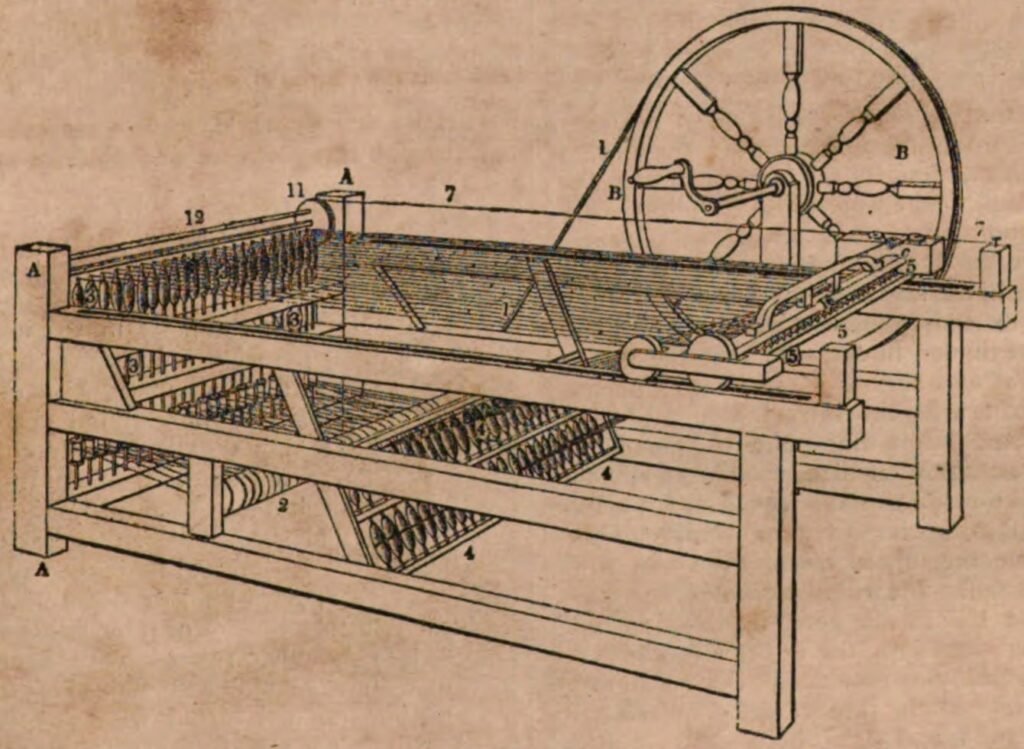
The spinning jenny was a hand-operated spinning machine that spun many threads at once instead of one. James Hargreaves of Lancashire patented it in 1770, and it marked one of the first steps in the development of cotton-spinning machinery.
History of the spinning jenny
Before the jenny, a spinner using a spinning wheel could make only one thread at a time. The flying shuttle, patented by John Kay in 1733, had greatly sped up weaving, and spinners struggled to supply enough yarn for the looms. Hargreaves, a largely self-taught weaver from the Blackburn area of Lancashire, set out to close that gap.
Reference works date his invention to 1764, and he received British patent number 962 in 1770. An older Science Museum Group catalog text places the invention between 1750 and 1757, so the date depends on the source. The patent described a wheel or engine that could spin, draw and twist sixteen or more threads at a time, managed by one person.
Hargreaves met hostility. In 1768 a mob from Blackburn attacked his house, and local spinners who feared for their jobs destroyed his machines. He fled to Nottingham, where he and Thomas James built a spinning mill, and he spent years in litigation trying to protect his patent. He died in 1778.
Who invented the spinning jenny?
Hargreaves is the recognized inventor, and no rival claimant appears in the sources used for this entry. His work still drew on earlier ideas. The Science Museum Group notes that Lewis Paul had invented the method of drawing out roving between pairs of rollers turning at different speeds in 1738. Hargreaves may not have known of it, since he did not use rollers in his jenny, but Richard Arkwright built them into his water frame in 1769.
The jenny, then, was one of several overlapping advances in cotton spinning during the 1760s. It differed from the water frame in being a hand-operated machine that worked with a moving carriage rather than with rollers.
How the spinning jenny works
The Science Museum Group describes the operation step by step. Loosely twisted cotton strands, called rovings, were wound on bobbins and held in a fixed rack below a moving carriage. They passed from the bobbins to the spindles between two wooden rails on the carriage, which could grip the rovings and release them.
The spinner moved the carriage out, stretching the rovings to a length, and then turned a wheel by hand. A band drove the spindles, which twisted the threads. The carriage was moved a little farther and the wheel turned again until the threads had the twist they needed. When the carriage was pushed back, a wire guide pressed on the yarn and wound it onto the spindles in cone-shaped masses called cops.
The early machine used eight spindles, according to historical accounts, and the carriage traveled about six feet. The arrangement let one spinner make many threads in the time one spinning wheel made a single thread.
Types and variants of the spinning jenny
Hargreaves’s first jenny was small and had eight spindles, but the design was soon enlarged. By the patent of 1770 it could spin sixteen or more threads, and a Science Museum Group text says one spinner could work 120 threads, a figure that must refer to machines larger than the first eight-spindle version. Spinning-jenny design was therefore less a single model than a family of hand-operated frames.
The jenny led directly to Samuel Crompton’s mule, which could spin much finer thread. The jenny lacked most of the motions the mule had, and the mule was later made automatic by Richard Roberts.
Spinning jenny vs. water frame
The jenny and Arkwright’s water frame appeared within a few years of each other, and they solved the spinning problem in different ways. The jenny multiplied the number of threads a person could spin by hand, using a moving carriage that stretched the rovings and a wheel that twisted them. The water frame, whose name points to its power source, drew out the roving between pairs of rollers turning at different speeds.
Each machine had limits. The jenny’s hand operation tied output to the strength and skill of the spinner, and it lacked most of the features that later allowed the finest threads to be spun. The water frame brought rollers into cotton spinning on a larger scale. The jenny led directly to Crompton’s mule, which could spin much finer thread.
Impact of the spinning jenny
The jenny increased the output of one spinner many times over and helped spinning keep pace with weaving. It became a symbol of the changes of the early Industrial Revolution, and the town of Blackburn grew rapidly as a center of cotton manufacture.
It also showed that new machines could provoke fear. As the Science Museum Group notes, Hargreaves became a victim of popular resentment against labor-saving machines and of the belief that they would throw many people out of work. Similar tensions followed the power loom, which mechanized weaving a few decades later, and the cotton towns around Manchester became the heart of the new factory system.
The spinning jenny today
No working jenny supplies the textile industry today, but the machine survives in museums. The Science Museum Group holds a replica built by Platt Brothers of Oldham between 1868 and 1912, and another replica built in 1971 from the patent drawings of 1770 and from a replica at Helmshore.
Models and replicas also appear in industrial museums elsewhere, including the Museum of Early Industrialization in Wuppertal, Germany.
More in Mechanical Engineering
Key facts
- James Hargreaves, a weaver from the Blackburn area of Lancashire, invented the spinning jenny in 1764 and patented it in 1770.2
- The patent, British patent number 962, described an engine that could spin sixteen or more threads at a time.3
- A mob attacked Hargreaves's house in 1768 and his machines were destroyed; he moved to Nottingham.2
- Lewis Paul invented roller drawing in 1738, and Arkwright built rollers into his water frame in 1769; Hargreaves did not use them in the jenny.1
- The jenny led directly to Crompton's mule, which could spin finer thread.1
Related concepts
Quick checkWho invented the spinning jenny?Show answer
James Hargreaves, a weaver of Blackburn, Lancashire, invented it in 1764 according to reference works and patented it in 1770, though an older museum text dates the invention earlier.
Sources
- Science Museum Group Collection, Replica of Hargreaves' Spinning Jenny (object co44544), https://collection.sciencemuseumgroup.org.uk/objects/co44544/replica-of-hargreaves-spinning-jenny-with-spare-wooden-spindles-original-and-spare-drive-cords
- The Oxford Companion to British History (J. Cannon), Hargreaves, James, via Encyclopedia.com, https://www.encyclopedia.com/history/encyclopedias-almanacs-transcripts-and-maps/hargreaves-james
- Jeremy Norman, James Hargreaves Invents the Spinning Jenny, History of Information, https://www.historyofinformation.com/detail.php?id=416
Editorially reviewed by Specialty Digest Editorial TeamLast reviewed November 4, 2026Researched and drafted with AI assistanceReport an issue