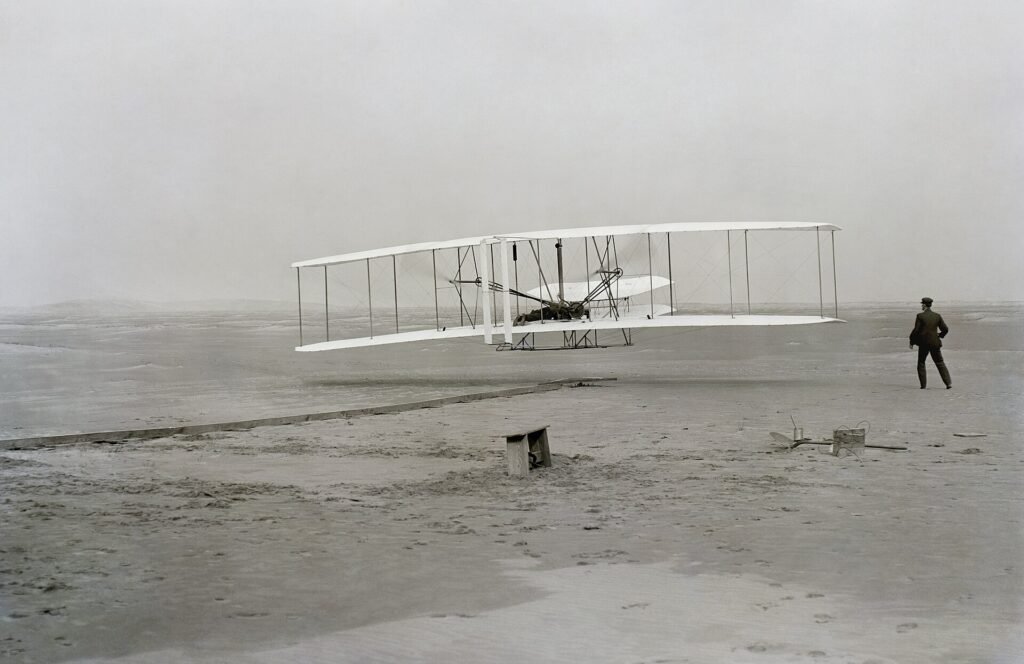
An airplane is a powered, fixed-wing aircraft that is heavier than air and flies because its wings produce lift as it moves forward. The first sustained and controlled flight of such a machine was made by Orville and Wilbur Wright on 17 December 1903 at Kill Devil Hills, near Kitty Hawk, North Carolina.
History of the airplane
The dream of flight is old. NASA lists the Greek legend of Icarus and Daedalus, kite flying in China, hydrogen-filled balloons in 18th-century France, and experiments with gliders in 19th-century England and Germany as steps along the way.
Around the turn of the 20th century, advances in engine technology and aerodynamics made powered flight in a heavier-than-air machine possible, yet attempts by leading designers proved unsuccessful. The honor of the first sustained and controlled flight went to two bicycle shop owners from Dayton, Ohio.
On 17 December 1903 Orville Wright flew the Wright Flyer for 12 seconds, covering 120 feet at a top speed of 6.8 miles per hour. The brothers made three more flights that day, taking turns at the controls. The longest covered 852 feet in 59 seconds, and the highest altitude in any flight was about 10 feet.
After the fourth flight, gusty winds tipped the machine over and wrecked it beyond repair, and it never flew again. Orville took the wreckage home to Ohio and restored it. It was displayed at the Science Museum in London until 1948, when the Smithsonian Institution took ownership, and it is now at the National Air and Space Museum in Washington, D.C.
The Wrights kept improving their designs, and by 1905 they had flown 24 miles in their Flyer III. Aircraft were first used in warfare in World War I. The first scheduled commercial passenger flight took place on 1 January 1914 between St. Petersburg and Tampa, Florida, and it shortened the trip between the two cities by more than 90 minutes.
Who invented the airplane?
The Wright brothers are credited with the first sustained and controlled flight of a powered, heavier-than-air aircraft, and the qualifying words matter. Others had flown in gliders and balloons, and claims of earlier hops by powered machines have been made, but those flights are generally not accepted as controlled and sustained.
Their breakthrough was three-axis control, the ability to steer the aircraft and keep its balance by controlling its pitch, roll and yaw. Combined with the mechanical experience they gained from running a bicycle business, it separated their work from that of the designers who failed to get off the ground. The National Park Service describes the four flights of that morning as the world’s first controlled flights.
The airplane was not the work of two people alone. Glider pioneers, engine builders and aerodynamics researchers all contributed, and other inventors in the United States and Europe quickly advanced the field after 1903.
How an airplane works
An airplane is acted on by four forces: lift, weight, thrust and drag. Its wings are shaped so that air moving over them produces lift, and the engine, driving a propeller or jet, supplies the thrust that keeps air moving past the wings against drag.
Control surfaces change the way the aircraft moves. Ailerons on the wings roll it, the elevator on the tail pitches the nose up or down, and the rudder yaws it left or right. The Wrights achieved roll control by twisting the wing tips, a method called wing warping, and modern aircraft use hinged ailerons instead.
Types of airplanes
Airplanes are grouped by how they are powered, how their wings are arranged and what they are for. Propeller-driven piston and turboprop aircraft are common for short routes and training. Jet airliners use turbofan engines, as described under jet engine.
The Wright Flyer was a biplane, with two wings stacked above one another. Most modern aircraft are monoplanes with a single wing on each side. By use, the main categories are passenger airliners, cargo aircraft, military aircraft, small private aircraft and seaplanes, which can take off from water.
Impact of the airplane
The airplane shortened distances. The Post Office was one of the first major users, speeding the delivery of mail across the United States, and scheduled passenger flights began in 1914. Today commercial aviation links nearly every region of the world.
Governments also invested in research. Within about a dozen years of the first flight, the United States formed the National Advisory Committee on Aeronautics, whose laboratories produced advances in aeronautics and later became part of NASA.
NACA research facilities, including the Langley laboratory in Hampton, Virginia, the Ames laboratory in Mountain View, California, the Lewis laboratory in Cleveland, Ohio, and a flight test unit at Muroc, now Edwards Air Force Base, led to many of those advances.
Air travel has costs as well as benefits. Aircraft consume large amounts of fuel and produce noise and carbon emissions, so efficiency and alternative fuels remain active areas of work.
Uses of the airplane today
Airplanes carry passengers and freight, patrol borders, fight fires, spray crops, deliver medical aid and train pilots. Large airports depend on air traffic control to keep flights separated and on schedule.
Modern airframes use lightweight composite materials and computer-assisted flight systems, but the arrangement the Wrights used, wings for lift, a power source for thrust and surfaces for control, remains the basis of the design.
FAQs about the airplane
How long did the first flight last? It lasted 12 seconds and covered 120 feet. The fourth flight of the day was the longest at 59 seconds.
Where is the original Wright Flyer? It is displayed at the Smithsonian’s National Air and Space Museum in Washington, D.C.
Is it an airplane or an aeroplane? Both words mean the same thing. Airplane is the usual American spelling, and aeroplane is common in British English.
More in Aviation and Air Transport
Key facts
- On 17 December 1903 Orville Wright flew the Wright Flyer for 12 seconds over 120 feet.1
- The longest of the four flights that day covered 852 feet in 59 seconds.1
- The Wrights' key advance was three-axis control.1
- The first scheduled commercial passenger flight was on 1 January 1914 between St. Petersburg and Tampa.1
- The four flights are described as the world's first controlled flights.2
Related concepts
In the news
Quick checkWho invented the airplane?Show answer
Orville and Wilbur Wright are credited with the first sustained and controlled flight of a powered heavier-than-air aircraft on 17 December 1903, building on earlier glider and engine work by others.
Sources
- NASA, 120 Years Ago: The First Powered Flight at Kitty Hawk, https://www.nasa.gov/history/120-years-ago-the-first-powered-flight-at-kitty-hawk/
- U.S. National Park Service, First Flights: December 17, 1903 (Wright Brothers National Memorial), https://www.nps.gov/places/6-first-flights-december-17-1903.htm
Editorially reviewed by Specialty Digest Editorial TeamLast reviewed November 4, 2026Researched and drafted with AI assistanceReport an issue