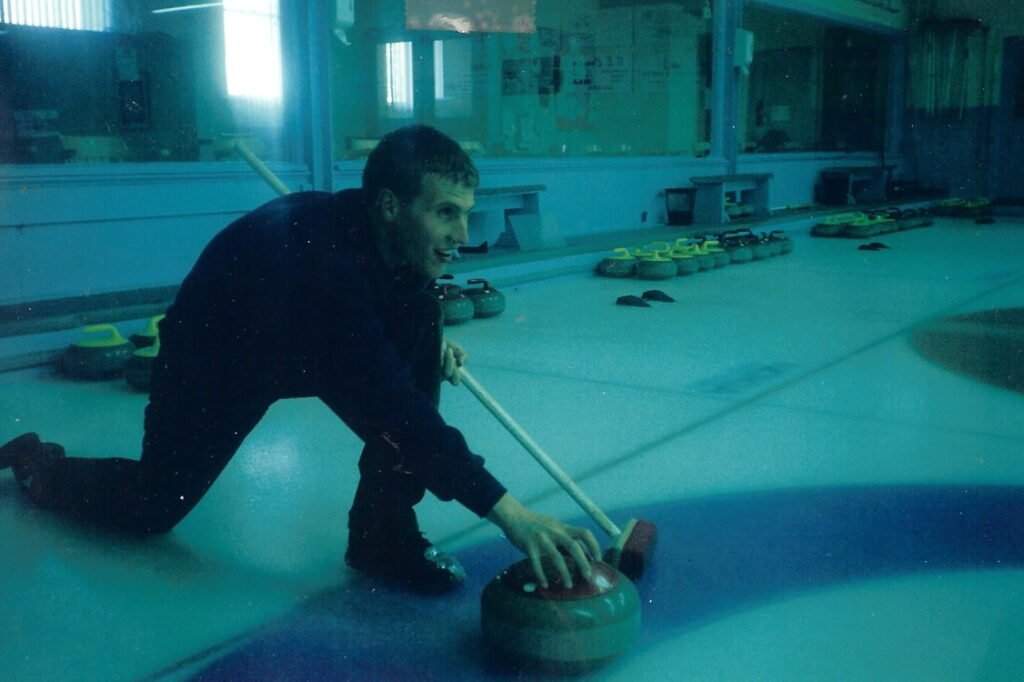
Curling is a team sport played on ice in which players slide heavy granite stones toward a circular target called the house, and the team with the stone closest to the center scores. International games last ten ends, and teammates sweep the ice in front of a moving stone to influence its path. World Curling governs the sport, which has been on the Winter Olympic medal program since 1998.
History of curling
Curling is widely believed to be one of the world’s oldest team sports. The earliest written evidence dates from 1540, when John McQuhin, a notary in Paisley, Scotland, recorded a challenge between a monk of Paisley Abbey and a representative of the abbot. The Flemish artist Pieter Bruegel, who lived from 1530 to 1569, painted a similar activity on frozen ponds.
Early curling was played on frozen lochs and ponds, and the first recognized clubs formed in Scotland. In the 19th century the game spread to Canada, the United States, Sweden, Switzerland, Norway and New Zealand. The Grand Caledonian Curling Club, formed in Edinburgh in 1838, adopted the first rules and became the governing body. After a demonstration at Scone Palace impressed Queen Victoria in 1842, the club was permitted in 1843 to become the Royal Caledonian Curling Club.
International organization came later. Six countries agreed in Perth in 1965 to form an international committee, and the International Curling Federation was established on 1 April 1966. It became an independent governing body in 1982, was renamed the World Curling Federation in 1990 and took the name World Curling in 2024.
Rules and how curling is played
Two teams of four players compete. Each player throws two stones, so each team throws eight, and an end is complete when all 16 stones have been delivered. Games last eight or ten ends, and international games are generally ten.
A stone must at least touch the outer ring of the house to count. After an end, the team with the stone closest to the center, known as the button, scores one point for each of its stones that is closer than the opponent’s nearest stone.
The last stone of an end is called the hammer. The team that did not score in the previous end throws it, and a blanked end, in which no one scores, leaves the hammer with the same team. Sweeping is allowed up to the tee line, and after a stone’s leading edge crosses that line only one player may sweep it.
The free guard zone rule protects stones placed in front of the house. Under the five-rock rule that World Curling adopted in 2017 for the 2018-19 season, opponents cannot remove them until five stones have been played. International games allow 73 minutes of thinking time per side, with two one-minute timeouts.
Mixed doubles is a separate format with two players per team, one man and one woman, a feature discussed more widely under gender in sport. Wheelchair curling also has its own competition, in which players who cannot throw from the hack may use a delivery stick.
Equipment and venues
Curling stones are made of granite and weigh between 17.24 and 19.96 kilograms. They may not exceed 914 millimeters in circumference and must be at least 114 millimeters high.
The sheet, or playing surface, is 45 to 46 meters long and 4.4 to 5.0 meters wide. The house has three rings with diameters of 4, 8 and 12 feet, centered on the tee line, which sits 16 feet (4.9 meters) from the backboard. Hog lines are 37 feet (11 meters) from the backboard, and the hacks, from which players push off, lie 12 feet behind each button. The game began on frozen lochs and ponds, but competitions now take place in indoor rinks with controlled ice.
Governing bodies and major competitions
World Curling set up its own headquarters in Edinburgh in 1994 and moved to Perth in May 2000. The Scotch Cup series between Scotland and Canada began in 1959, and its results are recognized as the early men’s world championship history. The Air Canada Silver Broom replaced it in 1968 and was sanctioned as the World Curling Championship. A world championship for women’s teams was endorsed in 1979, and the men’s and women’s events were combined in 1989.
The first World Mixed Doubles Curling Championship was held in 2008 in Vierumaki, Finland. The Curling World Cup debuted in 2018. A federation of this kind sets rules and sanctions events in the way described under sports governance.
Curling appeared at the 1924 Winter Games in Chamonix, where Great Britain won. The International Olympic Committee recognized this as its Olympic debut in 2006, and Olympedia now lists it as a full medal sport. Curling was a demonstration sport in 1932, 1988 and 1992, and the IOC gave it official medal status on 21 July 1992. It returned at Nagano in 1998 with eight teams, expanded to ten teams from 2002, and joined the Youth Olympic Winter Games in 2012.
Records and notable moments
The first world championship, the Scotch Cup, was held in Falkirk and Edinburgh in 1959, and the first title went to a team from Regina, Saskatchewan, skipped by Ernie Richardson.
Mixed doubles was accepted for the 2018 PyeongChang Olympics with eight teams, and it expanded to ten teams for Beijing 2022. Wheelchair curling was introduced in 2000, held its first world championship in January 2002 and joined the Paralympic program at Torino in 2006.
Olympedia lists Canada first in the Olympic medal table, with 14 medals including seven golds. Sweden follows with 13 medals including six golds, and Great Britain has seven medals including three golds.
Global reach of curling
From its Scottish origins, curling spread through the 19th century to Canada, the United States, Sweden, Switzerland, Norway and New Zealand, and those countries remain prominent in its results. Olympedia counts 525 athletes from 20 national Olympic committees across the Olympic editions it covers, and Switzerland, with nine Olympic medals, is among the leading nations alongside Canada and Sweden.
The sport depends on coordination, since the thrower, the sweepers and the skip, who directs play, must work as a unit, a theme explored under team cohesion.
More in Sports Coaching and Performance
Key facts
- The earliest written evidence of curling is from 1540 in Paisley, Scotland.1
- A match is played by two teams of four players, and international games last ten ends.2
- Curling stones are made of granite and weigh between 17.24 and 19.96 kilograms.2
- Curling became an official Winter Olympic medal sport in 1998 after the IOC granted medal status in 1992.1
- World Curling, the sport's governing body, took that name in 2024.1
Related concepts
Quick checkWhere did curling originate?Show answer
Curling is widely believed to have originated in Scotland, where the earliest written evidence, from 1540, records a challenge in Paisley, and where the first recognized clubs formed.
Sources
- World Curling, History of curling, https://worldcurling.org/about/history/
- Wikipedia, Curling (rules, equipment and dimensions), https://en.wikipedia.org/wiki/Curling
- Olympedia, Curling at the Olympic Games, https://www.olympedia.org/sports/CUR
Editorially reviewed by Specialty Digest Editorial TeamLast reviewed November 4, 2026Researched and drafted with AI assistanceReport an issue