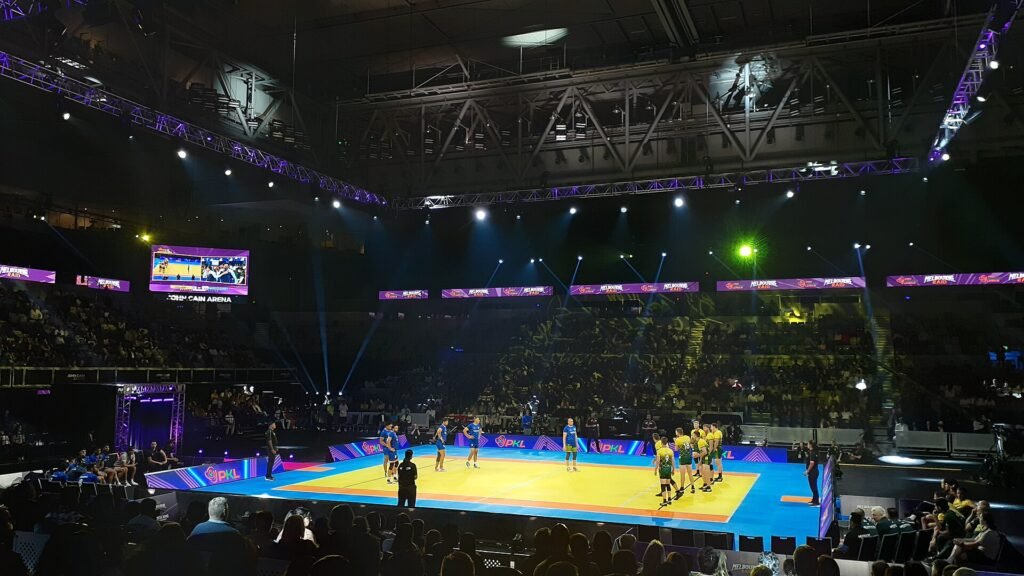
Kabaddi is a contact team sport from the Indian subcontinent in which a single raider enters the opposing half, tags defenders and tries to return home without being tackled. Two teams of seven players take the mat, and the raider must keep chanting the word “kabaddi” in a single breath throughout the raid. The sport is played in many regional forms and is now organized into professional leagues and Asian Games competitions.
History of kabaddi
Kabaddi is an indigenous Indian game, and its exact origin is unclear. Popular accounts place its history at about 4,000 years, though no single source settles the date. It has several regional names, including Hu-tu-tu in Maharashtra, Chedugudu or Gudugudu in the south, Ha-du-du and Chu-kitkit in the east, and Kabaddi in the north.
The game was shown as a demonstration at the 1936 Berlin Olympics and introduced to the Indian Olympic Games in 1938. Modern rules were framed in India during the twentieth century, and the Amateur Kabaddi Federation of India was founded in 1973.
The sport entered the Asian Games as a demonstration event in 1951 and 1982, and it became a medal event at the 1990 Beijing Games. India, China, Japan, Malaysia, Sri Lanka, Pakistan and Bangladesh took part that year, and India won the gold medal.
Rules and how kabaddi is played
Each team may name 10 to 12 players, with seven on the mat at a time and up to five available as substitutes. A standard match for men and junior boys has two halves of 20 minutes with a five-minute interval. Women and younger players play two halves of 15 minutes.
Teams take turns sending a raider across the center line into the other half. The raider chants “kabaddi” without drawing breath, tries to touch defenders and must return to his or her own side before the breath runs out. A raid counts only if the raider gets back safely, and defenders try to stop the return by tackling the raider or pushing him or her out of bounds.
Points are scored in several ways.
- One point goes to the raiding team for each defender who is tagged and declared out.
- One point goes to the defense when it tackles the raider or the raider loses the chant or steps out of bounds.
- Two bonus points, known as a lona or all-out, are awarded when every player on one team has been put out. The eliminated team then returns to the mat.
- One bonus point is scored when a raider crosses the bonus line with one foot while the other foot is in the air. It applies only when the defending side has at least six players on the mat.
Tagged defenders leave the mat and can be revived when their team scores later. If a match ends level, a seven-minute mini match is played, followed by a sudden-death raid called a golden raid and, if needed, a coin toss.
Substitutes may enter with the referee’s permission during a time-out or the interval, and a player who has been substituted may later return. No substitution is allowed for players who are out, and suspended or disqualified players are not replaced, so their team plays short-handed. The last raid of each half may finish after time expires, and on the way back a raider may cross the court only through the midline.
Players use a small set of skills. Raiders rely on touches and kicks, while defenders use holds on the ankle, thigh, waist and wrist, and they also block the raider’s path.
Equipment and venues
Kabaddi needs very little equipment, which is part of its appeal in villages and schools. The traditional playing surface was a stretch of muddy ground, and the sport is now mostly played on padded mats. Senior men’s courts are 13 meters long and 10 meters wide, and women’s courts are 12 meters by 8 meters, although sizes vary by tournament and age group.
A center line splits the court into equal halves. In each half, the baulk line lies 3.75 meters from the center line, and the bonus line sits one meter behind the baulk line. A referee and an umpire control the match, including time-outs and substitutions, with each team allowed two time-outs per half.
Governing bodies and major competitions
The International Kabaddi Federation was founded in 2004 and ran the first Kabaddi World Cup that year. A second body, World Kabaddi, was founded in 2018 and holds its own World Cup. The Asian Kabaddi Federation governs the sport in Asia and is affiliated with the Olympic Council of Asia. For how such bodies fit together, see sports governance.
The Pro Kabaddi League, a franchise competition, began in India on 26 July 2014 with eight teams. Its rules differ from the standard code, adding a 30-second raid limit, a do-or-die raid in which three successive empty raids put the raider out, a super raid and a super tackle.
Records and notable moments
India won the men’s gold medal at each Asian Games from 1990 to 2014, and Iran won the men’s title in 2018. A women’s event was added to the Asian Games in 2010. In the Kabaddi World Cup that is run under the International Kabaddi Federation, India has won most of the editions, with Iran frequently finishing second.
Global reach of kabaddi
Kabaddi is rooted in South Asia, and it is played in India, Pakistan, Bangladesh and Sri Lanka, among other countries. Nations from East Asia and the Middle East, including Japan, South Korea and Iran, also field teams at the Asian Games. A professional league and exhibition matches have taken the sport to other regions, and an exhibition match between a Pro Kabaddi all-star team and an Australian side was played in Melbourne in December 2024.
Kabaddi is not part of the Olympic program, and its main international stage is the Asian Games, which are run by the Olympic Council of Asia.
More in Sports Coaching and Performance
Key facts
- Array
Related concepts
Quick checkWhy does a kabaddi raider chant the word kabaddi?Show answer
The raider must keep chanting "kabaddi" in a single breath to show they are not drawing breath, and must return to their own half before the breath ends or the raid fails.
Sources
- Array
Editorially reviewed by Specialty Digest Editorial TeamLast reviewed November 4, 2026Researched and drafted with AI assistanceReport an issue