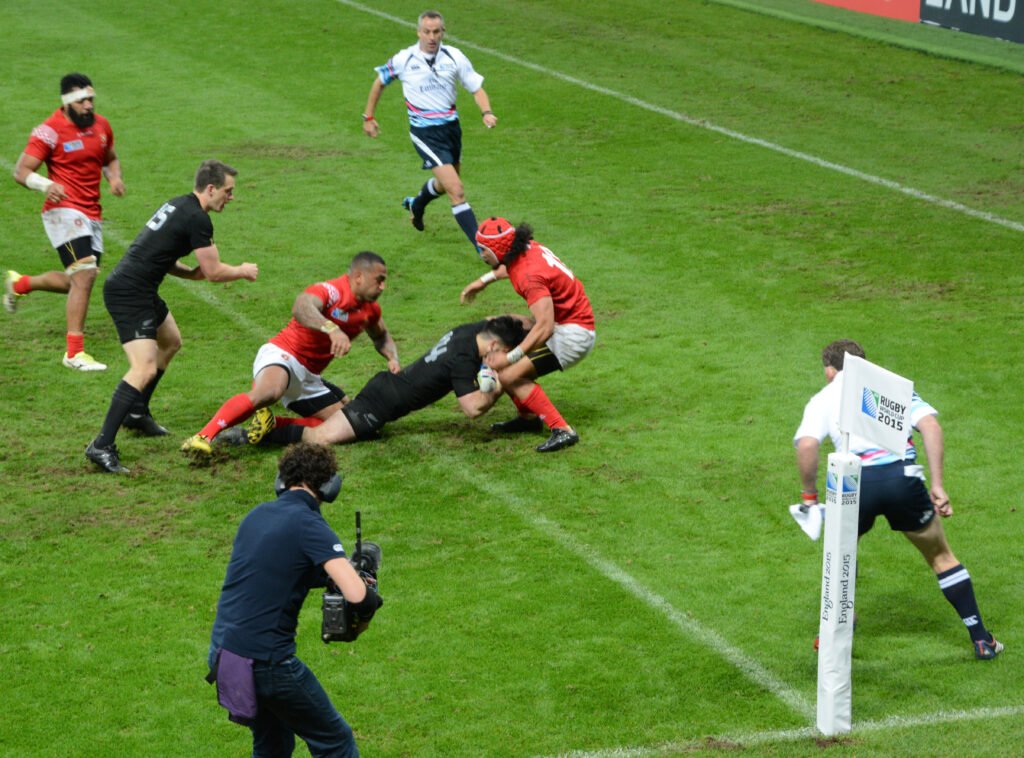
Rugby union is a team sport in which two teams of 15 players try to score by carrying, passing and kicking an oval ball and grounding it in the opponents’ in-goal area. A match lasts up to 80 minutes in two halves, and a try is worth five points. The sport is governed worldwide by World Rugby, which counts more than 130 member unions.
History of rugby union
A popular story says that in 1823 a Rugby School pupil named William Webb Ellis picked up the ball during a football game and ran with it. The World Rugby Museum notes that the story first appeared in 1876, in a letter by Mathew Bloxam to the school magazine, and that Bloxam had not witnessed the event himself. Many historians doubt it and call it the Webb Ellis myth.
The documented history starts with rules. Pupils at Rugby School compiled the first written rules in 1845, and running with the ball had been legislated for earlier, in 1841. Some historians argue that running with the ball developed gradually through school rule enforcement rather than from one boy’s act.
The Rugby Football Union (RFU) was formed in 1871. On March 27, 1871, Scotland hosted England in the first international match before about 4,000 spectators. Ireland began playing England and Scotland in 1875 and 1877, and the Welsh Rugby Union was formed in 1881.
In 1886 Ireland, Scotland and Wales formed the International Rugby Football Board after a contested try, proposing a neutral body to govern the rules. The RFU joined in 1890 and held half of the board’s 12 votes. New Zealand, South Africa and Australia joined in 1949.
Class and money split the sport. In August 1895 northern English clubs left the RFU over payments to players, which the union banned, and formed what became rugby league. Sources differ on whether 21 or 22 clubs took part. Rugby union itself stayed amateur until August 1995, when its governing body oversaw the move to professionalism.
Rules and how rugby union is played
No more than 15 players per team may be on the field during play. A match lasts no longer than 80 minutes, in two halves of no more than 40 minutes each plus time lost to stoppages. Half-time can last up to 15 minutes, and extra time is allowed only in knockout matches when the organizer authorizes it. In non-international matches the organizer may shorten the game. A half ends when the ball goes dead after time has expired, unless a scrum, line-out or restart kick awarded before time ran out has not yet been completed.
Under World Rugby’s Law 8, a try is worth 5 points, a conversion 2, a penalty goal 3 and a dropped goal 3. A tackle is defined as holding a ball-carrier and bringing that player to ground. A scrum is a set piece that normally consists of eight players from each team bound together in formation.
Britannica compares the two rugby codes: in union, a team can hold possession indefinitely while the ball is controlled and not lost forward, whereas in league each team gets a limited number of tackles. Union also keeps the ruck and the line-out, which league dispensed with in the early 20th century.
Equipment and venues
The Laws of the Game set the field of play at no more than 100 meters long and 70 meters wide, with a minimum of 94 by 68 meters. The in-goal area at each end may be between 6 and 22 meters deep. The crossbar of the goal posts is 3 meters above the ground to its top edge.
The oval ball weighs between 410 and 460 grams. Rugby’s equipment is otherwise modest, and the Laws concentrate on the playing area and the ball rather than on kit.
Governing bodies and major competitions
World Rugby is headquartered in Dublin, Ireland, with offices in London and Sydney. It describes itself as an international federation and a global movement, with 135 national member federations and six regional associations. Another page on its site notes that Benin became the newest member in September 2025, bringing the total to 134 unions, so the exact count depends on the page and the date.
The body began as the International Rugby Football Board in 1886. It became the International Rugby Board in 1998, and it was renamed World Rugby in November 2014. The board approved a Rugby World Cup in 1985, and the first men’s tournament was co-hosted by New Zealand and Australia in 1987.
The Women’s Rugby World Cup was first held in 1991, and World Rugby has governed it since 1998. Both World Cups are held every four years, and World Rugby calls the men’s tournament the third-largest sporting event in the world today. In October 2009 the return of rugby sevens to the Olympic program was secured.
Notable moments in rugby union history
In 1893 southern clubs defeated a proposal at an RFU meeting to allow broken time payments, which set up the split two years later. In 1905 Wales beat the touring New Zealand side, the only team to do so on that tour.
France joined the Home Nations in 1910 to create the Five Nations, and Italy joined in 2000, when the competition became the Six Nations. In 1932 the Home Nations unions cut ties with France over professionalism, and relations were restored in 1945.
Rugby union around the world
The game left the British Isles with students, soldiers and teams on tour. It was played in France by 1870, and McGill University played Harvard in a notable match in North America in 1874. Rugby was an Olympic sport in 1920 and 1924, and players from the American West Coast won gold both times.
World Rugby says the Rugby World Cup helped spread the game worldwide after 1987. Its membership now spans every region of the world through its six regional associations.
More in Sports Coaching and Performance
Key facts
- Rugby union is played by teams of 15, and a match lasts no longer than 80 minutes.67
- A try is worth 5 points, a conversion 2, a penalty goal 3 and a dropped goal 3.5
- The International Rugby Football Board was formed in 1886 and was renamed World Rugby in November 2014.1
- The first men's Rugby World Cup was held in 1987, and the first Women's Rugby World Cup in 1991.18
- The Rugby Football Union was formed in 1871, and the first international match was played that year.4
Related concepts
Quick checkDid William Webb Ellis invent rugby?Show answer
The story that he picked up the ball and ran in 1823 first appeared in 1876 and was not witnessed by its source, so many historians call it a myth. Rugby School pupils wrote the first rules in 1845.
Sources
- World Rugby, History, https://www.world.rugby/organisation/about-us/history
- World Rugby, Overview, https://www.world.rugby/organisation/about-us/overview?lang=en
- World Rugby Museum, William Webb Ellis and the Origins of Rugby: a new perspective, https://worldrugbymuseum.com/from-the-vaults/club-rugby/william-webb-ellis-and-the-origins-of-rugby-a-new-perspective
- Britannica, Rugby: The growth of the game, https://www.britannica.com/sports/rugby/The-growth-of-the-game
- World Rugby Passport, Laws of the Game: 8 Scoring, https://passport.world.rugby/laws-of-the-game/laws-by-number/8-scoring/
- World Rugby, Laws of the Game 2026 (Rugby Union), https://passport.world.rugby/media/jxrnmptk/2026en-laws-of-the-game-compressed.pdf
- World Rugby Passport, Laws of the Game: 5 Time, https://passport.world.rugby/laws-of-the-game/laws-by-number/5-time/
- World Rugby Museum, A brief history of the Rugby World Cup, https://worldrugbymuseum.com/from-the-vaults/rugby-world-cup/a-brief-history-of-the-rugby-world-cup
- Britannica, Rugby: Principles of play, https://www.britannica.com/sports/rugby/Principles-of-play
Editorially reviewed by Specialty Digest Editorial TeamLast reviewed November 4, 2026Researched and drafted with AI assistanceReport an issue