Ireland is a country occupying most of an island of the same name in the North Atlantic, off the northwestern coast of Europe. It is formally known as the Republic of Ireland (in Irish, Éire) and should not be confused with Northern Ireland, which covers the northeastern part of the same island and is a separate jurisdiction that remains part of the United Kingdom. The Republic of Ireland is an independent, sovereign state, a member of the European Union, and one of the world’s most economically globalized small countries.
Where Is Ireland? Location and Geography
Ireland sits at the western edge of Europe, separated from Great Britain by the Irish Sea and from mainland Europe by several hundred miles of open Atlantic. The Republic covers about 70,000 square kilometers (roughly 27,000 square miles), or a little over five-sixths of the island of Ireland, with Northern Ireland making up the remainder in the northeast.
The country’s interior is a broad, low-lying plain of farmland, bog, and lakes, ringed by a rim of hills and low mountains near the coast. The River Shannon, the longest river in Ireland or Britain, runs roughly through the center of the country before reaching the Atlantic. Ireland’s climate is temperate and maritime, kept mild through the winter by the Gulf Stream, with frequent rain and few temperature extremes.
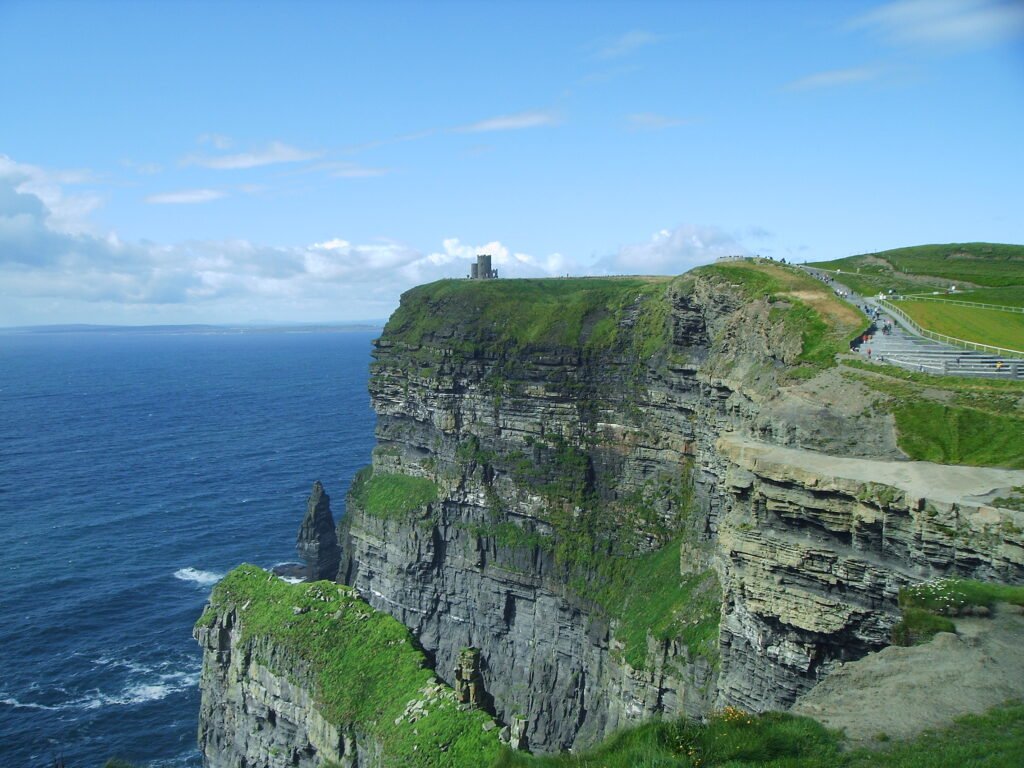
The Atlantic coastline, especially along the west, is the country’s most dramatic natural feature: a long, irregular edge of bays, peninsulas, and sea cliffs shaped by centuries of wave action. The best known of these are the Cliffs of Moher in County Clare, which rise more than 200 meters (about 700 feet) above the sea and are the most widely photographed natural landmark associated with the country.
A Brief History of Ireland
Ireland’s recorded history begins with Celtic-speaking peoples who settled the island by roughly the last centuries BCE, developing a rich oral and legal tradition organized around local kingships. Christianity arrived by the 5th century CE, traditionally associated with the missionary Saint Patrick, and Irish monasteries later became centers of learning and manuscript production known across early medieval Europe.
From the late 8th century, Viking raiders attacked and eventually settled parts of the coast, founding what became Dublin as a trading settlement. A Norman invasion beginning in 1169 opened centuries of English involvement in Ireland, which deepened over time into direct rule from London. In 1801, the Act of Union formally merged Ireland into the United Kingdom of Great Britain and Ireland.
The Great Famine of 1845 to 1852, caused by repeated failures of the potato crop, killed roughly one million people and drove mass emigration, permanently reshaping the island’s population and seeding large Irish communities abroad. Nationalist and republican movements grew through the following decades, culminating in the Irish War of Independence (1919 to 1921). The 1921 Anglo-Irish Treaty ended that conflict by creating the Irish Free State while partitioning six northeastern counties, which remained within the United Kingdom as Northern Ireland. The Free State became a fully independent republic in 1949.
Northern Ireland experienced decades of sectarian and political violence commonly known as the Troubles, from the late 1960s until the 1998 Good Friday Agreement, a peace settlement negotiated by the British and Irish governments together with Northern Irish parties. That agreement remains the basis for governance and cross-border cooperation on the island today.
Government and Economy in Brief
The Republic of Ireland is a parliamentary republic. Its legislature, the Oireachtas, consists of two houses: Dáil Éireann, the directly elected lower house where governments are formed, and Seanad Éireann, a smaller upper house. A president, elected directly by voters for a seven-year term, serves as head of state in a largely ceremonial role, while a head of government known as the Taoiseach leads the cabinet drawn from the Dáil.
Ireland joined the European Economic Community, the forerunner of the European Union, in 1973, and adopted the euro as its currency at the currency’s launch. It has built an unusually open, export-oriented economy for its size, anchored by a large presence of foreign multinational companies, particularly in technology, pharmaceuticals, and medical devices, alongside a long-standing agricultural sector centered on dairy and beef production. Ireland is also a member of the World Bank Group, which it joined in 1957, and a shareholder in the International Finance Corporation and the International Development Association.
Culture and People
Ireland has two official languages, Irish (Gaeilge) and English. English is the everyday language for the large majority of the population, while Irish remains the first language of small Gaeltacht communities, mainly along the western coast, and is taught in schools nationwide as part of a broader effort to sustain it. Roman Catholicism has historically been the largest religious tradition on the island, though Irish society today includes a wide range of beliefs and a growing share of people with no religious affiliation.
The country’s contribution to literature in English is large relative to its population, including Nobel laureates William Butler Yeats, George Bernard Shaw, Samuel Beckett, and Seamus Heaney, alongside writers such as James Joyce, Oscar Wilde, and Bram Stoker. Traditional Irish music, built around instruments like the fiddle, the button accordion, and the uilleann pipes, remains widely played in informal sessions in pubs and at festivals, and has strongly influenced folk and popular music internationally. Centuries of emigration, driven first by famine and later by economic downturns, produced Irish communities across North America, Britain, and Australia that remain a visible part of the country’s identity and its diplomatic relationships abroad.
What Ireland Is Best Known For
Internationally, Ireland is most associated with its rugged Atlantic coastline, epitomized by the Cliffs of Moher, and with a set of ancient and early medieval monuments recognized by UNESCO. The Brú na Bóinne complex in County Meath, which includes the Neolithic passage tomb of Newgrange, and the early medieval monastic site of Skellig Michael (Sceilg Mhichíl) off the coast of County Kerry are both inscribed on the UNESCO World Heritage List. Beyond its monuments and coastline, Ireland is known globally for its literary tradition, its traditional music, and the worldwide celebration of St. Patrick’s Day, alongside its more recent role as a European base for major technology and pharmaceutical companies.
Why Ireland Matters
Ireland’s importance is out of proportion to its small size and population of roughly 5.5 million. As a long-standing member of the European Union and the eurozone, it sits inside the EU’s single market while maintaining close economic and political ties to the United Kingdom and the United States. Its history of famine, emigration, and colonial rule, followed by independence and a peace process in the north, is frequently studied as a case of a small nation negotiating sovereignty, identity, and reconciliation. Economically, Ireland’s role as a European hub for global technology and pharmaceutical firms gives it outsized influence on debates over corporate taxation and multinational investment. Culturally, its literature, music, and diaspora have given Ireland a global visibility that far exceeds its geographic footprint.
Key Takeaways
- Ireland is an independent country covering most of the island of Ireland in the North Atlantic; Northern Ireland, on the same island, is a separate part of the United Kingdom.
- Its population was estimated at about 5.46 million in April 2025, with Dublin, the capital, home to roughly 29 percent of that total.
- Ireland’s history moves from Celtic and early Christian settlement through Viking and Norman incursions, centuries of British rule, the Great Famine, and independence in the early 20th century, with the island later partitioned.
- It is a parliamentary republic with a ceremonial president, a head of government called the Taoiseach, and a two-chamber parliament, the Oireachtas.
- The economy is small but highly globalized, built on European Union membership, the euro, and a large multinational technology and pharmaceutical sector.
- Two UNESCO World Heritage Sites, Brú na Bóinne and Skellig Michael, sit alongside the Cliffs of Moher as the country’s best-known landmarks.
- Irish literature, traditional music, and a large global diaspora give Ireland cultural influence well beyond its size.
Sources
- Central Statistics Office (Ireland), “Population and Migration Estimates, April 2025,” cso.ie
- World Bank, “Ireland Overview,” worldbank.org/en/country/ireland/overview
- UNESCO World Heritage Centre, “Brú na Bóinne, Archaeological Ensemble of the Bend of the Boyne,” whc.unesco.org/en/list/659
- UNESCO World Heritage Centre, “Sceilg Mhichíl (Skellig Michael),” whc.unesco.org/en/list/757
Key facts
- Capital: Dublin
- Population: about 5.46 million (Republic of Ireland, April 2025 estimate, CSO)
- Official languages: Irish and English
- Government: parliamentary republic
- Currency: Euro
- EU member since: 1973
Quick checkWhat are Ireland's two official languages?Show answer
Irish (Gaeilge) and English.
Sources
- Central Statistics Office (Ireland), "Population and Migration Estimates, April 2025," cso.ie
- World Bank, "Ireland Overview," worldbank.org/en/country/ireland/overview
- UNESCO World Heritage Centre, "Bru na Boinne, Archaeological Ensemble of the Bend of the Boyne," whc.unesco.org/en/list/659
- UNESCO World Heritage Centre, "Sceilg Mhichil (Skellig Michael)," whc.unesco.org/en/list/757
Editorially reviewed by Specialty Digest Editorial TeamLast reviewed September 27, 2026Researched and drafted with AI assistanceReport an issue