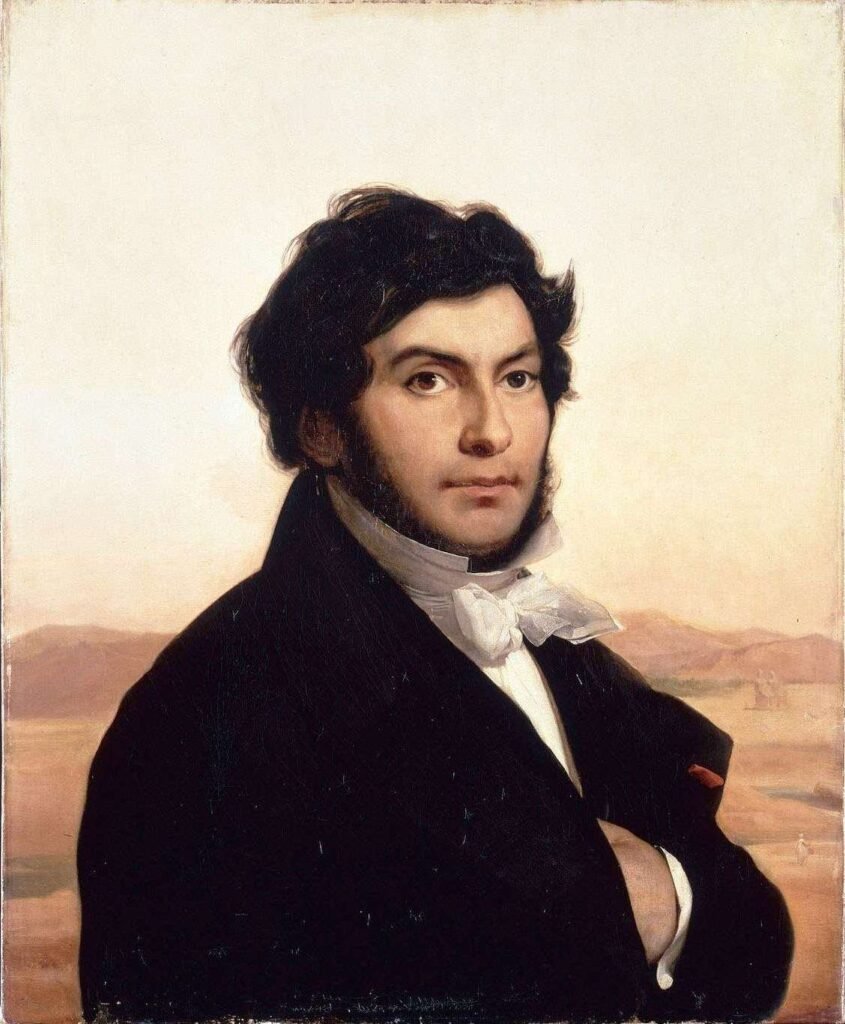
Jean-François Champollion (1790 to 1832) was a French scholar who deciphered ancient Egyptian hieroglyphs and is regarded as the founder of scientific Egyptology. In 1822 he showed that hieroglyphic writing combined signs for sounds with signs for ideas, which let scholars read inscriptions that had been unreadable for centuries. His work turned the Rosetta Stone from a puzzle into a key to the written voice of an entire civilization.
Early life of Jean-François Champollion
Champollion was born on December 23, 1790, in Figeac, a town in southern France. He was the youngest child of Jacques-Joseph Champollion, a bookseller, and his wife Jeanne-Françoise. His brother, also named Jacques-Joseph, was twelve years older and later called himself Champollion-Figeac. The younger brother became known as Champollion le Jeune, meaning “the younger,” to tell the two apart.
The family was not wealthy, but the boy was precocious. According to the MacTutor biography, at about age five he taught himself to read by comparing prayers he had memorized with the printed prayer book. By the age of ten he could read Greek and Latin as well as French. His brother then took charge of his education, and in 1801 the boy moved to Grenoble to live with him.
In Grenoble he studied Hebrew and then Arabic, Syriac and Chaldean, and in 1804 he entered the local lycée, a state secondary school. There he met Joseph Fourier, the mathematician who had joined Napoleon‘s 1798 expedition to Egypt as a scientific adviser and who now served as the regional prefect. Fourier encouraged the student’s interest in Egypt and helped protect his time for private study. In 1807, at sixteen, Champollion lectured to the Grenoble Society of Arts and Sciences on the geography of Egypt and was soon elected a member.
He then moved to Paris, where he took courses at the Collège de France and the School of Oriental Languages. His studies there included Persian, Hebrew, Syriac and Coptic. Coptic is the latest stage of the Egyptian language, and Champollion became convinced it was the bridge to the ancient tongue. In a 1809 letter to his brother he wrote that he dreamed in Coptic. He returned to Grenoble to teach history at the university, but his support for Napoleon cost him the post after the emperor’s final defeat in 1815, and he was sent into a period of exile in Figeac.
Major contributions of Jean-François Champollion
The Rosetta Stone is a slab of black stone found by French soldiers near the town of Rosetta, in the Nile delta, in July 1799. It carries one decree honoring King Ptolemy V in three kinds of writing: Egyptian hieroglyphs, demotic (a cursive Egyptian script) and ancient Greek. Scholars could read the Greek, so they knew the message. The open question was how the hieroglyphs worked. Many believed each sign stood only for an idea, like a pictograph, rather than for a spoken sound.
Progress came from several people. The English polymath Thomas Young showed in the 1810s that demotic had developed from hieroglyphic writing and contained alphabetic signs. Champollion began working on the stone in 1808, and in an 1821 paper he still claimed that hieroglyphs represented things, not sounds. After reading Young’s work he recognized the paper was wrong and went much further.
His decisive step combined two tools. The first was his command of Coptic, which let him match Egyptian signs to real words and sounds. The second was the names of rulers, which were written phonetically even in hieroglyphic texts, including the titles and names of Greek and Roman sovereigns. On September 27, 1822, he announced his results to the Academy of Inscriptions in Paris, and he published them that year as the Lettre à M. Dacier. His central conclusion was that hieroglyphic writing was both ideographic and phonetic, meaning its signs could stand for ideas and for sounds at the same time. He set out the full system in the Précis du système hiéroglyphique des anciens Égyptiens in 1824.
Champollion then built the field around the decipherment. In 1826 he became curator of the Egyptian collections at the Louvre, where he arranged a new exhibition. From 1828 to 1830 he led a Franco-Tuscan expedition up the Nile with the Italian scholar Ippolito Rosellini, copying inscriptions and collecting objects. He was dismayed by the looting of tombs in the Valley of the Kings. In 1831 a chair of Egyptian history and archaeology was created for him at the Collège de France, but illness allowed him to give only three lectures.
His reputation was not free of controversy. Young felt that Champollion never gave him fair credit, and some scholars in France and Germany doubted the decipherment for years. Those doubts faded only after his brother published his Egyptian grammar and dictionary after his death.
Legacy of Jean-François Champollion
Champollion died in Paris on March 4, 1832, after a series of strokes, at the age of 41. He was buried in the Père Lachaise Cemetery. Honors followed, including a museum in Figeac and a crater on the far side of the Moon that bears his name.
His real legacy is that Egypt can now speak in its own words. Temple walls, tomb paintings, royal decrees and religious texts that had been decoration became history, letters and literature. Egyptology grew into a full academic discipline on that foundation, and later scholars refined his readings of grammar and vocabulary.
His method also matters beyond Egypt. He solved a hard problem by comparing a text in an unknown script with a text in a known one, and by tying a lost language to a living descendant. That approach remains central to decipherment today and is a classic case study in linguistics.
FAQs
When was Jean-François Champollion born? He was born on December 23, 1790, in Figeac, France, and died in Paris on March 4, 1832.
What is Champollion famous for? He is famous for deciphering Egyptian hieroglyphs in 1822, using the Rosetta Stone and his knowledge of Coptic.
Did Champollion work alone on hieroglyphs? No. Thomas Young made important earlier findings, and Champollion built on the work of others, though he went much further than any of them.
What did Champollion prove about hieroglyphs? He proved that hieroglyphs record the spoken Egyptian language, using signs for both sounds and ideas.
More in Languages & Linguistics
Key facts
- Champollion was born in Figeac, France, on December 23, 1790, and died in Paris on March 4, 1832.12
- He announced his decipherment of hieroglyphs to the Academy of Inscriptions on September 27, 1822.1
- His key finding was that hieroglyphic signs could be both phonetic and ideographic.2
- He became curator of the Egyptian collections at the Louvre in 1826.2
- He led a Franco-Tuscan expedition to Egypt from 1828 to 1830.12
Related concepts
In the news
Quick checkWhat did Champollion show about Egyptian hieroglyphs in 1822?Show answer
He showed that hieroglyphs combine signs for sounds with signs for ideas, so they record the spoken Egyptian language.
Sources
- MacTutor History of Mathematics, Jean-François Champollion, https://mathshistory.st-andrews.ac.uk/Biographies/Champollion/
- Encyclopedia of Modern Europe (Encyclopedia.com), Champollion, Jean-François, https://www.encyclopedia.com/history/encyclopedias-almanacs-transcripts-and-maps/champollion-jean-francois
Editorially reviewed by Specialty Digest Editorial TeamLast reviewed November 4, 2026Researched and drafted with AI assistanceReport an issue