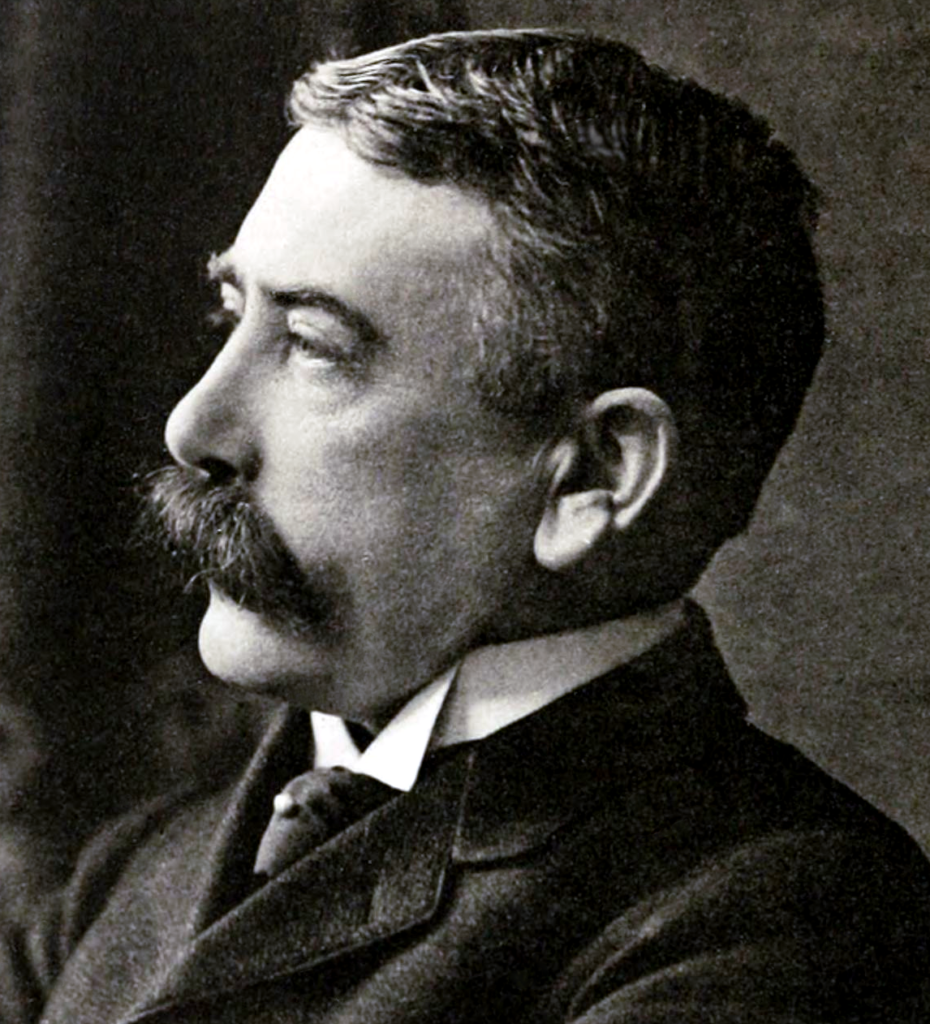
Ferdinand de Saussure (1857 to 1913) was a Swiss linguist whose ideas became the foundation of structural linguistics and, later, of structuralism across the humanities and social sciences. He argued that language should be studied as a system of signs, in which each element gets its value from its relations to the others. His ideas reached the world mainly through the Course in General Linguistics, a book assembled by his students after his death.
Early life of Ferdinand de Saussure
Saussure was born in Geneva, Switzerland, on November 26, 1857, into a family known for its scientists. He showed an early talent for languages. By about age 15 he had learned Greek, French, German, English and Latin, and he wrote a short essay on the nature of language. He began university studies in Geneva in the natural sciences, but he stayed only a year before persuading his parents to let him study linguistics in Leipzig, Germany, in 1876.
Leipzig was then the leading center for the comparative study of the Indo-European languages. Saussure also spent time in Berlin. While still in his early twenties he wrote his Mémoire sur le système primitif des voyelles dans les langues indo-européennes, a study of the vowels of the parent language behind most European and many South Asian tongues. It was published in 1879. He earned his doctorate at Leipzig in 1880.
In 1881 he moved to Paris, where he lectured at the École Pratique des Hautes Études until 1891. In 1891 he returned to Geneva and taught Sanskrit and historical linguistics at the university. He remained in Geneva for the rest of his career and died on February 22, 1913, at the age of 55.
Major contributions of Ferdinand de Saussure
Saussure’s first major contribution was in historical linguistics, the study of how languages change over time. In the Mémoire he proposed that the reconstructed ancestor of the Indo-European language family once contained sounds that had later disappeared but had left traces in the vowels of the daughter languages. This idea became known as the laryngeal theory. It had little direct evidence at first. After his death, the discovery and decipherment of the ancient Hittite language showed a consonant in many of the places his theory predicted, and scholars now accept some version of it.
His broader fame rests on the Course in General Linguistics, published in 1916 by his former students Charles Bally and Albert Sechehaye. They worked from notebooks taken by students in the three courses on general linguistics he gave at Geneva between 1907 and 1911. Saussure did not write the book himself, which is why scholars still debate how closely it reflects his own thinking. Robert Godel published surviving manuscripts and class notes in 1957 to help answer that question.
The Course introduced several distinctions that remain basic to the field.
The first is the linguistic sign. Saussure described a sign as having two inseparable sides: the signifier, which is the sound pattern or acoustic image, and the signified, which is the concept. He held that the link between them is arbitrary. Nothing about the sounds in the word “ox” ties them to the animal, which is why French uses boeuf and German uses Ochse. Yet for speakers of a language the link is fixed by social convention and cannot be changed at will.
The second is the difference between langue and parole. Langue is the shared system of a language, which exists in a community of speakers. Parole is the individual act of speaking. Saussure argued that linguists should focus on langue because it is the stable system that makes individual speech possible. He compared it to the rules of chess: the rules define the game, and the material of the pieces does not matter, as long as each piece can be told apart from the others.
The third is the contrast between synchronic and diachronic study. Synchronic study describes a language at one moment in time, while diachronic study follows its change through history. Saussure insisted that the first deserved to be treated as a subject in its own right. He also described two kinds of relations among linguistic elements: syntagmatic relations between items that occur together in a sentence, and paradigmatic relations between an item and others that could have taken its place.
He also suggested that a wider science of signs, which he called semiology, could be built on the same ideas.
Legacy of Ferdinand de Saussure
The Course shaped twentieth-century linguistics. Its emphasis on language as a structured system guided the Geneva school of Bally, Sechehaye, Godel and Henri Frei, and it influenced the Prague school and the Danish linguist Louis Hjelmslev. Because it held that a sound matters only by its difference from other sounds, it also anticipated the idea behind the phoneme. It also gave new force to the study of meaning as a product of relations within a system.
Beyond linguistics, Saussure’s view that meaning arises from structure inspired structuralism in anthropology, literary theory and the social sciences, as well as the field of semiotics, the study of signs. His concept of langue as a social fact also resembles the sociologist Emile Durkheim’s thinking, although no direct influence between the two has been found.
Later scholars criticized his approach. Some argued that treating language as a closed system leaves out social context, individual creativity and historical change. Others noted that many of his ideas had precedents in earlier nineteenth-century work. Even so, his vocabulary of sign, signifier, signified, langue and parole remains standard in linguistics and cultural studies today.
FAQs
When was Ferdinand de Saussure born? He was born in Geneva on November 26, 1857, and died on February 22, 1913.
What is Saussure best known for? He is best known for the Course in General Linguistics, which defined the sign, the split between langue and parole, and the study of language as a structured system.
Did Saussure write the Course in General Linguistics? No. Charles Bally and Albert Sechehaye compiled it in 1916 from students’ notes of his lectures.
What is the difference between signifier and signified? The signifier is the sound or written form of a sign, and the signified is the concept it brings to mind.
More in Languages & Linguistics
Key facts
- Saussure was born in Geneva on November 26, 1857, and died on February 22, 1913.12
- His Memoire on Indo-European vowels was published in 1879 and he earned his doctorate at Leipzig in 1880.12
- He taught in Paris from 1881 to 1891, then at Geneva until his death.12
- The Course in General Linguistics was published posthumously in 1916 by Charles Bally and Albert Sechehaye.12
- He defined the sign as signifier plus signified and separated langue from parole.1
Related concepts
Quick checkWhat are the two sides of a linguistic sign in Saussure's theory?Show answer
The signifier, which is the sound pattern, and the signified, which is the concept it evokes.
Sources
- International Encyclopedia of the Social Sciences (Encyclopedia.com), Saussure, Ferdinand de, https://www.encyclopedia.com/people/literature-and-arts/language-and-linguistics-biographies/ferdinand-de-saussure
- New World Encyclopedia, Ferdinand de Saussure, https://www.newworldencyclopedia.org/entry/Ferdinand_de_Saussure
Editorially reviewed by Specialty Digest Editorial TeamLast reviewed November 4, 2026Researched and drafted with AI assistanceReport an issue