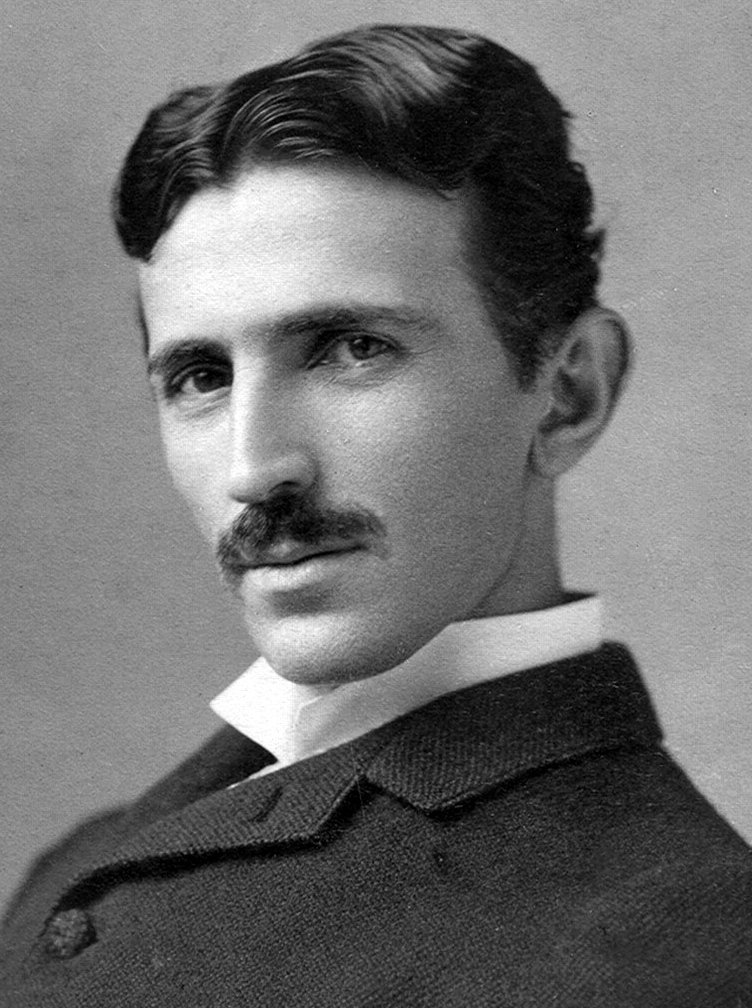
Nikola Tesla (1856 to 1943) was a Serbian-American inventor and electrical engineer best known for the alternating current (AC) induction motor and for polyphase AC power systems. He was born in what is now Croatia, worked in Europe and the United States, and received about 300 patents. His ideas helped make AC the standard way of delivering electricity.
Early life of Nikola Tesla
Tesla was born on July 10, 1856, in Smiljan, in what is now Croatia, to Serbian parents, Milutin and Djuka Tesla. The Lemelson Center at MIT notes that his mother invented small household appliances, and it describes her as an early inspiration.
He studied in Graz and left in 1878 to work as a draftsman in Maribor. In 1880 he moved to Prague to study at the Karl-Ferdinand University. He left Prague in 1881 for Budapest, where Ferenc Puskas hired him to help install an Edison telephone exchange.
While in Budapest he improved some equipment and formed the idea for the induction motor. In this design a rotating magnetic field makes the motor turn, so no electrical connection to the rotor is needed. He struggled at first to win attention for the idea.
Career and major work of Nikola Tesla
In 1884 Tesla went to New York and took a job with Thomas Edison. Edison valued his abilities but did not want to support his work on arc lighting. Tesla left, and in 1886 he founded the Tesla Electric Company, which funded his arc light experiments.
He then worked on finishing his AC motor and system. His patents were licensed to the Westinghouse company in 1888. At the 1893 World’s Columbian Exposition in Chicago, Westinghouse supplied all the lighting using the Tesla polyphase system, which showed the public that AC could run smoothly and safely.
The fair was a turning point because many people still doubted that alternating current was safe and reliable. Its success in lighting the exposition helped win public acceptance for the technology.
In 1895 a fire in his New York laboratory destroyed his books, notes and equipment. He later moved to Colorado Springs and developed the idea of a world-wide wireless network for communication. With financing from J. P. Morgan he set up a laboratory on Long Island, but the funding ended after investors came to favor Guglielmo Marconi.
Ideas and contributions of Nikola Tesla
The induction motor is Tesla’s best-known contribution. Compared with earlier direct current (DC) machines, it needed no brushes and no electrical connection to the rotor, which made it more durable and cheaper to run. Variants of the same principle still power much of the world’s industrial equipment, and the design is covered in more detail in the entry on the electric motor.
In outline, alternating current in fixed coils around the motor creates a magnetic field that rotates. That rotating field induces currents in the rotor, and the interaction between the two makes the rotor spin. Earlier DC motors relied on a commutator and brushes to feed current to the rotor, parts that wear and need regular maintenance.
Polyphase AC was the second major contribution. It uses several alternating currents that are offset from one another, which allows smooth motor operation and efficient transmission over distance. This work fed into the development of the power grid, in which AC can be stepped up to high voltages for long lines and stepped down for homes.
Tesla also invented the Tesla coil, a high-voltage resonant transformer used in early radio and electrical demonstrations. His later proposals for wireless communication, including his World Telegraphy System, aimed to transmit news and messages through a network of stations. These ideas are often discussed alongside the history of radio, although they were never built as he imagined.
Tesla and Edison: the war of the currents
Tesla’s AC system competed with Edison’s DC system for electric lighting and power in the late 1800s. The contest, often called the war of the currents, was as much about business as about engineering. AC proved better suited to long-distance transmission, and it later became the main standard for power systems.
Edison’s early power stations supplied direct current, which loses energy over distance and so needs generating plants close to customers. AC can be raised to a high voltage, sent a long way and then lowered again for use, which is why it won out for large networks.
Tesla also believed that Marconi had used his ideas. In 1901 Marconi transmitted Morse code from England to Canada, and in the decades after that the two men’s work was compared repeatedly. The sources used here describe Tesla’s belief rather than settle the question of priority, and radio history has many contributors.
Legacy of Nikola Tesla
In 1916 the American Institute of Electrical Engineers awarded Tesla the Edison Medal for his early work on polyphase and high-frequency currents. His finances remained troubled, especially after his early patents expired. He became increasingly reclusive and lived in a room at the New Yorker Hotel in New York until his death on January 7, 1943.
In 1960 the unit of magnetic flux density was named the tesla in his honor. His name is also widely known in popular culture, and his AC work is a quiet part of nearly every modern building. The story of his later life, including his unfinished projects, continues to attract writers and museum curators.
The Edison Medal recognized his meritorious achievement in early original work on polyphase and high-frequency currents, a phrase that captures why engineers still honor him despite his later setbacks. Engineers use the tesla unit whenever they describe the strength of a magnetic field, from small magnets to the large scanners used in hospitals.
More in Electrical Engineering
Key facts
- Nikola Tesla was born on July 10, 1856, in Smiljan, in what is now Croatia, and died on January 7, 1943, in New York.1
- He moved to New York in 1884 and briefly worked for Thomas Edison.1
- His induction motor patents were licensed to the Westinghouse company in 1888.2
- Tesla received about 300 patents for his inventions.2
- The American Institute of Electrical Engineers gave him its Edison Medal in 1916, and the unit of magnetic flux density was named the tesla in 1960.1
Related concepts
Quick checkWhat is Nikola Tesla best known for?Show answer
He is best known for the alternating current induction motor and for polyphase AC power systems, which helped AC become the standard for electric power. He also invented the Tesla coil and proposed a wireless system of world communication.
Sources
- Engineering and Technology History Wiki, Nikola Tesla, https://ethw.org/Nikola_Tesla
- MIT Lemelson Center, Nikola Tesla, https://lemelson.mit.edu/resources/nikola-tesla
Editorially reviewed by Specialty Digest Editorial TeamLast reviewed November 4, 2026Researched and drafted with AI assistanceReport an issue