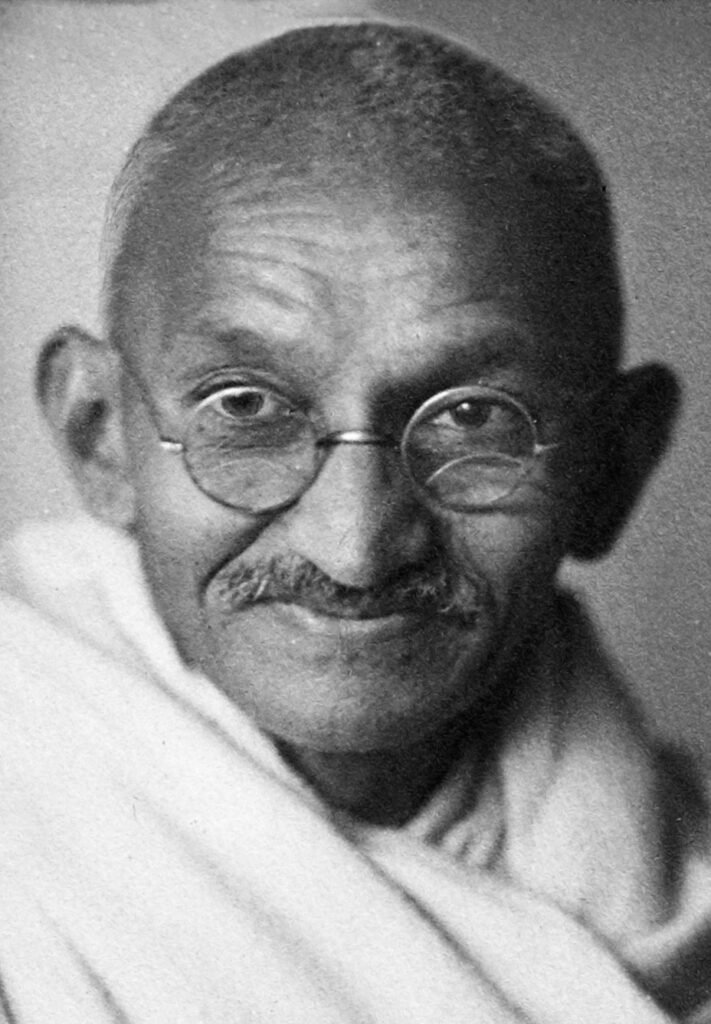
Mahatma Gandhi (1869 to 1948) was an Indian lawyer and political leader who developed satyagraha, a method of nonviolent resistance to unjust laws, and became the best-known figure of India’s movement for independence from British rule. Born Mohandas Karamchand Gandhi, he was given the title Mahatma, which means Great-Souled. He was assassinated on 30 January 1948, a few months after India became independent.
Early life of Mahatma Gandhi
Gandhi was born in Porbandar, the capital of a small principality in what is now the state of Gujarat in western India. His father served there as chief minister, and his mother was a deeply religious Hindu. The family belonged to a branch of Hinduism that placed great weight on nonviolence and on tolerance between religious groups, a background that later writers have treated as central to the position he came to hold.
In the second half of the 1880s Gandhi went to London to study law. After completing his studies he returned to India to work as a barrister. In 1893 he traveled to Natal in South Africa, where an Indian trading company employed him.
Career and major work of Mahatma Gandhi
In South Africa Gandhi worked to improve living conditions for the Indian minority, campaigning above all against increasingly racist legislation. The experience deepened his political and religious commitments and led him to try nonviolent methods in the struggle for basic rights. News of his results reached India before he did, so when he returned in 1915 he was already known. Within a few years, during the First World War, he had become a leading figure in the Indian National Congress.
Between the world wars he launched a series of nonviolent campaigns against the British authorities. The first Non-Cooperation Campaign of 1920 and 1921 showed how hard such protest was to control, because a crowd at Chauri Chaura in the United Provinces attacked a police station, killed many of the police and set the building on fire. The United Nations points to the historic Salt March of 1930 as an example of his call for mass civil disobedience to British law.
Gandhi also worked to unite Hindus, Muslims and Christians, and he campaigned for the emancipation of the so-called untouchables in Hindu society. Independence in 1947 arrived together with the partition of India and the creation of Pakistan. The partition set off massacres in which hundreds of thousands of people were killed and millions had to move, Muslims toward Pakistan and Hindus the other way. A report prepared for the Norwegian Nobel Committee by its adviser Jens Arup Seip called independence and partition, for Gandhi and his movement, both the greatest victory and the worst defeat.
Ideas and contributions of Mahatma Gandhi
Gandhi’s central idea was satyagraha, usually translated as truth force. In his version, people do not reject the rule of law as a principle, but they break laws that they judge to be unreasonable or oppressive. Each person who does so must accept the punishment, while calmly refusing to grant the law any legitimacy. The hope was that opponents, first the South African authorities and later the British in India, would come to see that their legislation was unlawful.
He treated nonviolence as a matter of principle, whereas many fellow nationalists preferred it mainly as a tactic. That firmness won him respect whatever people thought of Indian nationalism or religion, and even the British judges who sentenced him to prison recognized him as an exceptional personality. The United Nations summarizes the underlying theory as the belief that just means lead to just ends, and that violence cannot sensibly be used to build a peaceful society.
Scholars of nonviolent action, such as Gene Sharp, explain why the approach can work. The power of rulers rests on the consent of the population, so withdrawing cooperation weakens it. Sharp separates nonviolent action into three categories: protest and persuasion, non-cooperation, and nonviolent intervention such as blockades and occupations.
Legacy of Mahatma Gandhi
Gandhi’s methods inspired nonviolent movements for civil rights and social change around the world. Martin Luther King Jr. adopted his philosophy, and the United Nations observes 2 October, Gandhi’s birthday, as the International Day of Non-Violence. The General Assembly created the day in a resolution of 15 June 2007, which India introduced on behalf of 140 co-sponsors.
Gandhi was nominated for the Nobel Peace Prize in 1937, 1938, 1939 and 1947, and again a few days before he was killed in January 1948, but he never received it. In 1948 the Norwegian Nobel Committee decided to make no award, on the grounds that there was no suitable living candidate. Later committee members publicly regretted the omission, and when the Dalai Lama won the prize in 1989 the committee chairman called it in part a tribute to the memory of Gandhi.
The adviser’s report of 1948 concluded that Gandhi had left a deep mark on an ethical and political attitude that would remain a norm for many people inside and outside India, and said he could be compared only to the founders of religions.
Criticism and controversies
Gandhi’s career also drew serious criticism, some of it from people who admired him personally. In 1937 an adviser to the Nobel Committee, Jacob Worm-Müller, called him a good and noble man but pointed to sharp turns in his policies that his followers could hardly explain. He also questioned whether Gandhi was consistently pacifist, given the violence that followed the first Non-Cooperation Campaign. A frequent complaint from non-Indians was that Gandhi was too much of an Indian nationalist.
The same report observed that his well-known struggle in South Africa had been waged on behalf of Indians only, and not on behalf of Black Africans, whose living conditions were even worse. Critics in the international peace movement also doubted that his ideals were meant to be universal.
In September 1947 a news report said Gandhi had told a prayer meeting that the Indian government might have to go to war with Pakistan if justice could not be secured in any other way. Gandhi confirmed that the report was correct but incomplete, and said that his own view had not changed. The episode left several Nobel Committee members doubtful, and the committee gave the 1947 prize to the Quakers instead. His story is also tied to the wider history of colonialism and of independence in India.
More in History
Key facts
- Gandhi (1869 to 1948) was born in Porbandar, in present-day Gujarat, India.2
- He went to London to study law in the late 1880s and moved to Natal, South Africa, in 1893.2
- He returned to India in 1915 and became a leading figure in the Indian National Congress.2
- His method, satyagraha, meant breaking unjust laws without violence and accepting the punishment.2
- The United Nations observes 2 October, his birthday, as the International Day of Non-Violence.1
- He was assassinated on 30 January 1948 and never received the Nobel Peace Prize.2
Related concepts
Quick checkWhy did Gandhi never win the Nobel Peace Prize?Show answer
He was nominated five times, but the committee chose other laureates in 1937 and 1947 and made no award in 1948, saying there was no suitable living candidate. Later committee members publicly regretted the omission.
Sources
- United Nations, International Day of Non-Violence, https://www.un.org/en/observances/non-violence-day
- NobelPrize.org, Mahatma Gandhi, the missing laureate, https://www.nobelprize.org/prizes/themes/mahatma-gandhi-the-missing-laureate/
- NobelPrize.org, Martin Luther King Jr. Facts, https://www.nobelprize.org/prizes/peace/1964/king/facts/
Editorially reviewed by Specialty Digest Editorial TeamLast reviewed November 4, 2026Researched and drafted with AI assistanceReport an issue