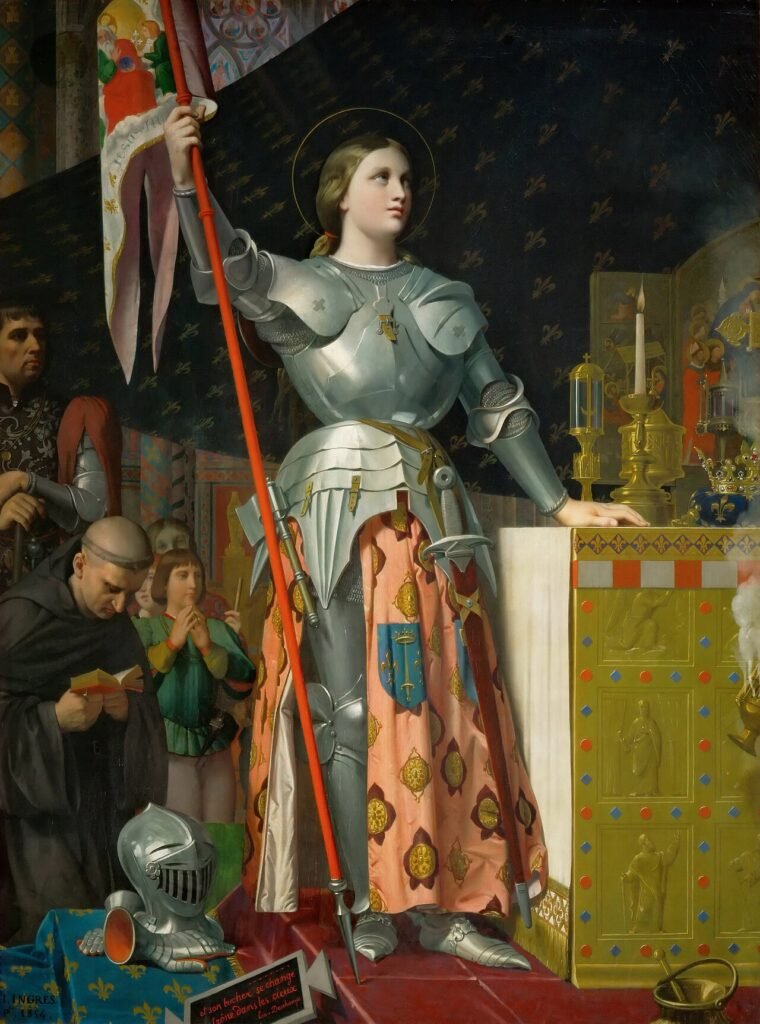
Joan of Arc (about 1412 to 1431), known in French as Jeanne d’Arc, was a peasant girl from northeastern France who said she was guided by divine voices and helped turn the Hundred Years’ War in favor of the French. She was burned at the stake for heresy at about age 19, and the Catholic Church later declared her a saint.
Early life of Joan of Arc
Joan was born around 1412 in the village of Domremy, in the duchy of Bar in northern France. Her parents were Jacques d’Arc and Isabelle Romee, and the family farmed. She had brothers and a sister, and as a child she learned the work of the farm. She is not known to have had any formal education.
Most of what is known about her life comes from the records of her trial, which preserve her own answers to questions. She told her judges that at about age 13, in a garden near her home, she first saw a vision of Saint Michael, with Saint Catherine and Saint Margaret appearing later. She said the voices told her to drive the English out of France and to see the dauphin crowned at Reims.
France was then deep in the Hundred Years’ War, a long struggle between France and England over the French crown that ran from 1337 to 1453. Under the Treaty of Troyes in 1420, the English king Henry V had been recognized as heir to the French throne, while the dauphin Charles was left with little more than the area around Chinon. Many of his armies had lost battles in the field.
Career and military campaign
In 1428 Joan asked Robert de Baudricourt, the captain at Vaucouleurs, to send her to the dauphin. He refused at first, but after she returned in early 1429 he arranged an escort to Chinon. There, according to the tradition, Charles tested her by hiding among his courtiers, and she picked him out. Churchmen at Poitiers examined her and found her to be a good Christian.
She was then allowed to travel with an army to Orleans, a city on the Loire that the English had been besieging for months. Orleans mattered because its loss would probably have meant the loss of the war. Joan entered the city in late April 1429, and the siege was lifted in early May. Historians still debate how much credit belongs to her and how much to the commanders who adopted new tactics there. What is not disputed is that her arrival gave the defenders new confidence.
The victory opened what is known as the Loire campaign. French forces took Jargeau, Meung and Beaugency and won the battle of Patay in June 1429. Reims, which had been held by England’s Burgundian allies, then opened its gates. On 17 July 1429, Charles VII was crowned king in Reims cathedral with Joan beside him. The poet Christine de Pizan wrote a poem celebrating Joan in 1429, the only literary work about her written in her lifetime. Her family was ennobled the same year.
Trial and execution
Joan was captured by Burgundian forces in 1430 and sold to the English. She was held at Rouen, then under English control, and tried for heresy by a church court. Her answers were recorded, and they show her defending herself skillfully. When asked whether she believed she was in a state of grace, a question meant to trap her, she answered that if she was not, she hoped God would put her there, and if she was, that God would keep her there.
Under threat of burning, she recanted her claim of divine guidance, then withdrew the recantation, and she was condemned as a relapsed heretic. She was burned at the stake in Rouen on 30 May 1431. Her ashes were thrown into the Seine. Several accounts describe the trial as politically driven, since a verdict that Joan’s voices came from God would have undermined the English cause.
Role in the Hundred Years’ War
Joan’s own military role was limited. She did not hold formal command, and women were normally excluded from military councils of her day. Even so, the campaigns she joined restored French morale and brought a series of victories that had been rare before. France ended the war in 1453, a generation after her death. Her influence on that outcome, as against changes in tactics and the later work of the crown, remains a subject of scholarly discussion.
Her reliance on faith also shaped how she was remembered. Her king did not act to save her, and attempts to free her were not organized by him. Charles VII is generally described as a hesitant ruler, and some writers see a contrast between his behavior and her devotion.
Rehabilitation and legacy
The verdict was reviewed from 1452, and in July 1456 the pope revoked the condemnation, declaring the trial invalid. Her mother had campaigned for this for years. Joan was beatified in 1909 and canonized in 1920, and she is one of the patron saints of France. Her feast day is 30 May, the date of her execution.
Stories grew up around her after her death. Within a few years, a woman named Jeanne des Armoises was presented to the public as Joan who had supposedly escaped, but she could not repeat to Charles VII the private secrets Joan had told him in 1429, and the claim collapsed. Popular tradition also says that Joan’s father died of grief soon after her execution, yet records indicate he lived until 1440.
Joan of Arc became a national symbol that people with very different politics have claimed, and she has been honored in art, literature, music and statues around the world. Her story is also a case study in how a trial record can preserve the voice of an ordinary person from the Middle Ages. Her life continues to interest historians of Christian belief and of women in medieval society, as well as of war.
More in History
Key facts
- Joan of Arc was born around 1412 in Domremy and was burned at Rouen on 30 May 1431.1
- Her presence at Orleans in 1429 was followed by French victories in the Loire campaign.1
- Charles VII was crowned at Reims on 17 July 1429.2
- A church court condemned her in 1431, and the condemnation was revoked in July 1456.2
- She was beatified in 1909 and canonized in 1920.2
Related concepts
Quick checkWhy was Joan of Arc executed?Show answer
A church court at Rouen, under English control, condemned her as a relapsed heretic after she withdrew a recantation. Many accounts say the trial was politically driven.
Sources
- World History Encyclopedia, Joan of Arc, https://www.worldhistory.org/Joan_of_Arc/
- Encyclopedia.com, Joan of Arc (c. 1412-1431), https://www.encyclopedia.com/women/encyclopedias-almanacs-transcripts-and-maps/joan-arc-c-1412-1431
Editorially reviewed by Specialty Digest Editorial TeamLast reviewed November 4, 2026Researched and drafted with AI assistanceReport an issue