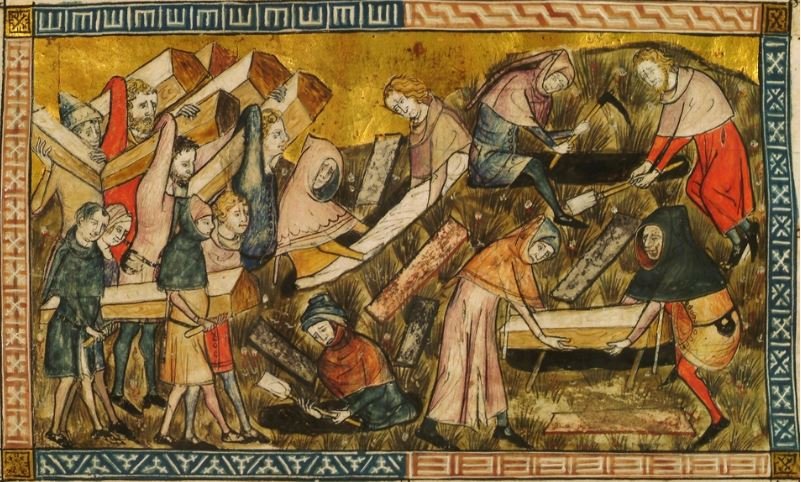
The Black Death was a plague pandemic that spread across Europe, Asia and North Africa in the middle of the 14th century, with its worst years in Europe between 1347 and 1351. It was caused by the bacterium Yersinia pestis and was the first wave of the second plague pandemic, which kept returning to Europe until about 1750. Researchers commonly estimate that it killed between one third and one half of Europe’s population in roughly five years, though no exact count is possible.
Background of the Black Death
Plague is first a disease of animals. Yersinia pestis lives mainly in small mammals and their fleas, and the World Health Organization (WHO) explains that people catch it through flea bites, contact with infected tissue or, in the pneumonic form, by breathing in respiratory droplets from a patient. An outbreak therefore needs the bacterium, an animal reservoir and a flea vector to meet crowded human settlements. Medieval Eurasia offered all of these along its busy trade routes and in its dense towns and ports. Diseases that pass from animals to people in this way are called zoonotic diseases.
The Black Death was not the first plague pandemic. Justinian’s plague struck the Mediterranean world in 541 and 542, and a third pandemic began in China’s Yunnan region in the mid-19th century and spread worldwide by ship from Hong Kong in 1894. Between them came the 14th-century outbreak. Historical accounts describe it moving from the Caspian Sea region into almost every European country from 1347. Scholars still debate exactly where it began and by which routes it spread.
For a long time historians also questioned whether plague caused the Black Death at all, because the medieval disease seemed to behave differently from modern cases. Ancient DNA research largely settled the matter. In 2010, a team led by Stephanie Haensch reported Y. pestis DNA and protein signatures in skeletons from mass graves in northern, central and southern Europe. Their results pointed to at least two related variants, which suggests the disease reached Europe on more than one occasion. A second team, led by Kirsten Bos, published a reconstructed genome in 2011 from victims buried in London between 1348 and 1350.
What happened during the Black Death
The pandemic reached European ports in 1347 and then moved inland and northward. The Haensch team dates the epidemic from 1347 to 1353, and mortality in most regions peaked in the first few years. In London, officials opened the East Smithfield burial ground in late 1348 or early 1349 specifically for plague victims. Because of this, researchers can date those remains unusually well.
Plague takes several clinical forms, and WHO describes them today. Bubonic plague causes painful swollen lymph nodes called buboes and has a case-fatality ratio of roughly 30 to 60 percent when untreated. Pneumonic plague infects the lungs, can pass directly from person to person and is fatal without early treatment. Septicemic plague spreads through the bloodstream and is also fatal untreated. Medieval people had no antibiotics, which are the treatment that makes plague curable now, so mortality was far higher than it would be with modern care.
The scale of the disaster raises an obvious question about whether the medieval bacterium was unusually dangerous. The 2011 London genome found no unique mutations that would make it more virulent than modern strains. The authors concluded that other factors, such as environment, flea and rodent dynamics and how susceptible people were, probably help explain the death toll. That is an inference from one set of remains and not a settled finding, and researchers continue to test it.
The number of deaths is uncertain. The Bos study cites an estimated 30 to 50 percent of Europe’s population lost in five years, while the Haensch study describes about one third of Europeans dying over the following few years. WHO states that the Black Death caused more than 50 million deaths in Europe. These figures differ because medieval records are incomplete and the size of Europe’s starting population is itself an estimate, so each should be read as an approximation.
Aftermath and significance of the Black Death
Plague did not vanish after the first wave. According to the Haensch study, it persisted in Europe until about 1750, returning in epidemics that grew progressively weaker. Each return reinforced fear of the disease and pushed city governments to act.
One lasting response was quarantine. In 1377, the Great Council of Ragusa, now Dubrovnik, ordered a 30-day separation period called a trentino for visitors from plague-affected places. Other cities adopted similar rules, and the period was later extended to 40 days, or quaranta in Italian, which gave quarantine its name. These early measures were an ancestor of modern epidemiology and disease control, even though no one yet understood what caused the illness.
The pandemic also left a scientific legacy. The 2011 genome study concluded that the Black Death of 1347 to 1351 was the main historical event that spread the ancestor of all currently circulating Y. pestis strains that infect humans. In other words, modern plague has medieval roots. Today the disease is rare and treatable. WHO reports that most human cases during 2019 to 2025 occurred in the Democratic Republic of the Congo and Madagascar, and that antibiotics work well when given early. WHO does not recommend general vaccination against plague, except for high-risk groups such as laboratory staff and health workers.
FAQs
What caused the Black Death? It was caused by the bacterium Yersinia pestis. Ancient DNA recovered from medieval burial sites across Europe confirmed this.
How many people died in the Black Death? No one knows exactly. Research papers estimate that between one third and one half of Europe’s people died within about five years, while WHO cites more than 50 million deaths in Europe.
Did the Black Death happen only once? No. It was the first wave of the second plague pandemic, and plague epidemics kept recurring in Europe until about 1750.
Does plague still exist? Yes. WHO says human plague remains endemic in several countries, but it can be treated with antibiotics.
Where did the idea of quarantine come from? Port cities such as Ragusa introduced waiting periods for arriving travelers during the Black Death era, starting with a 30-day rule in 1377 that later grew to 40 days.
More in Infectious Diseases
Key facts
- The Black Death was caused by the bacterium Yersinia pestis, confirmed by ancient DNA from medieval mass graves across Europe.2
- Its worst years in Europe ran from 1347 to 1351, and plague kept returning until about 1750.23
- Estimates of the toll range from one third to one half of Europe's population, and WHO cites more than 50 million deaths in Europe.123
- Ragusa (now Dubrovnik) set a 30-day isolation period for visitors in 1377, later extended to 40 days, which gave quarantine its name.4
- Plague is now treatable with antibiotics, and most recent human cases are in the Democratic Republic of the Congo and Madagascar.1
This entry explains a medical term. It is not medical advice. If you are concerned about your health, speak with a qualified health professional.
Related concepts
In the news
Quick checkWhat bacterium caused the Black Death?Show answer
Yersinia pestis, a bacterium carried by fleas on small mammals. Ancient DNA from medieval burial sites in London and across Europe confirmed it as the cause.
Sources
- World Health Organization, Plague fact sheet, https://www.who.int/news-room/fact-sheets/detail/plague
- Haensch et al., Distinct Clones of Yersinia pestis Caused the Black Death, PLoS Pathogens 2010, https://pmc.ncbi.nlm.nih.gov/articles/PMC2951374
- Bos et al., A draft genome of Yersinia pestis from victims of the Black Death, Nature 2011, https://pmc.ncbi.nlm.nih.gov/articles/PMC3690193
- CDC Emerging Infectious Diseases, Etymologia: Quarantine, https://wwwnc.cdc.gov/eid/article/19/2/ET-1902
Editorially reviewed by Specialty Digest Editorial TeamLast reviewed November 4, 2026Researched and drafted with AI assistanceReport an issue