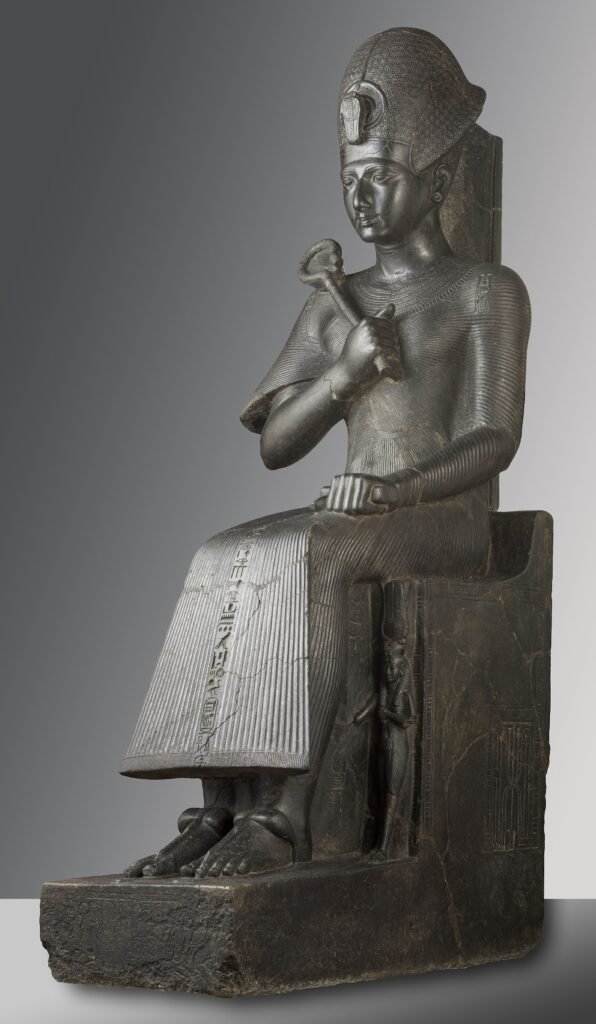
Ramesses II, also known as Ramesses the Great, was a pharaoh of ancient Egypt in the 19th Dynasty who reigned from about 1279 to 1213 BCE. His reign of roughly 66 years was among the longest in Egyptian history. He is remembered for the Battle of Kadesh, an early peace treaty with the Hittites, and monuments such as the temples at Abu Simbel.
Early life of Ramesses II
Ramesses was the son of Seti I and Queen Tuya. The World History Encyclopedia says he accompanied his father on military campaigns in Libya and Palestine at the age of 14 and, by the age of 22, led his own campaigns in Nubia with two of his sons, Khaemweset and Amunhirwenemef. He was named co-ruler alongside Seti, and the two carried out restoration projects and built a new palace at Avaris.
When Seti I died, Ramesses became sole ruler. The World History Encyclopedia gives 1290 BCE for Seti’s death and 1279 BCE for the start of the reign, but the dates of the 19th Dynasty are debated, so these figures should be treated as approximate. The throne name he used was Usermaatre-setepenre, which means Keeper of Harmony and Balance, Strong in Right, Elect of Ra.
Career and major work of Ramesses II
Ramesses began work on a new capital, Per-Ramesses, in the eastern Nile delta near the older city of Avaris. Its name means House of Ramesses. Some scholars think Seti I began the project, since it was already a military base when Ramesses started his campaigns.
Egypt had lost important trading centers in Syria and Canaan to the Hittites before his time. The World History Encyclopedia says Seti I recaptured Kadesh, but the Hittite king Muwatalli II took it back, so Ramesses planned a campaign to win the city again.nnThe main military event of his reign was the Battle of Kadesh against the Hittite king Muwatalli II, fought about 1274 BCE at the city of Kadesh in Syria. The World History Encyclopedia says Ramesses led some twenty thousand men in four divisions, named for the gods Amun, Ra, Ptah and Set. The Hittites struck the Amun division by surprise, and Ramesses rallied his forces until the Ptah division arrived.
The Egyptian accounts of the battle, including the Poem of Pentaur, describe a great victory. The World History Encyclopedia, however, says the result was closer to a draw than a decisive win for either side. Ramesses nevertheless used the battle to build his reputation as a great warrior.
The conflict led to a treaty. The World History Encyclopedia reports that a peace agreement was reached in 1258 BCE and that a Hittite version found at Bogazkoy in Turkey is now in the Istanbul Archaeology Museum. It is called the world’s first known peace treaty.
Monuments and building projects of Ramesses II
Ramesses commissioned more building than almost any other pharaoh. The World History Encyclopedia says that Hatshepsut built on a grander scale than any pharaoh before her, and that Ramesses II was the only later pharaoh to match her. The sources list the Ramesseum, his mortuary temple at Thebes, a hall at Karnak, a complex at Abydos and the temples at Abu Simbel. The World History Encyclopedia says many historians regard his reign as a high point of Egyptian art and culture, citing the painted tomb of his first wife, Nefertari, which was found looted but is celebrated for its wall paintings.
The two temples at Abu Simbel, on the Nile in the far south of Egypt, are his most famous works. The Great Temple is dedicated to the gods Ra-Horakhty and Ptah and to the deified Ramesses himself, and the Small Temple is dedicated to the goddess Hathor and Queen Nefertari. In front of the Great Temple sit colossal statues about 20 meters tall. Dating is uncertain. Scholars place construction either in 1264 to 1244 BCE or in 1244 to 1224 BCE, depending on how they read his reign.
In the 20th century the temples faced flooding from the Nile. UNESCO says they were saved from the rising waters through an international campaign carried out between 1960 and 1980. The site is part of the Nubian Monuments from Abu Simbel to Philae World Heritage listing.
Family and later life of Ramesses II
The World History Encyclopedia reports that Ramesses had more than 200 wives and concubines, about 96 sons and 60 daughters, and outlived most of them. Nefertari was his first wife and favorite queen, and she seems to have died fairly early in their marriage. After her, he promoted Isetnefret to queen, and later some of his daughters served as consorts.
The same source says he lived to be 96, but such figures from ancient Egypt are uncertain. Ramesses died in 1213 BCE after one of the longest reigns in Egyptian history.
Legacy of Ramesses II
The World History Encyclopedia says that no part of Egypt lacks some mention of Ramesses the Great. The Greeks later knew him as Ozymandias, a form of his throne name. His monuments remain among the best-known sights in Egypt, and the rescue of Abu Simbel became a model for international cooperation in protecting heritage.
Controversies and debates about Ramesses II
His claim of victory at Kadesh is the most visible dispute. Because the main accounts were carved on temple walls as royal propaganda, historians compare them with the Hittite evidence and conclude that no clear winner emerged. Ramesses is also often linked with the pharaoh of the biblical Book of Exodus, but the World History Encyclopedia states that there is no historical or archaeological evidence for this connection.
The dates of his reign, the age at which he died and the exact timing of his monuments also vary between sources, and scholars continue to refine them.
More in History
Key facts
- Ramesses II reigned from about 1279 to 1213 BCE as the third pharaoh of the 19th Dynasty.1
- He fought the Hittites at the Battle of Kadesh about 1274 BCE, which was closer to a draw than a decisive victory.1
- A peace treaty with the Hittites dated to 1258 BCE is known as the first peace treaty on record.1
- The temples at Abu Simbel were saved from the rising Nile by a UNESCO campaign from 1960 to 1980.2
- There is no historical or archaeological evidence linking him to the pharaoh of the Book of Exodus.1
Related concepts
Quick checkDid Ramesses II win the Battle of Kadesh?Show answer
He claimed a great victory, but historians describe the battle as closer to a draw, and it was followed by a peace treaty with the Hittites around 1258 BCE.
Sources
- World History Encyclopedia, Ramesses II, https://www.worldhistory.org/Ramesses_II/
- UNESCO World Heritage Centre, Nubian Monuments from Abu Simbel to Philae, https://whc.unesco.org/en/list/88/
- World History Encyclopedia, Abu Simbel, https://www.worldhistory.org/Abu_Simbel/
Editorially reviewed by Specialty Digest Editorial TeamLast reviewed November 4, 2026Researched and drafted with AI assistanceReport an issue