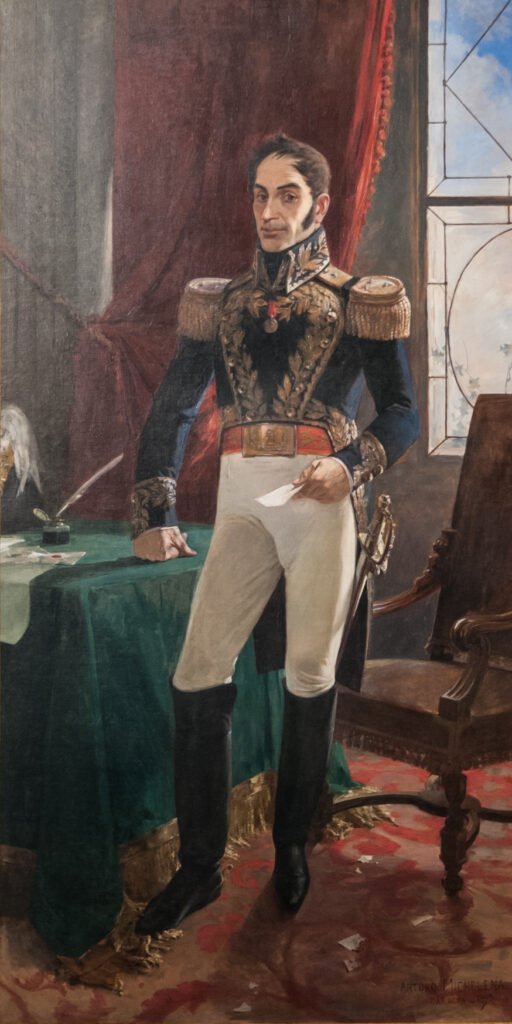
Simón Bolívar (1783 to 1830), known as El Libertador, was a Venezuelan military and political leader who led the independence of much of northern South America from Spain. He helped create the state of Gran Colombia, which covered what are now Colombia, Venezuela, Ecuador and Panama, and the country of Bolivia took its name from him. He died on 17 December 1830 near Santa Marta, in present-day Colombia.
Early life of Simón Bolívar
Bolívar was born in Caracas in 1783 into a wealthy Creole family. He lost his father at age three, and his mother died before he turned ten. His tutor, Simón Rodríguez, strongly influenced him with ideas from Rousseau and took him on long rides across the plains of Venezuela, which gave him a deep knowledge of his homeland.
In 1799 he went to Europe for the education customary for a young man of his class. He married in Madrid in 1802, but his wife died of fever in January 1803. In Paris in 1804 he met the naturalist Alexander von Humboldt. In August 1805 he is said to have sworn an oath on the Sacred Mount during his time in Italy to break the chains of Spain, although the account comes from Rodríguez, who wrote it down forty-six years later and probably embellished it.
The Spanish colonies had a rigid social order. Creoles held almost all of the wealth, and many resented the Spanish-born officials who arrived in large numbers at the end of the eighteenth century. Wars in Europe, including those of Napoleon, cut the colonies off from Spain and created conditions in which independence could be won in practice before it was won in law.
Career and major work of Simón Bolívar
Bolívar returned to Venezuela in 1807 and entered public life in 1810, when the Caracas junta of 19 April began the movement for independence. He went to London to seek British support, and he returned with the veteran conspirator Francisco de Miranda. Venezuela declared independence on 5 July 1811, but the republic fell in 1812 and Bolívar went to Cartagena.
In 1813 he led the Admirable Campaign, a coordinated series of attacks that brought him to Caracas on 6 August 1813. His government there was close to a dictatorship, and royalist forces led by José Tomás Boves defeated him in 1814. He went into exile in Jamaica in 1815 and Haiti in 1816, where President Alexandre Pétion supplied him with equipment. Two expeditions in 1816 and 1817 failed.
Bolívar then changed his strategy and built a base far from Caracas. He set up a government at Angostura in 1817 and called a congress there in February 1819. After crossing the Andes, his army won the Battle of Boyacá on 7 August 1819 and entered Bogotá three days later. On 17 December 1819 he proclaimed the new state of Colombia, later known as Gran Colombia, and was chosen as its president. A second victory at Carabobo on 24 June 1821 opened the road to Venezuela‘s capital. His lieutenant Antonio José de Sucre won at Pichincha on 24 May 1822, which brought Ecuador into the union.
Ideas and contributions of Simón Bolívar
In his address to the Congress of Angostura in 1819, Bolívar argued that the diversity of Venezuela’s population called for a strong, highly centralized government to hold society together. He drew on the same ideas when he prepared a draft constitution for the new state in Upper Peru. In August 1825 the deputies of that region named their country Bolívar, and the name later became Bolivia.
Military victories gave these political ideas their force. He met the Argentine liberator José de San Martín at Guayaquil on 25 July 1822, after which San Martín stepped aside. In Peru Bolívar rebuilt an army and won at Junín on 6 and 7 August 1824, and Sucre’s victory at Ayacucho on 9 December 1824 brought the fighting for South American independence to a close.
Legacy of Simón Bolívar
Spanish rule over most of South America ended during his lifetime, and he is remembered under the title El Libertador, the Liberator. Bolívar is honored across northern South America as the Liberator. His name appears in the title of the nation of Bolivia, and the independence he won ended Spanish rule across a large part of the continent. His dream of a lasting union did not survive him, as Venezuela and Ecuador left the federation in 1830, the year of his death.
The United States recognized Colombia on 19 June 1822, when the federation included the territory of today’s Colombia, Ecuador, Venezuela and Panama. His last wish was that his death might calm political conflict and help the Colombian peoples unite.
Controversies and criticism
Bolívar’s career included serious disputes. In 1813 he issued a proclamation at Trujillo that promised death to any Spaniard who did not actively conspire against tyranny, and the government he set up in Caracas in 1813 was close to a dictatorship. After Miranda surrendered, Bolívar helped hand him over to the Spanish, an episode that remains controversial, and in 1814 he was accused of taking public funds and was briefly jailed.
The congress that Bolívar called at Panama to unite the Latin American states also failed. In 1826 José Antonio Páez, a Venezuelan leader, revolted in Venezuela, and in 1828 the national convention at Ocaña tried to remove his extraordinary powers. Bolívar had himself proclaimed dictator and escaped an attack in Bogotá on 25 September 1828 by jumping from a window. In 1830 Congress accepted his resignation, and he left for the coast, without resources, and died in the home of a Spaniard who had remained loyal to the Spanish crown.
More in History
Key facts
- Bolívar was born in Caracas in 1783 and died near Santa Marta on 17 December 1830.1
- His army won the Battle of Boyacá on 7 August 1819.1
- Colombia, later called Gran Colombia, was proclaimed on 17 December 1819.1
- The United States recognized Colombia on 19 June 1822.2
- Bolivia was named for him in 1825.1
- Venezuela and Ecuador left the federation in 1830.2
Related concepts
Quick checkWhy is Bolivia named after Simon Bolivar?Show answer
In August 1825 the deputies of Upper Peru named their new country Bolívar in his honor, and he prepared a draft constitution for it. The name later became Bolivia.
Sources
- Larousse, Simón Bolívar, https://www.larousse.fr/encyclopedie/personnage/wd/109361
- Office of the Historian, U.S. Department of State, Colombia, https://history.state.gov/countries/colombia
Editorially reviewed by Specialty Digest Editorial TeamLast reviewed November 4, 2026Researched and drafted with AI assistanceReport an issue