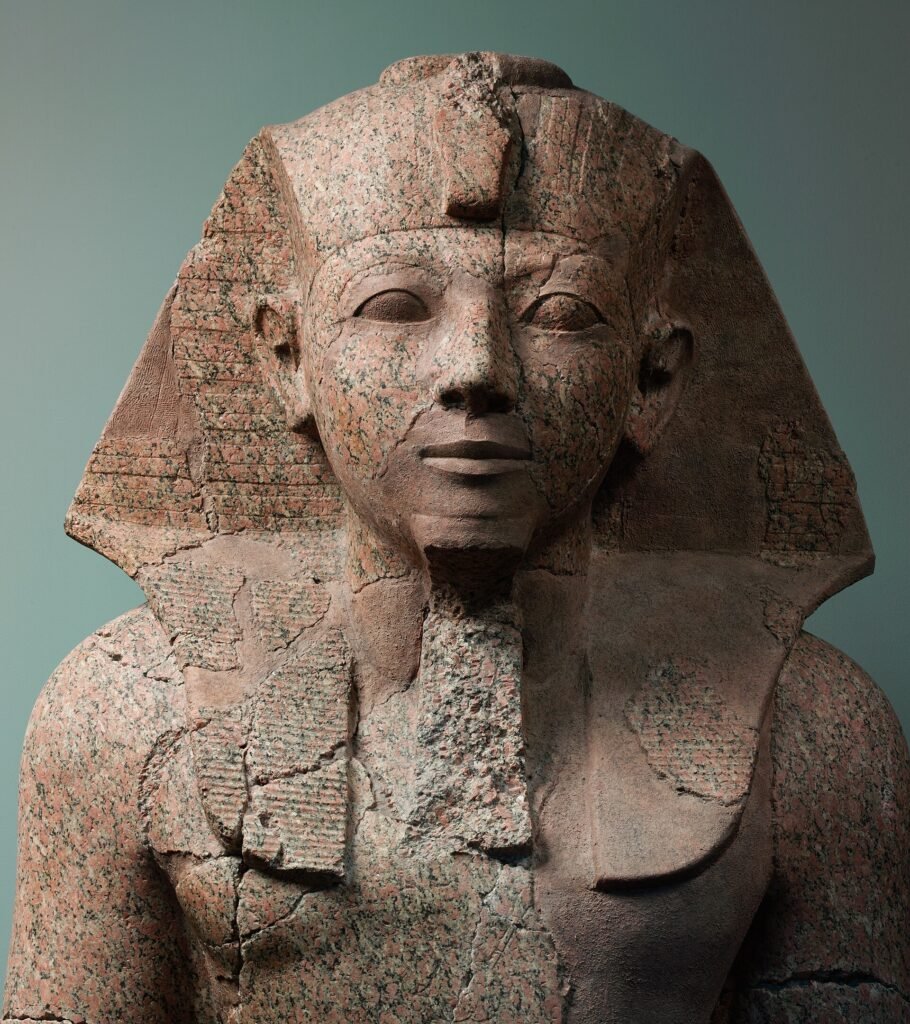
Hatshepsut was a ruler of ancient Egypt in the 18th Dynasty who reigned from about 1479 to 1458 BCE and took the full title and authority of pharaoh. She began as regent for her young stepson Thutmose III and then ruled as king in her own right. She is remembered for her mortuary temple at Deir el-Bahari, a trading expedition to Punt, and the later removal of her name from many monuments.
Early life of Hatshepsut
Hatshepsut was a daughter of Thutmose I, who reigned from about 1520 to 1492 BCE according to the World History Encyclopedia. She married her half-brother Thutmose II, and she held the title God’s Wife of Amun, an important religious office at Thebes. The couple had a daughter, Neferure. Thutmose II fathered a son, Thutmose III, with a lesser wife named Iset, and this boy was named as his successor.
Thutmose II died while Thutmose III was still a child, and Hatshepsut became regent, controlling the affairs of state until he came of age. Dates differ between sources. The World History Encyclopedia gives her reign as 1479 to 1458 BCE, while Egypt’s Ministry of Tourism and Antiquities gives about 1473 to 1458 BCE, so the start of her rule is uncertain by several years.
Career and major work of Hatshepsut
Around the seventh year of her rule, Hatshepsut took the title of king. In statues and reliefs she was shown with the dress and symbols of a male pharaoh, although her inscriptions still referred to her as a woman. To support her claim, she had reliefs made that showed Thutmose I naming her as his co-ruler, said that the god Amun had predicted her rise, and linked her to the expulsion of the Hyksos some 80 years earlier.
She relied on advisers, above all a courtier named Senenmut. The World History Encyclopedia says he was a man of modest birth who rose to prominence at court, and that his relationship with the queen remains mysterious. The Ministry of Tourism and Antiquities identifies him as the chief steward of Amun who designed her temple.
Her reign was mostly peaceful. After early campaigns to secure her position, the army was used in small groups to protect trade expeditions and the borders. Hatshepsut put resources into building instead. Projects spread across Egypt, but Thebes received the most attention, and the temple of Karnak grew under her supervision. Sandstone was quarried in large amounts, cedar was imported from the Levant, and ebony came from Africa.
The temple at Deir el-Bahari
Her best-known monument is the mortuary temple at Deir el-Bahari, on the west bank of the Nile at Luxor, across the river from Karnak. Its ancient name, Djeser-djeseru, means the Holy of Holies. The Ministry of Tourism and Antiquities describes three levels, each with a colonnade, and statues of Hatshepsut in the form of the god Osiris leaning against the pillars of the upper terrace.
The temple also includes places for the cults of Thutmose I, the goddess Hathor and the funerary god Anubis, as well as an open altar for the sun god Ra-Horakhty. The most important sanctuary, dedicated to Amun, is cut into the cliff behind the upper courtyard. The walls carry painted reliefs of religious festivals and of the transport of obelisks from the quarry to Karnak.
The World History Encyclopedia notes that later pharaohs admired the temple so much that they chose to be buried nearby, and the area became known as the Valley of the Kings.
Ideas and contributions of Hatshepsut
Hatshepsut’s reign is often described as a time of prosperity built on trade and construction rather than war. She sent an expedition to Punt, a trading partner of Egypt since Middle Kingdom times, and had scenes carved at Deir el-Bahari to show the goods it brought back. The sources disagree about where Punt lay. The World History Encyclopedia places it in modern Somalia, while the Ministry of Tourism and Antiquities says it is believed to be near modern Eritrea.
Her approach to legitimacy also stands out. By combining the royal image of a male king with her own female identity and emphasizing divine support, she held power for about two decades. The World History Encyclopedia notes that other women had ruled Egypt before her, such as Merneith and Sobekneferu, but that she is the best known after Cleopatra.
Death and legacy of Hatshepsut
Hatshepsut died in 1458 BCE according to the World History Encyclopedia, and Thutmose III then ruled alone. He became one of Egypt’s great military rulers, and the same source says he never lost a battle and expanded the empire.
After her death, her name and image were removed from many monuments. The World History Encyclopedia says this was most likely ordered by Thutmose III. Because the Egyptians believed that erasing a name harmed the afterlife, some scholars argue that the person responsible did not wish her ill, and her name survives in some secluded places. Other scholars suggest that some references were simply overlooked.
The effort to remove her from memory did not succeed, and she is now counted among the great rulers of ancient Egypt. The World History Encyclopedia says she built on a grander scale than any pharaoh before her, raising two enormous obelisks at Karnak, and that Ramesses II was the only later pharaoh to match her. In 2006 Zahi Hawass announced that a mummy in the Cairo museum was hers. The World History Encyclopedia says an examination of that mummy showed that she died in her fifties of an abscess following a tooth extraction. This identification is based on the claim of one researcher and has not removed all doubt.
Controversies and debates about Hatshepsut
Scholars debate why she took the title of king, why her name was erased and how long after her death it happened. The World History Encyclopedia calls her one of the most celebrated and controversial women of the ancient world. The motives of Thutmose III, the role of Senenmut and the exact dates of her reign remain open questions, and historians who read the same inscriptions reach different conclusions.
More in History
Key facts
- Hatshepsut reigned from about 1479 to 1458 BCE in the 18th Dynasty, with some sources starting her rule at about 1473 BCE.1
- She began as regent for her stepson Thutmose III and later ruled as pharaoh.1
- Her mortuary temple, Djeser-djeseru, was designed by Senenmut at Deir el-Bahari.2
- Her name was removed from many monuments after her death, most likely by Thutmose III.1
- Her expedition to Punt is shown in reliefs at Deir el-Bahari.2
Related concepts
Quick checkWho was Hatshepsut?Show answer
She was an 18th Dynasty ruler of Egypt who served as regent and then took the title of pharaoh around 1479 to 1458 BCE, and who built the temple at Deir el-Bahari.
Sources
- World History Encyclopedia, Hatshepsut, https://www.worldhistory.org/Hatshepsut/
- Ministry of Tourism and Antiquities, Egypt, Hatshepsut Temple, https://egymonuments.gov.eg/en/monuments/hatshepsut-temple
- World History Encyclopedia, Thutmose III, https://www.worldhistory.org/Thutmose_III/
Editorially reviewed by Specialty Digest Editorial TeamLast reviewed November 4, 2026Researched and drafted with AI assistanceReport an issue