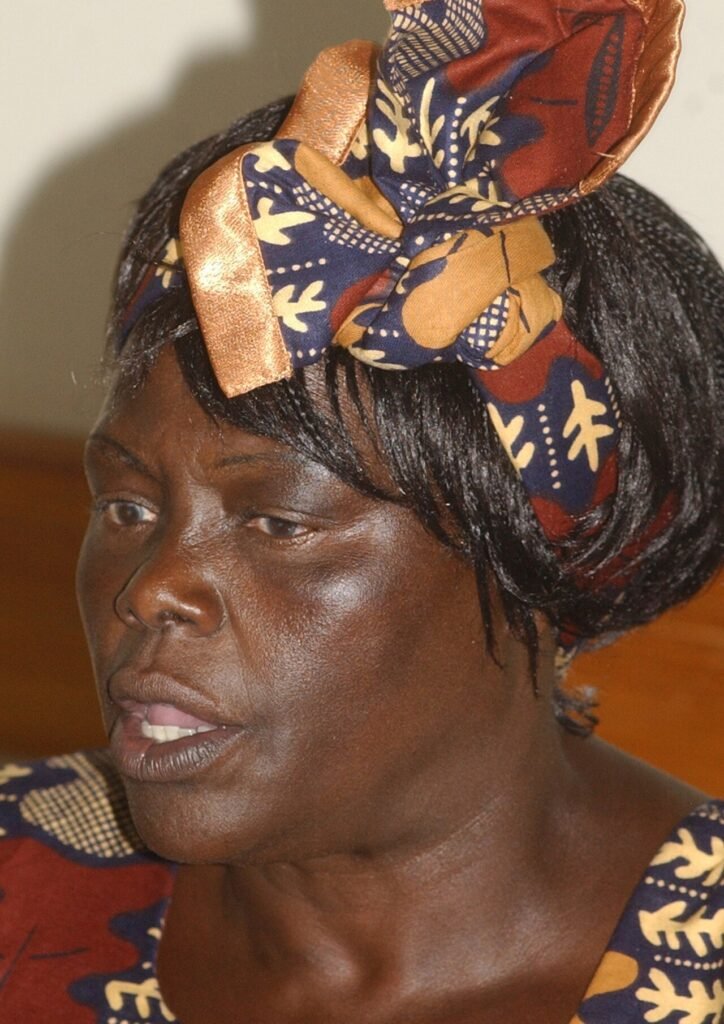
Wangari Maathai (1940 to 2011) was a Kenyan scientist, environmental activist and political figure who founded the Green Belt Movement. In 2004 she became the first African woman to win the Nobel Peace Prize, for linking sustainable development, democracy and peace.
Early life and education
Wangari Muta Maathai was born on 1 April 1940 in Nyeri, a rural area of Kenya. In her Nobel lecture she said that her inspiration came partly from childhood observations of nature there. As she grew up, she saw forests being cleared and replaced by commercial plantations, which reduced local biodiversity and the ability of forests to conserve water.
She studied in Kenya, the United States and Germany. She earned a degree in biological sciences from Mount St. Scholastica College in Atchison, Kansas, in 1964, and a master of science degree from the University of Pittsburgh in 1966. She also did doctoral studies in Germany and completed a PhD at the University of Nairobi in 1971. She was the first woman in East and Central Africa to earn a doctorate.
At the University of Nairobi she taught veterinary anatomy. She became chair of the department in 1976 and an associate professor in 1977, and in both cases she was the first woman in the region to hold the position.
Career and the Green Belt Movement
Maathai was active in the National Council of Women of Kenya from 1976 to 1987 and served as its chair from 1981 to 1987. In 1976, through the council, she put forward the idea of planting trees together with ordinary people. The Green Belt Movement was founded in 1977.
She said the movement began partly as a response to needs raised by rural women, such as a lack of firewood, clean drinking water, balanced diets, shelter and income. Women are often the first to notice environmental damage, she observed, because they farm the land and feed their families. Tree planting was a practical response. It was simple, it gave quick results, and it kept people interested.
The movement worked with women’s groups to plant trees on farms, school grounds and church land. The trees provided fuel, food, shelter and income. In 1986 the movement set up a Pan-African Green Belt Network, and people from other African countries learned its methods. Initiatives based on them were later launched in countries including Tanzania, Uganda, Malawi, Lesotho, Ethiopia and Zimbabwe. Figures for the total vary with the date. A Nobel biography written around the time of the award said more than 20 million trees, while the Nobel Committee’s own statements cite about 30 million.
Ideas and contributions
Maathai’s central idea was that environmental protection, democracy and peace depend on each other. When the environment is destroyed or badly managed, she argued, people lose their livelihoods, and scarce resources can lead to poverty and conflict. This view, summarized in her lecture as the indivisibility of sustainable development, democracy and peace, was the basis of the Nobel Committee’s decision.
The movement combined reforestation with civic education. In its citizen education programs, people identified their own problems, the causes and possible solutions. Maathai wanted communities to see that they had knowledge and skills of their own, instead of assuming that solutions must come from outside. Through the movement, women also gained more influence over their social and economic position.
The committee noted that the Green Belt Movement also dealt with education, family planning, nutrition and the fight against corruption. It described her approach as thinking globally and acting locally. She also supported the Jubilee 2000 campaign for cancellation of unpayable debts of poor African countries.
Politics and recognition
Maathai took part in the struggle for democracy in Kenya and belonged to the opposition to the government of Daniel arap Moi. The Nobel Committee said she stood up courageously against an oppressive regime and drew national and international attention to political oppression. She also campaigned against land grabbing and the improper allocation of forest land.
In December 2002 she was elected to parliament with an overwhelming share of the vote, 98 percent according to her Nobel biography, and she was afterward appointed assistant minister for environment, natural resources and wildlife.
The Nobel Peace Prize for 2004 was announced on 8 October 2004, with the citation for her contribution to sustainable development, democracy and peace. She delivered her Nobel lecture in Oslo on 10 December 2004. Earlier awards included the Right Livelihood Award in 1984 and the Goldman Environmental Prize in 1991. She wrote four books, including her memoir Unbowed.
Legacy of Wangari Maathai
Wangari Maathai died on 25 September 2011 in Nairobi. The Green Belt Movement continues to work on restoring ecosystems, conserving forests, and supporting livelihoods and advocacy. She is remembered as a scientist who turned deforestation into a political and social issue and who showed that practical, locally led action can carry global meaning.
The Nobel Committee also noted that she was the first African from the vast area between South Africa and Egypt to receive the prize. In her lecture she joined a line of African laureates that included Nelson Mandela, F. W. de Klerk, Desmond Tutu, Albert Luthuli, Anwar el-Sadat and Kofi Annan. She accepted the prize on behalf of the people of Kenya and Africa and said she was especially mindful of women and the girl child.
Her work is often discussed alongside sustainability and community-led conservation. The Nobel Committee noted that forest loss contributes to desertification in Africa and threatens other regions, and that protecting forests is a vital part of strengthening the living environment of the planet. Her story is also often cited in discussions of women’s leadership in environmental and development work.
More in Conservation
Key facts
- Wangari Maathai was born on 1 April 1940 in Nyeri, Kenya, and died on 25 September 2011 in Nairobi.1
- She was the first woman in East and Central Africa to earn a doctorate.1
- She started the Green Belt Movement in 1977, and its women planted about 30 million trees.1
- She won the 2004 Nobel Peace Prize for her contribution to sustainable development, democracy and peace.1
- She was the first African woman to receive the Nobel Peace Prize.1
Related concepts
Quick checkWhy did Wangari Maathai win the Nobel Peace Prize?Show answer
The Norwegian Nobel Committee honored her for her contribution to sustainable development, democracy and peace, linking tree planting by women with democratic rights and peace.
Sources
- Nobel Prize Outreach, Wangari Maathai facts, biographical, press release and Nobel lecture, https://www.nobelprize.org/prizes/peace/2004/maathai/facts/
- Green Belt Movement, Wangari Maathai, https://www.greenbeltmovement.org/wangari-maathai
Editorially reviewed by Specialty Digest Editorial TeamLast reviewed November 4, 2026Researched and drafted with AI assistanceReport an issue