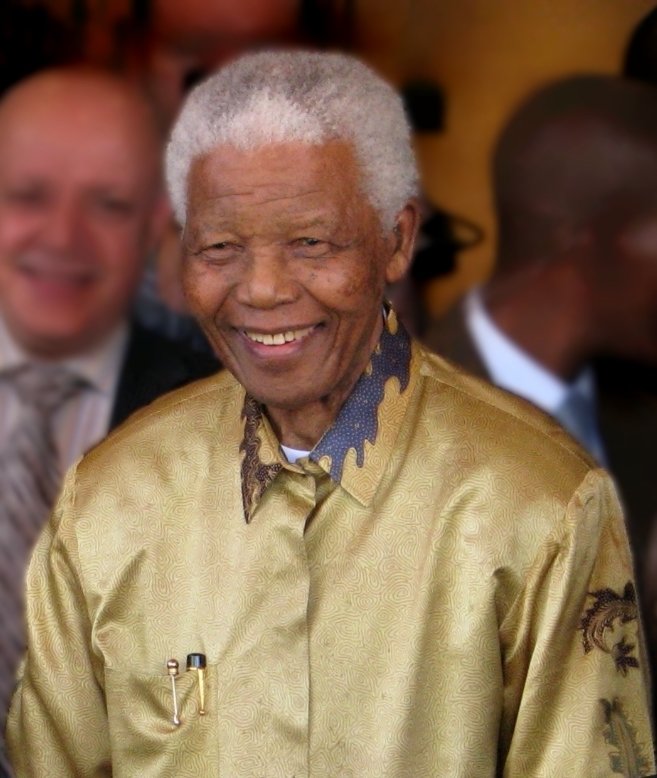
Nelson Mandela (1918 to 2013) was a South African lawyer and anti-apartheid leader who spent 27 years in prison and then became the first president of a democratic South Africa, serving from 1994 to 1999. He shared the 1993 Nobel Peace Prize with the president who released him, F. W. de Klerk. He died in Johannesburg on 5 December 2013.
Early life of Nelson Mandela
Nelson Rolihlahla Mandela was born on 18 July 1918 in Mvezo, in the Transkei region of what is now South Africa. His father, Hendry Mphakanyiswa, belonged to the Tembu people, and the Nobel Foundation describes Mandela as the son of a chief. A relative who held the position of paramount chief supported his education, and Mandela went to the University College of Fort Hare, the only university open to Black, Coloured and Indian students in South Africa at the time.
He later moved to Johannesburg, where he was introduced to Walter Sisulu and studied law at the University of the Witwatersrand. He became one of the first Black lawyers in South Africa. In 1944 he joined the African National Congress, or ANC, and soon became part of a group of young activists that included Sisulu and Oliver Tambo.
Career and major work of Nelson Mandela
After the National Party introduced its apartheid policies in 1948, Mandela took part in resistance to them. Early in the 1950s he was elected leader of the ANC Youth League. The Defiance Campaign, which began on 26 June 1952 and ran for about two years, made him one of the most influential figures in the liberation movement. He was elected Transvaal president of the ANC and its deputy national president in 1952.
Mandela stood trial for treason from 1956 to 1961 and was acquitted. The government banned the ANC in 1960, and Mandela became convinced that armed struggle was unavoidable. In June 1961 the ANC executive agreed that members who wished to join his campaign would not be stopped, which led to the formation of Umkhonto we Sizwe, the movement’s armed wing. It carried out sabotage.
Mandela was arrested in 1962 and sentenced to five years of hard labor. In 1963, when other leaders were arrested at Lilliesleaf Farm in Rivonia, he was brought to stand trial with them on charges of sabotage and plotting to overthrow the government by violence. His statement from the dock drew wide international attention. On 12 June 1964 eight of the accused, including Mandela, were sentenced to life imprisonment.
He was held on Robben Island, off Cape Town, from 1964 to 1982, and then at Pollsmoor Prison on the mainland. During these years his reputation grew steadily, and he refused to compromise his political position in order to win his freedom. President F. W. de Klerk announced the unbanning of the ANC on 2 February 1990, and Mandela walked out of Victor Verster Prison on 11 February 1990 after 27 years.
Ideas and contributions of Nelson Mandela
Mandela’s defining contribution was the negotiated end of apartheid. In May 1990 he led an ANC delegation to talks at Groote Schuur in Cape Town, which produced a shared commitment to end political violence. In September 1991 he signed the National Peace Accord for the ANC, an agreement among several political organizations that set up structures to reduce the violence that had spread across the country. He was elected president of the ANC in 1991, and he took part in the constitutional talks that followed.
The Nobel Committee cited this work in 1993, when it honored Mandela and de Klerk for the peaceful termination of the apartheid regime and for laying the foundations of a new democratic South Africa. The award recognized a leader who had once argued for armed resistance and who later committed himself to negotiation.
The first democratic elections in South Africa began on 27 April 1994, and Mandela cast his vote in Inanda, near Durban. He was then sworn in as president at the Union Buildings in Pretoria, in a ceremony attended by the largest gathering of international leaders in the country’s history and about 100,000 supporters. He led the government until he retired from active politics in June 1999 after a single term.
Legacy of Nelson Mandela
After leaving office Mandela devoted much of his time to charity. He raised funds for the Nelson Mandela Children’s Fund and supported the Nelson Mandela Foundation, which campaigned on health and education. In November 2009 the United Nations General Assembly announced that his birthday, 18 July, would be known as Mandela Day in recognition of his contribution to freedom and human rights.
He died on 5 December 2013. A memorial service on 15 December at the FNB Stadium in Johannesburg was attended by 91 sitting heads of state, along with other dignitaries. Today his life is a central reference in the history of South Africa, and he remains one of the best-known political prisoners in modern history.
Criticism and controversies
Mandela’s decision to approve an armed wing of the ANC remains one of the most debated parts of his story. The apartheid government treated sabotage as treason, and it was for plotting to overthrow the state by violence that he received a life sentence in 1964. Mandela and the ANC presented the turn to force as a last resort after a campaign of nonviolent protest that had been met with bans, arrests and repression.
The Nobel Foundation notes that he was inspired in part by guerrilla wars in Algeria and Cuba, and that sabotage was the movement’s method. The negotiations of 1990 to 1994 also took place during a period of serious political violence in Natal and the Transvaal. Mandela issued an ultimatum to the government in 1991 over that violence, and he said the ANC would leave the talks if its demands were not met.
More in History
Key facts
- Mandela was born on 18 July 1918 in Mvezo and died on 5 December 2013 in Johannesburg.1
- He was sentenced to life imprisonment on 12 June 1964 and held on Robben Island until 1982.23
- He was released from Victor Verster Prison on 11 February 1990 after 27 years.3
- He shared the 1993 Nobel Peace Prize with F. W. de Klerk.1
- He served as president of South Africa from 1994 to 1999.3
- The United Nations named 18 July Mandela Day in 2009.3
Related concepts
In the news
Quick checkWhy did Nelson Mandela win the Nobel Peace Prize?Show answer
He shared the 1993 prize with F. W. de Klerk for their work for the peaceful termination of the apartheid regime and for laying the foundations for a new democratic South Africa.
Sources
- NobelPrize.org, Nelson Mandela Facts, https://www.nobelprize.org/prizes/peace/1993/mandela/facts/
- NobelPrize.org, Nelson Mandela Biographical, https://www.nobelprize.org/prizes/peace/1993/mandela/biographical/
- South African History Online, Nelson Rolihlahla Mandela, https://www.sahistory.org.za/people/nelson-rolihlahla-mandela
Editorially reviewed by Specialty Digest Editorial TeamLast reviewed November 4, 2026Researched and drafted with AI assistanceReport an issue