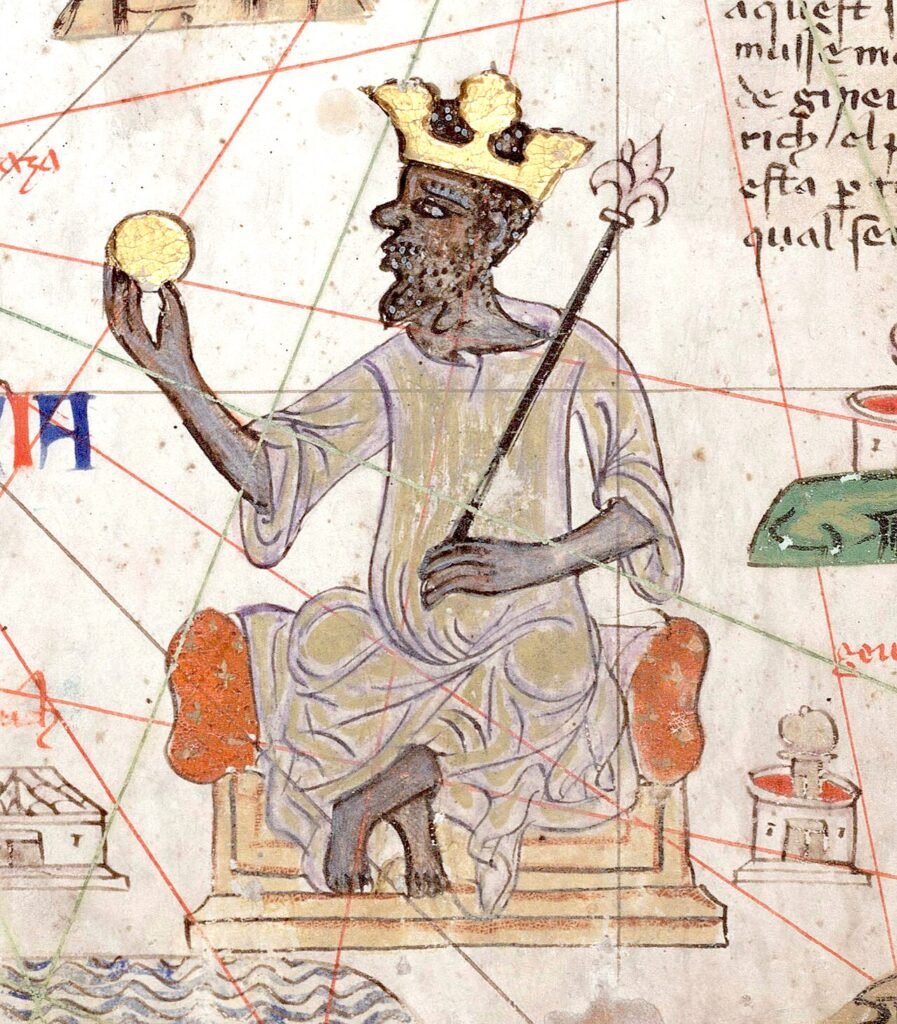
Mansa Musa, also called Musa I of Mali, was the ruler of the Mali Empire in West Africa from 1312 to about 1337. He is best known for his pilgrimage to Mecca in 1324, when his caravan and his gifts of gold made a lasting impression on the Middle East and, later, on Europe.
Early life and rise to power
Little is recorded about Musa’s life before he became king. Mansa was the Mali title for a king, and his own name is sometimes given as Kanku Musa. He was a grand-nephew of Sundiata Keita, the founder of the Mali Empire, which arose in the 13th century and grew rich as a trade hub between the interior and southern coast of West Africa and the lands north of the Sahara.
Caravans carried salt from the north, while gold and ivory came from the south. The capital was Niani, and the most important trading city was Timbuktu, near the Niger River, where several land and water routes met. The rulers of Mali had adopted Islam through contact with Arab merchants, and several of them made the pilgrimage to Mecca before Musa.
According to a story recorded in later sources, Musa came to power after his predecessor, Abu Bakr II, sailed out into the Atlantic with a large fleet of ships and was never seen again. Musa had been named to rule while Abu Bakr was away, and he took the throne in 1312.
Career as ruler of Mali
Musa expanded and held together one of the largest states of its time. One account says his army numbered around 100,000 men, including a cavalry corps. He extended Mali’s control west to the Gambia and the lower Senegal, along the southern Sahara in the north and east to Gao on the Niger. A reference work says his conquests doubled the empire’s territory and made it second in size only to the Mongol Empire, although such comparisons depend on estimates.
To govern such a large area, he divided the empire into provinces led by governors who answered to him. Record keeping improved, and reports were sent to government offices at Niani. The state’s wealth came from taxes on trade, from the copper and gold mines it controlled, and from tribute from conquered peoples. The southern gold-producing region was left semi-independent because production had always been higher when local people had more autonomy.
The pilgrimage to Mecca
In 1324 Musa set out on the hajj, the Muslim pilgrimage to Mecca, with a very large entourage. Figures in the sources vary. One account lists 8,000 courtiers, 12,000 servants and 100 camel loads of gold, while another describes 100 camels each carrying about 300 pounds of gold dust and hundreds of other animals carrying food and cloth. These numbers come from later retellings, so they are best treated as signs of the scale and not as exact counts.
He arrived in Cairo in July 1324. According to the 14th-century Arab historian al-Umari, Musa flooded the city with gifts and gave a load of gold to every court emir and office holder. He and his people spent so much that the price of gold fell in Egypt. Another account says the gold dinar lost about 20 percent of its value against the silver dirham and took some 12 years to recover. Some merchants raised their prices for the visitors, and Musa is said to have left Cairo in debt.
After Cairo, he continued to Mecca and bought land and houses in Arabia so that pilgrims from Mali would have a place to stay. He returned with scholars and an Andalusian architect, Ishak al-Tuedjin, who was lured from Cairo with a large gift of gold. The pilgrimage also created lasting ties between Mali and the Arab states, and Egyptian traders began to look for access to the gold trade of West Africa.
Building and learning under Musa
Back in Mali, Musa had a large audience chamber built at Niani, along with mosques at Gao and Timbuktu. These included the Djinguereber mosque in Timbuktu, completed by 1330 and designed with al-Tuedjin’s help. Because stone was scarce in the region, builders used beaten earth reinforced with wood, a style that survives in the region today. A royal palace and fortification walls were also built at Timbuktu to guard against raids by Tuareg nomads.
Musa supported Islamic learning. He brought books and scholars to Mali and sent native scholars to Fez in Morocco to study and return as teachers. Under his rule Timbuktu became a major center of religious study and trade, with mosques and Quranic schools.
Legacy and debates about his wealth
Musa is often said to have been the richest person in history. Historians caution that this cannot be measured, since no records give a full account of his assets and the surviving descriptions are later or secondhand. What is clear is that the Mali Empire’s gold trade made it rich and that his pilgrimage spread news of that wealth far beyond Africa.
That news reached Europe. A Catalan map from about 1375, the Catalan Atlas, shows a crowned African ruler on a throne holding a large gold nugget, a figure usually identified as Mansa Musa. The image was part of the first detailed European map of West Africa and helped stir interest in the region’s gold.
He was succeeded by his son Mansa Maghan, who ruled from 1337 to 1341, and then by his brother Mansa Sulayman. The change led some to suspect foul play, though evidence is lacking. Mali stayed prosperous for roughly another century, but new trade routes and internal conflict weakened it. By the 1460s the Songhai kingdom had taken most of its territory. Musa remains a symbol of the wealth, learning and reach of medieval West Africa.
Key facts
- Mansa Musa ruled the Mali Empire from 1312 until about 1337.1
- He made the pilgrimage to Mecca in 1324 and reached Cairo in July of that year.1
- Arab writers said his gifts of gold lowered the price of gold in Egypt.2
- He brought back scholars and an architect and built mosques at Gao and Timbuktu.1
- The Catalan Atlas of about 1375 shows a crowned African ruler holding a gold nugget, usually identified as Musa.1
Related concepts
Quick checkWhy was Mansa Musa famous?Show answer
He ruled the wealthy Mali Empire and became famous for his 1324 pilgrimage to Mecca, when his caravan and gifts of gold amazed Cairo and spread news of Mali across the Middle East and Europe.
Sources
- World History Encyclopedia, Mansa Musa I, https://www.worldhistory.org/Mansa_Musa_I/
- Northwestern Magazine, A Golden Age: King Mansa Musa's Reign, https://magazine.northwestern.edu/features/caravans-of-gold-fragments-in-time/a-golden-age-king-mansa-musas-reign
Editorially reviewed by Specialty Digest Editorial TeamLast reviewed November 4, 2026Researched and drafted with AI assistanceReport an issue