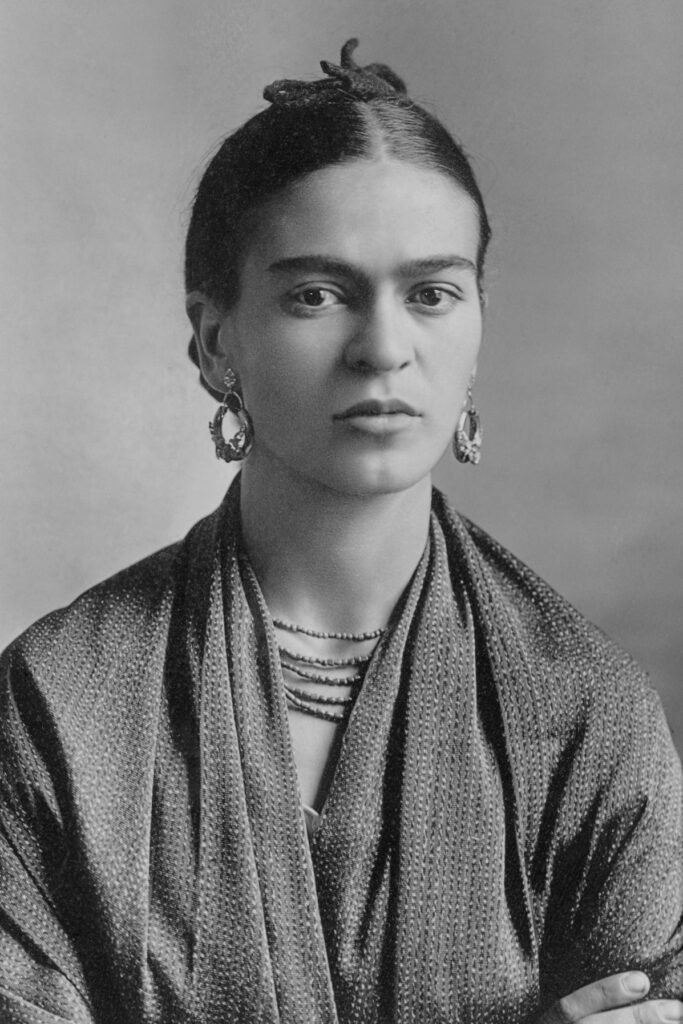
Frida Kahlo (1907 to 1954) was a Mexican painter best known for her self-portraits, which draw on Mexican folk art, her own physical suffering and the history of her country. She was born in Coyoacán, now part of Mexico City, and spent much of her life in the family home known as the Casa Azul. She died there on 13 July 1954 at the age of 47.
Early life of Frida Kahlo
Magdalena Carmen Frida Kahlo Calderón was born on 6 July 1907 in Coyoacán, the third of four daughters of Guillermo Kahlo and Matilde Calderón, according to the Museo Frida Kahlo. Her father was a photographer who had left Germany for Mexico in 1890 and changed his first name from Wilhelm to Guillermo. Her mother, born in Mexico City, came from a family with Indigenous and Spanish ancestry. The family home, later called the Casa Azul, was built by her father on land in Coyoacán.
As a child Kahlo contracted polio, which left her with a damaged leg, but she was a promising student who hoped to study medicine. On 17 September 1925, when she was 18, the bus she was riding in collided with a streetcar. She was gravely injured and spent a month in the Red Cross hospital, and she would live with pain and repeated surgeries for the rest of her life.
During her recovery she began to paint. The accident ended her plans for a medical career and turned her toward art, and her own body became one of her main subjects.
Career and major works
Kahlo married the muralist Diego Rivera on 21 August 1929, in a civil ceremony in Coyoacán. She was 22 and he was more than twenty years older, and her mother is reported to have described the pairing as an elephant and a dove. The couple traveled to San Francisco in 1930 and 1931 and later to Detroit and New York, and SFMOMA notes that her style moved away from broad, mural-like handling toward a folk mode based on nineteenth-century Mexican portraiture.
The couple divorced in 1939 and remarried on 8 December 1940, and their relationship remained difficult. Her health also worsened. In 1934 she was hospitalized three times, and in later years she endured further operations.
Her work began to attract international attention in the late 1930s. The French writer André Breton arranged a solo exhibition for her in New York in 1938, and in March 1939 she took part in the exhibition Mexique in Paris. After that show the French government bought her self-portrait The Frame, which is now in the Centre Pompidou. In 1943 she painted Self-Portrait as a Tehuana, also called Diego on My Mind, in which a radiant headdress frames her face.
In 1953 the photographer Lola Álvarez Bravo organized an exhibition of her work in Mexico City, the only solo show Kahlo had in her country during her lifetime. It opened on 13 April, and because of her poor health she arrived by ambulance and took part lying on a hospital bed. In August of that year gangrene led doctors to amputate her right leg below the knee. Days before she died, she wrote the words Viva la Vida on a canvas of watermelons.
Ideas and contributions
SFMOMA states that her work was driven by a revaluing of the culture and ethos of Indigenous Mexico, often called Mexicanidad. Many of her paintings merge images of the cosmos, the earth and the body with her immediate reality, so that pain and personal history appear within the symbols of Aztec, colonial and revolutionary Mexico. In her later self-portraits she isolated her own image and surrounded herself with animals and plants.
Several works from her years in Detroit, including Henry Ford Hospital of 1932, follow the form of the retablo, a small votive painting traditionally made on a metal sheet to thank a saint for help during a crisis. By borrowing this humble popular form, she gave private suffering the weight of a public devotional image. This approach set her small, intense pictures apart from the large-scale public murals of Rivera and his contemporaries.
Breton called her a Surrealist, but Kahlo rejected the label. In an interview she said that people thought she was a Surrealist, but she never painted dreams, only her own reality. Her work is therefore usually described as an independent, realist and symbolic alternative to both mural painting and Surrealism.
She also took part in the political life of her time. She was a member of Mexico’s Communist Party, and in 1937 the exiled Russian revolutionary Leon Trotsky and his wife stayed at the Casa Azul.
Death of Kahlo
Kahlo died on 13 July 1954, aged 47. The official cause of death was recorded as pulmonary embolism, although no autopsy was performed, and at least one biographer has argued that she may have taken her own life, a claim that remains unproven.
Legacy of Frida Kahlo
The Casa Azul is now the Museo Frida Kahlo, where visitors can see her home, her collections and exhibitions in Coyoacán. Her image and work have become symbols of Mexican identity and of resilience, and SFMOMA notes that she means something different to the women’s movement than to the Chicana movement.
The French purchase of The Frame in 1939 brought her work into a national collection in Europe during her lifetime. In 2025 her painting The Dream (The Bed) sold at auction for 54.7 million US dollars, a record for a work by a woman artist, and her face is among the most recognizable in modern art.
Controversies and criticism
Kahlo’s fame has produced debate about how she should be read. Some critics argue that her biography, especially her illness and her marriage to Rivera, has overshadowed the formal skill and the political ideas in her paintings. Her self-portraits are frequently reduced to autobiography, even though she drew deliberately on Mexican tradition and public history.
More in Visual Arts
Key facts
- Frida Kahlo was born on 6 July 1907 in Coyoacán, Mexico, and died on 13 July 1954 at the age of 47.1
- She was gravely injured in a bus and streetcar collision on 17 September 1925.1
- She married Diego Rivera on 21 August 1929.1
- The French government bought her self-portrait The Frame after the 1939 Mexique exhibition in Paris.1
- Her only solo exhibition in Mexico during her lifetime opened on 13 April 1953.1
Related concepts
Quick checkWas Frida Kahlo a Surrealist?Show answer
Andre Breton called her one, but Kahlo rejected the label, saying she painted her own reality rather than dreams. SFMOMA describes her work as an independent alternative to Surrealism.
Sources
- Museo Frida Kahlo (Casa Azul), Frida Kahlo: Vida y obra, timeline of her life, https://www.museofridakahlo.org.mx/frida/
- San Francisco Museum of Modern Art, Frida Kahlo, artist biography, https://www.sfmoma.org/artist/Frida_Kahlo/
Editorially reviewed by Specialty Digest Editorial TeamLast reviewed November 4, 2026Researched and drafted with AI assistanceReport an issue