The unification of Germany was the process by which a patchwork of independent German states became a single nation-state, the German Empire, in 1871. It was led by the kingdom of Prussia and its minister-president Otto von Bismarck, and it was achieved through three wars in 1864, 1866 and 1870 to 1871. It should not be confused with the reunification of East and West Germany in 1990.
Background to the unification of Germany
For centuries the area of present-day Germany was part of the Holy Roman Empire. The US Office of the Historian notes that by the eighteenth century it was a conglomeration of more than 300 kingdoms, duchies, principalities and free cities. After the wars of Napoleon weakened the old empire, Emperor Francis II laid down the imperial crown on 6 August 1806, and the empire ceased to exist. The Congress of Vienna of 1814 and 1815 created a looser German Confederation of sovereign princes and free cities.
That arrangement did not satisfy growing nationalist demands for a unified state with a liberal constitution. In the revolution of 1848 and 1849 an elected all-German parliament met in Frankfurt and drafted a constitution. The attempt failed when the Prussian king, Frederick William IV, refused the imperial crown it offered him.
Otto von Bismarck, who had opposed the 1848 revolution, became Prussian minister-president in 1862. In a speech of 30 September 1862 he set out a policy of force, later remembered as the “iron and blood” speech. The Bundeszentrale für politische Bildung, the German federal agency for civic education, notes that Bismarck was driven mainly by considerations of power. He wanted a smaller German state led by Prussia, without Austria.
Course of events: the three wars of unification
The first war came in 1864, after a dispute over the future of the duchies of Schleswig and Holstein. Austria and Prussia fought Denmark together and won, and they placed the duchies under joint administration. In 1865 the Convention of Gastein divided the duchies, with Prussia governing Schleswig and Austria governing Holstein.
The arrangement did not last. Bismarck provoked a conflict with Austria, and Prussian troops entered Holstein on 7 June 1866. Two weeks later Prussia left the German Confederation. The Austro-Prussian War was decided on 3 July 1866 at the Battle of Königgrätz, and the Austrian-led confederation came to an end. In 1867 Prussia founded the North German Confederation, which included the states north of the Main River.
The third war began in 1870 after a diplomatic dispute between France and Prussia. The southern states of Baden, Württemberg, Bavaria and Hesse-Darmstadt joined the Prussian side. The Franco-Prussian War was very costly. According to the German federal agency, around 180,000 soldiers died in ten months. After the French defeat at Sedan on 2 September 1870 the outcome was largely decided, although fighting continued until May 1871.
Bismarck used the patriotic mood to negotiate with the southern states in autumn 1870. In the November treaties they agreed to join the North German Confederation, to adopt the name German Reich, and to offer the imperial crown to the Prussian king, Wilhelm I. A revised constitution took effect on 1 January 1871, which the agency describes as the actual founding date of the German nation-state.
The proclamation of the German Empire
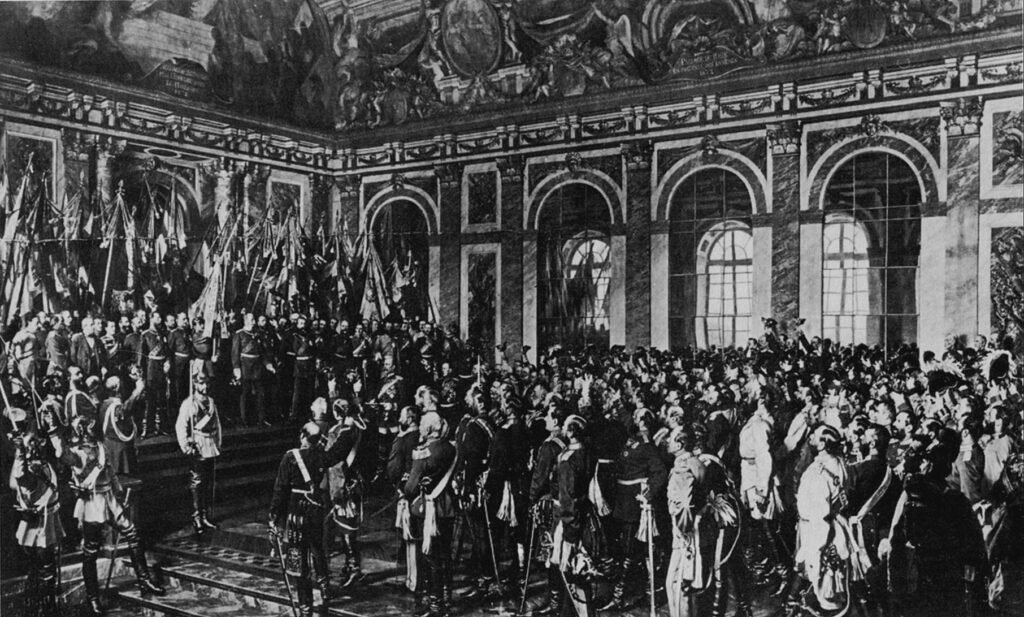
The symbolic founding took place on 18 January 1871 in the Hall of Mirrors at the Palace of Versailles, near Paris, which was still under siege. Wilhelm I was proclaimed German Emperor. No elected representatives attended. The ceremony was held among princes and senior officers, and for that reason, and because the empire was founded as a union of the German princes, the founding has often been described as a revolution from above led by Bismarck.
An elected Reichstag met after elections on 3 March 1871. It approved a new imperial constitution on 14 April, and Wilhelm I signed it on 16 April. This constitution stayed in force until 1918. The state was a constitutional monarchy with a federal upper house, the Bundesrat, which represented 25 member states. The emperor commanded the armed forces and appointed the chancellor, who did not need parliamentary approval. Men aged 25 and over could vote for the Reichstag, which was progressive compared with Prussia’s own class-based voting system at that time.
Aftermath of the unification
The new empire was not fully united inside. The federal agency lists tensions between Prussia and Bavaria, between a secular national state and political Catholicism, and between national liberals and socialists. Austria remained outside the empire, which is why historians describe the result as the smaller German solution.
The US Office of the Historian records that the Prussian king was recognized as German Emperor and that the United States and the new German Empire signed a consular convention in Berlin on 11 December 1871. The Deutsches Historisches Museum adds that one of the new empire’s main domestic issues was how to deal with the labor movement as cities such as Berlin grew rapidly.
Significance and legacy of the unification
The unification created a major industrial and military power in the center of Europe and changed the balance of power on the continent. The German federal agency notes that the first German nation-state brought many modern developments, but that it is also associated with militarism, antisemitism and colonial ambitions. The Deutsches Historisches Museum links the conflicts between the empire and other powers under Wilhelm II to the outbreak of the First World War.
Historians continue to debate whether the unification was inevitable or whether it depended on the political skill and ruthlessness of Bismarck and on the weakness of rivals. Some stress nationalism and economic integration, while others stress Prussian power and the three wars. Both views agree that the German Empire created in 1871 lasted until 1918, when a new constitution replaced the Bismarckian one.
Key facts
- Prussia fought Denmark in 1864, Austria in 1866 and France in 1870 to 1871 in the three wars of unification.1
- The Battle of Königgrätz on 3 July 1866 decided the war with Austria, and Prussia founded the North German Confederation in 1867.1
- The German Empire was proclaimed at Versailles on 18 January 1871, and its constitution took effect on 1 January 1871.1
- The imperial constitution was approved by the Reichstag on 14 April 1871 and signed by Wilhelm I on 16 April 1871.1
- Before unification, the German-speaking lands were a conglomeration of more than 300 states.2
Related concepts
Quick checkWhen was the German Empire proclaimed?Show answer
It was proclaimed on 18 January 1871 in the Hall of Mirrors at Versailles, when Wilhelm I of Prussia became German Emperor. The constitution had already taken effect on 1 January 1871.
Sources
- Bundeszentrale für politische Bildung, Vor 150 Jahren: Proklamation des Deutschen Kaiserreichs (15 January 2021, in German), https://www.bpb.de/kurz-knapp/hintergrund-aktuell/325614/vor-150-jahren-proklamation-des-deutschen-kaiserreichs/
- Office of the Historian, US Department of State, Germany: Guide to Country Recognition and Relations, https://history.state.gov/countries/germany
- Deutsches Historisches Museum, Online Presentation: From the Foundation of the German Empire to the End of the First World War (1866-1918), https://www.dhm.de/en/offer/online-presentation-from-the-foundation-of-the-german-empire-to-the-end-of-the-first-world-war-1866-1918/
Editorially reviewed by Specialty Digest Editorial TeamLast reviewed November 4, 2026Researched and drafted with AI assistanceReport an issue