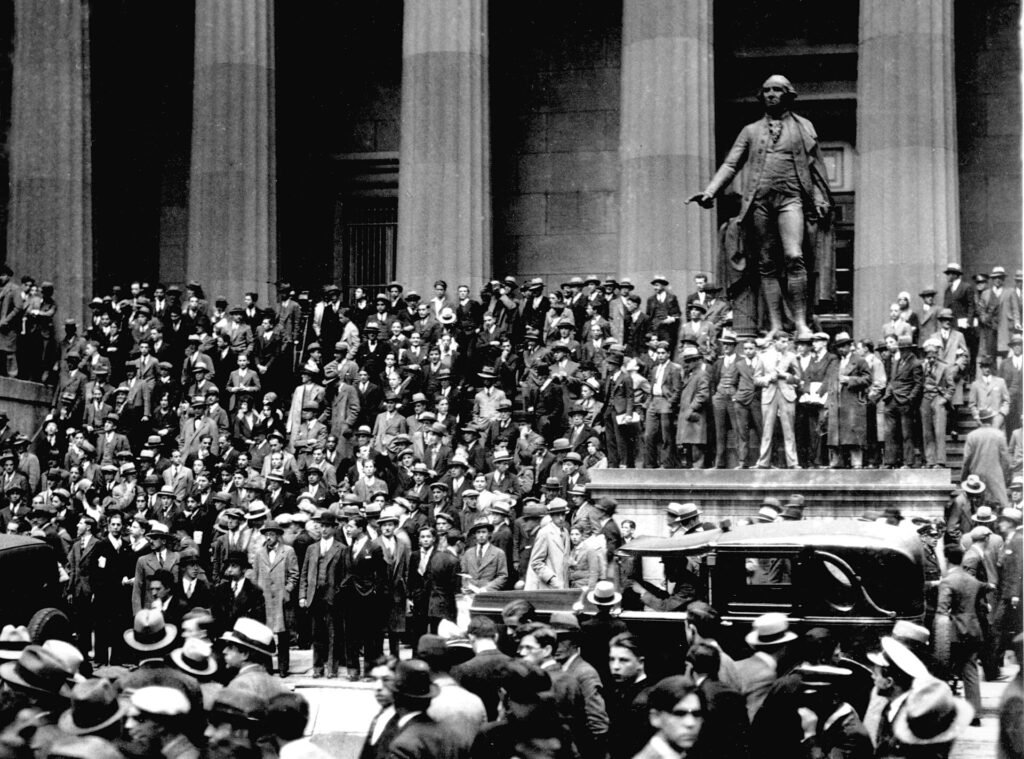
The Wall Street Crash of 1929 was a sudden collapse in United States stock prices in October 1929, centered on the New York Stock Exchange. Prices fell sharply on Black Thursday, 24 October, and the Dow Jones Industrial Average dropped nearly 13 percent on Black Monday, 28 October, and nearly 12 percent on Black Tuesday, 29 October. The crash ended a long boom and is often treated as the symbolic start of the Great Depression, although economists distinguish between the crash and the depression that followed.
Background to the Wall Street Crash of 1929
The 1920s brought rising prosperity in the United States, and share prices rose with it. According to the Federal Reserve History project, the Dow Jones Industrial Average increased six-fold, from 63 in August 1921 to 381 in September 1929. The index peaked on 3 September 1929, closing at 381.17. New technologies such as automobiles and telephones spread, and ordinary men and women began to invest in stocks and bonds.
Much of the buying was financed with borrowed money. Brokerage houses, investment trusts and margin accounts let buyers put down a fraction of the price, typically 10 percent, and borrow the rest, using the shares themselves as collateral. When prices rose, this lending multiplied the gains. When prices fell, it multiplied the losses.
The Federal Reserve was among the skeptics. The governors of many Federal Reserve Banks and a majority of the Federal Reserve Board believed that speculation diverted resources from productive uses such as commerce and industry. The Board and the Federal Reserve Bank of New York disagreed about the remedy. The Board favored direct action, asking reserve banks to refuse credit to member banks that lent to speculators. New York’s governor, George Harrison, wanted a higher discount rate, the interest rate that banks pay to borrow from the Fed. The Board refused several requests before accepting the plan in August 1929, and New York’s discount rate reached 6 percent.
The higher rate had effects beyond the United States. Because the international gold standard linked interest rates among countries, foreign central banks had to raise their own rates, and the Federal Reserve History project says that tighter money tipped economies around the world into recession. The stock boom nevertheless continued until the autumn.
Course of the crash
After the September peak, prices swung sharply, with sudden falls and quick recoveries. The economist Irving Fisher said in mid-October that stock prices had reached what looked like a permanently high plateau. In October, Charles Mitchell, president of National City Bank, and a group of bankers publicly bought large blocks of shares at high prices to restore confidence. The effort failed, and investors began selling in large numbers.
The Franklin D. Roosevelt Presidential Library dates the crash symbolically to Black Thursday, 24 October 1929. The steepest one-day falls came on Black Monday and Black Tuesday. By mid-November the Dow had lost almost half of its value, and the slide continued into the summer of 1932.
Money leaving the stock market flowed into New York City’s commercial banks, which also took over millions of dollars in loans that had financed stock purchases. The sudden surge strained their reserves. To relieve the pressure, the Federal Reserve Bank of New York bought government securities on the open market, sped up lending through its discount window and lowered its discount rate. It assured commercial banks that it would supply the reserves they needed.
These steps were controversial at the time, and the Board and several reserve banks complained that New York had exceeded its authority. Looking back, the Federal Reserve History project concludes that the actions helped contain the crisis in the short run. The stock market collapsed, but the commercial banks at the center of the storm stayed open.
Aftermath of the crash
The crash still did damage to the wider economy. Investors and consumers were frightened, and many people lost savings, feared for their jobs and worried about paying bills. Purchases of expensive goods bought on credit, such as automobiles, fell, and firms such as Ford cut production and laid off workers. Unemployment rose, and the contraction that had begun in the summer of 1929 deepened.
The effects of the crash itself faded within months, and by the fall of 1930 a recovery seemed close. Then problems in the banking system turned what might have been a short, sharp recession into a much longer depression. The Federal Reserve History project points to banking panics beginning in the fall of 1930, which led to a fall of nearly 30 percent in the money supply by the winter of 1933.
Stock prices took a long time to recover. The Dow closed at 41.22 on 8 July 1932, its lowest value of the twentieth century and 89 percent below its peak. It did not return to its 1929 high until 23 November 1954.
Significance and legacy of the crash
The crash led to lasting changes in how financial markets are regulated. Among the agencies created during the New Deal, the Roosevelt Library lists the Federal Deposit Insurance Corporation in 1933 and the Securities and Exchange Commission in 1934. Banking legislation in 1933 and 1935 also reformed the Federal Reserve and the wider financial system.
Economists and central bankers drew two main lessons. First, a central bank should be careful about acting against rising stock prices, because spotting and deflating a bubble is difficult and tight monetary policy can have broad and unintended effects. Second, the damage from a stock market crash can be contained by supplying liquidity to the banking system, as the New York Fed did in the fall of 1929.
The debate has not ended. Scholars such as Milton Friedman and Anna Schwartz shaped a consensus in the 1960s that the crash alone did not cause the Depression, and that later monetary and banking failures mattered more. The Federal Reserve History project notes that the financial crisis of 2008 led some scholars to revisit these conclusions, including the question of whether central banks can and should try to prevent asset bubbles. The economics of the period is still studied for those reasons.
More in Economics
Key facts
- The Dow Jones Industrial Average rose from 63 in August 1921 to a peak close of 381.17 on 3 September 1929.1
- The Dow fell nearly 13 percent on Black Monday, 28 October 1929, and nearly 12 percent on Black Tuesday, 29 October.1
- By mid-November 1929 the Dow had lost almost half of its value.1
- The Dow closed at 41.22 on 8 July 1932, 89 percent below its peak, and regained its 1929 high on 23 November 1954.1
- Buyers often paid about 10 percent of a share price and borrowed the rest on margin.1
- Franklin D. Roosevelt Presidential Library dates the symbolic start of the Great Depression to Black Thursday, 24 October 1929.2
Related concepts
In the news
Quick checkDid the stock market crash of 1929 cause the Great Depression?Show answer
Not alone. The crash hurt confidence and spending, but economists point to later banking panics, a falling money supply and the gold standard as major causes of the long depression.
Sources
- Federal Reserve History, Stock Market Crash of 1929, https://www.federalreservehistory.org/essays/stock-market-crash-of-1929
- Franklin D. Roosevelt Presidential Library and Museum, Great Depression Facts, https://www.fdrlibrary.org/great-depression-facts
- Federal Reserve History, The Great Depression, https://www.federalreservehistory.org/essays/great-depression
Editorially reviewed by Specialty Digest Editorial TeamLast reviewed November 4, 2026Researched and drafted with AI assistanceReport an issue