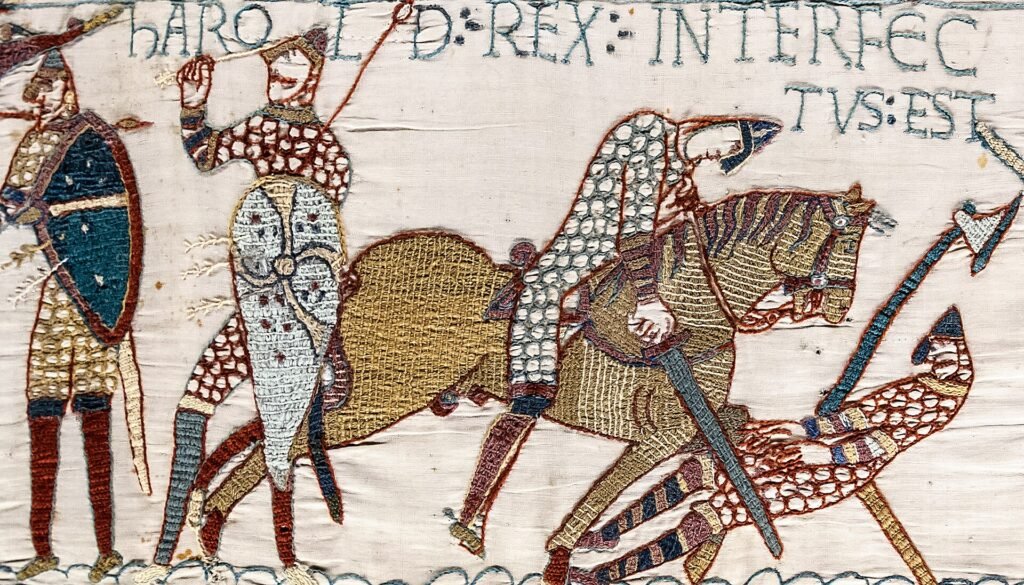
The Battle of Hastings was fought on 14 October 1066, when the Norman army of William, Duke of Normandy, defeated the English army of King Harold II on a ridge about seven miles from Hastings in southern England. Harold was killed in the fighting, and William was crowned king of England on Christmas Day. The battle opened the Norman Conquest and is often described as the most famous battle in English history.
Background of the Battle of Hastings
The year 1066 was turbulent for England. King Edward the Confessor died on 5 January without a direct heir, leaving the country open to rival claims. He had entrusted the kingdom to Earl Harold of Wessex, his brother-in-law and the commander of the royal army, and Harold was consecrated king in Westminster Abbey the following day. Two other men claimed the crown: Harald Hardrada, king of Norway, and William of Normandy.
Harold spent the early months of the year guarding the south coast against an expected invasion. In May, his exiled brother Tostig led a raid on eastern England, and Earl Edwin of Mercia defeated it. In mid-September, Hardrada landed near York with a Norwegian army. Harold marched north quickly and, on 25 September, defeated the Norwegians and Tostig at the Battle of Stamford Bridge.
A few days later, news arrived that William had landed at Pevensey in Sussex on 28 September. William’s invasion fleet was the result of months of planning, since his army and horses had to cross the Channel by ship. Harold’s army rode south in a series of forced marches, stopped briefly in London to collect more troops, and arrived opposite William’s army on the evening of 13 October.
Course of the Battle of Hastings
Modern scholars suggest that each army had between 5,000 and 7,000 men, so the forces were evenly matched in size. They differed in style. The English traveled on horseback but fought on foot, and at the center of the line stood the king’s housecarls, professional retainers with heavy battle-axes. The Normans relied on a cavalry force of perhaps 2,000 to 3,000 knights and also had archers, including some who used powerful crossbows.
At daylight on 14 October, Harold arranged his men along a ridge, now partly occupied by Battle Abbey. William lined up his troops on rising ground to the south, across a valley. The English fought in a close formation called a shield wall, and it withstood repeated and bloody assaults up the hillside by Norman cavalry and archers. The fight lasted the whole day, which was exceptionally long by medieval standards and a sign of how evenly matched the sides were.
Gradually the Normans gained the upper hand. Harold’s brothers Gyrth and Leofwine were among those killed. In the last Norman attack, Harold himself was killed, and without leadership the English line gave way and fled. A research summary from EBSCO adds that many Anglo-Saxon nobles died during the fighting, and that those who survived later lost their lands.
Our knowledge of the battle comes mainly from two sources, the Bayeux Tapestry and the chronicler William of Poitiers. Between them they give more detail than exists for any other medieval battle, but many points remain unclear. Even the exact location is a matter of some debate. English Heritage says the precise extent of the battlefield is not known, and historians have questioned whether Battle Abbey was built exactly where Harold fell.
Aftermath of the Battle of Hastings
William was crowned on Christmas Day 1066 and ruled until his death in 1087. His reign introduced new ways of governing England. In 1086 he ordered the compilation of the Domesday Book, a survey recording land and its holders after the Conquest. He and his followers also built castles and other fortifications across the country, and French and Latin became common among the ruling classes.
Around 1071, William founded Battle Abbey on the site as a memorial to the dead and as penance for the bloodshed of the Conquest. He insisted that the high altar of the abbey church should mark the spot where Harold was killed, even though the narrow, waterless ridge was a poor location for a monastery. The church was consecrated in 1094. The founding monks came from Marmoutier in France.
The abbey remained important for centuries. Its community was reduced from 52 to 34 monks by the Black Death of 1348 and 1349, and the abbey was dissolved in 1538. Much of the battlefield survived because it became part of the abbey’s great park and later a country estate, which explains why English Heritage can describe it as one of the least altered of all medieval battlefields.
Significance and legacy of the Battle of Hastings
The battle changed the government and culture of what is now the United Kingdom. It replaced an Anglo-Saxon royal house with Norman rulers from France, brought a new nobility, and linked English history more closely to the Continent. The language of the elite also shifted, as French and Latin became prevalent among the upper classes.
The Bayeux Tapestry is the most famous memorial of the event. The EBSCO summary describes it as a 231-foot piece of linen needlework made to commemorate the battle, and it remains a key source for the weapons, armor and tactics of both sides.
Historians also caution against simple stories. The armies were closely matched, the outcome turned on a long day of fighting, and it depended in part on Harold having just fought a major battle in the north. The Norman Conquest reshaped England, but how much of that change was the direct result of a single battle is still debated, and the surviving evidence is limited and sometimes one-sided.
Key facts
- The Battle of Hastings was fought on 14 October 1066 on a ridge about seven miles from Hastings.13
- King Edward the Confessor died on 5 January 1066, and Harold defeated Harald Hardrada at Stamford Bridge on 25 September.13
- William landed at Pevensey on 28 September 1066, and each army is estimated at 5,000 to 7,000 men.13
- Harold was killed in the last Norman attack, and William was crowned on Christmas Day 1066.12
- Battle Abbey was founded around 1071 as penance, with its high altar placed where Harold was said to have fallen.1
Related concepts
In the news
Quick checkWhat are the two main sources for the Battle of Hastings?Show answer
The Bayeux Tapestry and the writings of the chronicler William of Poitiers.
Sources
- English Heritage, History of Battle Abbey and Battlefield, https://www.english-heritage.org.uk/visit/places/1066-battle-of-hastings-abbey-and-battlefield/history-and-stories/history/
- English Heritage, 1066 and the Norman Conquest, https://www.english-heritage.org.uk/learn/histories/1066-and-the-norman-conquest/
- EBSCO Research Starters, Battle of Hastings, https://www.ebsco.com/research-starters/history/battle-hastings
Editorially reviewed by Specialty Digest Editorial TeamLast reviewed November 4, 2026Researched and drafted with AI assistanceReport an issue